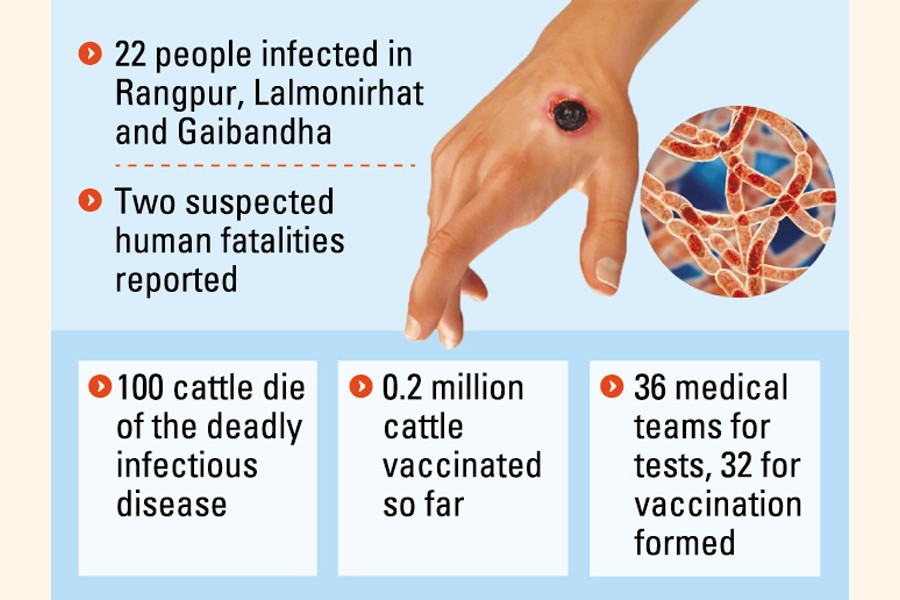
The government has launched a comprehensive programme to combat anthrax as the deadly infectious disease has spread in the northern region, affecting both cattle and humans, with 22 people diagnosed with the disease and two suspected deaths reported so far.
It is learnt, a number of people were found infected with anthrax last month in Rangpur.
Now new cases have also been detected in Gaibandha, which led the health and livestock authorities to start a large awareness campaign.
Officials from the Department of Livestock Services (DLS) said they have reinforced cattle vaccination in all upazilas of Rangpur and some nearby areas of Gaibandha and Kurigram districts.
They advised people not to panic, as anthrax can be fully cured if treated on time, and the death rate in humans is very low.
Cases of infection in humans have so far been found in three upazilas of Rangpur-Pirgachha, Kaunia, and Mithapukur-and in Sundarganj upazila of Gaibandha, along with some parts of Lalmonirhat, according to the DLS.
Last month, eight of 12 people tested in Pirgachha upazila were confirmed to have anthrax, according to the Institute of Epidemiology, Disease Control and Research (IEDCR).
The tests were done after two people had died with symptoms similar to those of anthrax.
However, IEDCR could not confirm if they actually died of the disease because no samples were taken before their deaths.
The Livestock Department also found anthrax in frozen beef from the same area. According to IEDCR, anthrax is a serious bacterial disease that affects both animals and humans.
People can get infected through cuts on the skin, by eating raw or half-cooked meat, or by inhaling anthrax spores. The incubation period can range from 1 to 20 days.
Due to the spread of anthrax (locally known as torka) in several districts, the Ministry of Fisheries and Livestock has taken urgent and coordinated measures to stop the disease from spreading further.
Local livestock offices, with the help of local administration, are continuing vaccination, animal health checks, courtyard meetings, street campaigns, leaflet distribution, and public announcements using loudspeakers.
To increase awareness, advertisements have been published in national newspapers, and special field activities have been launched. These include monitoring affected areas, preventing slaughtering of sick animals, and ensuring all cattle receive vaccination.
Under the "One Health" initiative, the Department of Livestock is also working closely with the local Health Department to spread awareness.
Officials are advising people through meetings and training sessions not to slaughter sick animals, not to throw dead cattle in open areas or water, but to bury them deeply in the ground, and to contact the nearest veterinary office if any animal falls sick.
Rangpur and Gaibandha have been marked as the most affected districts, and special vaccination programmes are underway there.
The Livestock Research Institute (LRI) will soon send around 3.0 million doses of anthrax vaccine to Rangpur Division, with 2.0 million doses specifically for Rangpur and Gaibandha.
So far, 0.167 million cattle have been vaccinated in nine upazilas of Rangpur: Pirgachha (53,400), Kaunia (34,000), Rangpur Sadar (26,500), Mithapukur (34,500), Gangachhara (4,800), Taraganj (4,300), Badarganj (5,000), and Pirganj (5,000). Courtyard meetings, street rallies, and awareness sessions have also been held.
For health checkup in 36 slaughterhouses, 36 medical teams have been formed, along with 32 vaccination teams-17 in Mithapukur, 8 in Pirgacha, and 7 in Kaunia.
In Gaibandha's Sundarganj upazila, 26,400 cattle have been vaccinated. Emergency measures, such as burial of dead cattle, miking, meetings, and leaflet distribution, have been completed while five veterinary medical teams have been formed.
Anthrax is usually fatal for affected animals. While it rarely kills humans, if not treated on time, the infection can turn deadly.
Since 2010, anthrax cases have been reported almost every year from different parts of Bangladesh, especially in the northern districts.
The current outbreak became serious after two suspected anthrax deaths and the death of more than 100 cattle over the past three months.
tonmoy.wardad@gmail.com
© 2026 - All Rights with The Financial Express

