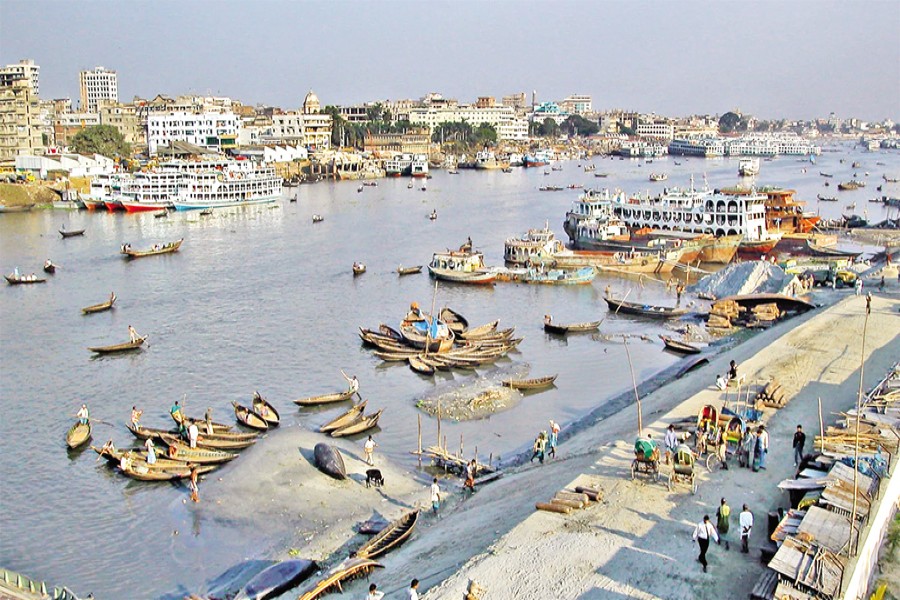
The interim government has taken up an initiative to clean rivers and canals surrounding Dhaka city as the World Bank (WB) is expected to provide US$370 million worth of fund shortly, officials said.
Under the move, eight relevant government agencies would get involved in cleaning the rivers around the capital, they said.
The WB may confirm its $370 million worth of loan within February this year, Economic Relations Division (ERD), according to officials.
"We have completed negotiations with the World Bank early this month (January). The proposed loan is expected to be approved by the WB Board within February. Then, we will sign a loan deal with the global lender shortly," said a senior Economic Relations Division (ERD) official.
Dhaka is surrounded by five rivers and some canals namely Dhleshwari, Buriganga, Turag, Balu and Shitalakhya.
These peripheral waterways, which are crucial for transport and drainage, are heavily polluted due to industrial wastes and urbanization.
Industrial effluents and biomedical wastes of those rivers and canals are polluting domestic wastewaters day by day, according to experts.
The environmental, health, and economic costs associated with the river pollution are estimated to be around $2.83 billion annually, the World Bank Country Environmental Analysis report 2018 revealed.
A Bangladesh Water Development Board (BWDB) official said the government wants to improve water quality, increase navigability, restore natural flow, and improve domestic wastewater management to transform Dhaka into a more livable and sustainable city.
The project aims to help revive the "biologically dead" water bodies through addressing high environmental risks, involving dredging, and cleaning and removing illegal encroachments, he added.
According to the project proposal, the Local Government Engineering Department (LGED), Dhaka WASA, Dhaka North City Corporation, Dhaka South City Corporation and Narayanganj City Corporation would build necessary infrastructure to check disposal of industrial and urban wastes into the rivers.
Of the proposed US$370 million WB loan, a sum of $290 million would be spent by the five aforesaid public entities.
The Bangladesh Water Development Board (BWDB) would conduct 17-km dredging in Turag as part of the river restoration works, set up a waste management plant and initiate some other necessary works on the four rivers around the capital Dhaka, officials said.
Under the WB-supported initiative, the DNCC would clean the Gulshan Lake and the DWASA would take necessary steps to resume operation of the idle Dasherkandi water treatment plant.
Currently, the Dasherkandi waste treatment plant is not fully operative although the DWASA has already set up the plant a few years back with the credit support from China, they said.
The Water Resources Planning Organisation (WARPO) would also conduct some research and make a policy for the sake of river restoration and environment-friendly waterways.
Besides, the Department of Environment (DoE) would also make some study and policy papers for the WB-funded river restoration project.
According to the DWASA official, the project is focused on river boundary demarcation, dredging, ecological restoration, and waste management.
Aligned with the Bangladesh Delta Plan 2100, the initiative is expected to address long-term sustainability.
Located in central Bangladesh, the capital city of Dhaka attracts the majority of the area's rural migrants and has grown to a population of nearly 18 million. It is expected to become the third most populous city in the world by 2050.
Dhaka's landscape is dominated by five rivers and 200 canals and all of them play a critical role in supporting the city. The rivers are the integral part of the lives of its inhabitants, as they provide transport, drainage, recreation, and fisheries.
These rivers are also considered the lifeline of the environment and ecosystem of the greater Dhaka area.
© 2026 - All Rights with The Financial Express

