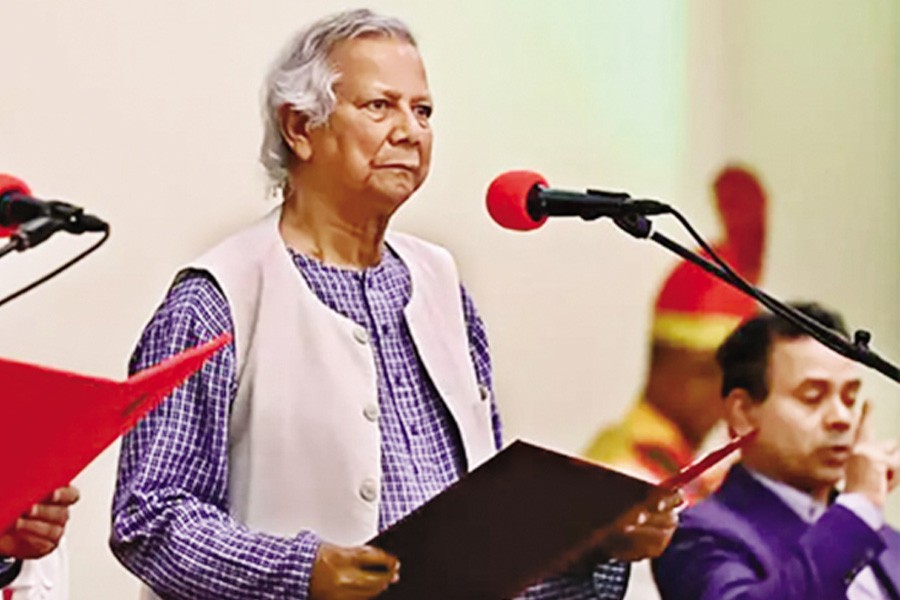
 Prof Muhammad Yunus taking oath as the Chief Adviser on Aug 8, 2024.
 The interim government, led by Professor Muhammad Yunus, marks one year in office, following its swearing-in on August 8, 2024, reports BSS.
The administration assumed office in the wake of an uprising that led to the ouster of Sheikh Hasina's regime on August 5, 2024.
Despite the challenges of a turbulent transition, the Yunus-led government has been widely credited with a series of notable reforms and governance successes over the past year in the areas of electoral system, governance, press freedom, economy, judiciary, law and order, and trial of killers in the uprising.
On August 5, Prof Yunus announced that the next parliamentary elections would be held in February 2026. On the next day, the Chief Adviser's Office (CAO) sent a letter to the Election Commission (EC), asking it to complete all preparations to hold the national elections in February 2026 before the holy month of Ramadan starts.
The government has formed a number of reform commissions, including the Electoral Reform Commission, Police Reform Commission, Judiciary Reform Commission, Anti-Corruption Reform Commission, Public Administration Reform Commission, Health Reform Commission, Mass Media Reform Commission, Labour Rights Reform Commission, and Women Affairs Reform Commission. The commissions submitted their reports, and the government also took many steps as per their recommendations.
Key Achievements of the Interim Government in 12 months:
Restoration of Peace and Stability:
Peace and order returned after the July Uprising, preventing chaos and cycles of revenge. Prof Yunus's moral leadership provided a stabilising force, guiding the nation toward reconciliation and democratic renewal instead of violence.
Economic Revival:
The government turned around a devastated economy, food inflation reduced from 14 per cent to nearly half, overall inflation fell to 8.48 per cent (lowest in 35 months), record remittances of US$ 30.33 billion, exports up 9.0 per cent, and Taka strengthened against the dollar for the first time in years. Banks have been stabilised.
Trade and Investment Gains:
After concluding successful trade tariff negotiations with the United States, Bangladesh secured sizable foreign direct investment (including Handa Group's US$ 250 million in textiles, creating 25,000 jobs), and doubled FDI flows compared to the last government's period.
Democratic Reforms and July Charter:
The government formed reform commissions, built national consensus across 30 plus parties and finalised the historic July Charter, ensuring institutional accountability and protections against any future return of fascism. The July Charter is expected to usher in a new democratic era with enhanced check and balances in the country's power structures.
Justice for July Massacres:
Transparent trials of crimes against humanity committed in July-August last year are underway, holding perpetrators accountable and reinforcing the rule of law. Four major trials have commenced. Trial of ousted prime minister Sheikh Hasina has begun.
Election Roadmap and Reforms:
The government has set the deadline of February 2026 for holding free, fair, and festive national elections, with inclusion of expatriates, first-time voters, and women. It is launching digital consultation platforms for citizen feedback, aiming to make the election a national celebration of democracy. Some 800,000 police, irregular Ansar and military troops would be mobilised to ensure a peaceful general election.
Institutional and Legal Reforms:
Independent judiciary was strengthened via reform-driven appointments.
Police reforms: It formed human rights cells, bodycams, transparent interrogation rooms and UN-standard protest protocols.
Legal reforms: massive changes in the CPC and CrPC, new ordinance mandating a maximum 12-hour family notification on arrest, lawyer access, medical safeguards, and online GD filing.
Press Freedom and Internet Rights:
The interim government repealed the repressive Cyber Security Act, dropped all cases against journalists, guaranteed freedom for criticism, and enshrined internet access as a fundamental right.
Foreign Policy Shift:
The government reoriented Bangladesh's foreign policy from reliance on a single country towards a balanced, multi-polar approach. It expanded cooperation with the US, China, European Union and others on trade, investment, medical aid and crisis response, making Bangladesh a proactive, respected regional actor. Concerted efforts have been made for the revival of SAARC and obtaining membership of ASEAN.
Expatriate and Labour Rights:
Bangladesh secured resumption of the UAE visas and Malaysia's introduction of multiple-entry visas, while regularised undocumented workers in the Gulf states. The government has taken plans to send 100,000 youths to Japan and more workers to Italy, South Korea and Serbia, broadening opportunities for expatriates.
Support for Martyrs and Injured Revolutionaries:
The interim government listed all the martyrs and injured of the July Uprising, and provided nearly Tk one billion in savings certificates and allowances to 775 martyrs' families, plus Tk 1.53 billion in aid to 13,800 injured revolutionaries. It also sent severely wounded abroad for advanced treatment and rehabilitation.
Maritime and Infrastructure Development:
The government declared the Bay of Bengal a core national resource for a "water-based economy". It has moved to scale up efficiency of the Chattogram Port, expanded coastal development plans, and initiated deep-sea fisheries and industrial projects with global partners.
July Memorial Museum:
The government has taken an initiative to turn the Ganabhaban into the 'July Mass Uprising Memorial Museum' - aiming to preserve the memories of the July Uprising. Photos of the July uprising, various memorials, clothes of martyrs, letters, important documents, newspaper cuttings of that time, audio-videos and other materials would be kept in the museum.
July Shaheed Smrity Foundation:
The government has established the July Shaheed Smrity Foundation to provide support to the families of martyrs and those injured during the July Uprising. The foundation is focusing on raising funds to provide immediate healthcare support to injured people, offer short-term financial support to victim families, preserve the memory of those who sacrificed their lives and implement projects that would ensure long-term impact.
© 2026 - All Rights with The Financial Express

