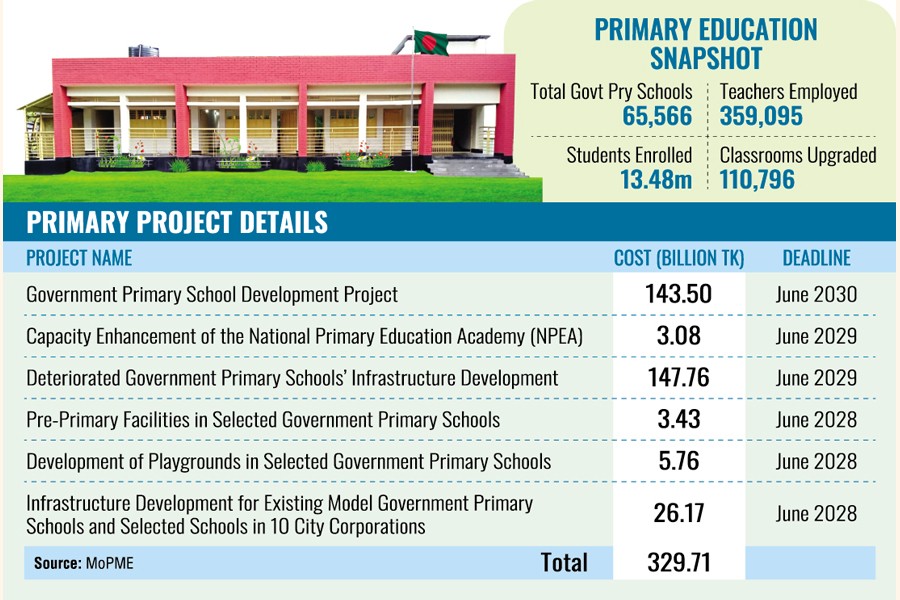
The Ministry of Primary and Mass Education (MoPME) has sought nearly Tk 330 billion in government funding, entirely from domestic sources, to implement six major development projects aimed at improving infrastructure and learning environments in primary schools across Bangladesh over the next three to five years.
"These initiatives are being designed to continue the momentum once the fourth phase of the Primary Education Development Programme (PEDP-4) -- a comprehensive sector-wide plan launched in 2018 at a cost of Tk 328 billion, of which 42.61 per cent came from foreign funding -- concludes in June next year," said a senior MoPME official.
However, education experts and practitioners have raised concerns over the new set of projects, arguing that they focus too narrowly on infrastructure while overlooking critical areas such as teacher recruitment and capacity development.
They also questioned the decision to rely solely on domestic financing, warning that it may strain the government's fiscal space. Experts suggested that mobilising concessional loans or grants from development partners could ease pressure on the national exchequer while ensuring better financial sustainability and technical support for the initiatives.
The ministry last week submitted a Development Project Proposal (DPP) for the "Government Primary School Development Project", with an estimated cost of Tk 143.50 billion. The project aims to construct 24,742 classrooms and improve other infrastructure in 3,476 selected government primary schools across all districts by June 2030.
The Socio-Economic Infrastructure Division of the Planning Commission recently held a Project Evaluation Committee (PEC) meeting to review a proposed initiative to upgrade 534 government primary schools at a cost of Tk 26.17 billion, averaging more than Tk 49 million per school.
The project, titled "Infrastructure Development for Existing Model Government Primary Schools and Selected Schools in 10 City Corporations," aims to be completed by 2028. It will cover 488 model schools across 64 districts and 46 schools in 10 city corporations, focusing on classrooms, libraries, multipurpose rooms, teachers' facilities, and modern teaching aids to enhance learning and teaching environments.
The plan includes constructing 6,292 classrooms, renovating 1,308 rooms, carrying out piling in 160 schools, and developing land at 218 schools.
Among other planned initiatives, the "Deteriorated Government Primary Schools' Infrastructure Development" project is set to be implemented at a cost of Tk 147.76 billion by June 2029.
The "Pre-Primary Facilities in Selected Government Primary Schools" project, with an estimated cost of Tk 3.43 billion, is scheduled for completion by June 2028, while the "Development of Playgrounds in Selected Government Primary Schools" project has been allocated Tk 5.76 billion for the same period.
Additionally, the ministry has proposed the "Capacity Enhancement of the National Primary Education Academy (NPEA)" project, costing Tk 3.08 billion, which is also expected to be completed by June 2029.
A survey conducted under the PEDP-3 project revealed that 17,414 government primary schools, or 26.56 per cent of the total in Bangladesh, are in dilapidated condition.
Many of these schools suffer from cracked walls, damaged plaster with exposed rods, leaky roofs, holes in floors, rusted doors and windows, and classrooms that flood during rainfall. In some, lights and fans are broken, creating both physical and mental discomfort for students.
The latest annual report from MoPME shows that Bangladesh currently has 65,566 government primary schools, with 13.48 million students enrolled and 359,095 teachers employed.
Under five ongoing or completed projects, some schools have received infrastructure upgrades covering 110,796 classrooms, ministry officials said, adding that the actual demand on the ground remains much higher, with many government primary schools still in poor condition.
"Only improving infrastructure is not sufficient for quality education; the quality and quantity of teachers are equally necessary," said Dr Mustafa K Mujery, former director general of the Bangladesh Institute of Development Studies (BIDS).
He noted that the government is facing fiscal constraints due to fragile revenue mobilisation.
jahid.rn@gmail.com
© 2026 - All Rights with The Financial Express

