The village courts across 61 districts are offering swift and affordable justice, enabling the poor and marginalized communities to resolve disputes at a minimal cost and without delay, reports BSS.
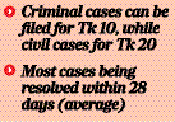
Criminal cases can be filed with the courts for just Taka 10, while civil matters require a fee of Taka 20. Although the legal framework allows up to 90 days for case disposal, recent data showed that most cases are being resolved within an average of 28 days.
These courts also emphasise reconciliation between the parties concerned, fostering harmony within the community. However, many citizens still approach police stations or formal courts for minor disputes due to limited awareness of the village court services.
Legal experts have opined that the village courts are particularly benefiting the vulnerable groups, such as women, persons with disabilities, and ethnic minorities, by providing easier access to justice.
They have noted that broader use of the village courts could significantly ease the burden on higher courts, reduce case backlogs, and accelerate the delivery of justice nationwide.
The "Activating Village Courts in Bangladesh - Phase III" project, under the Local Government Division, is one of the major initiatives of the Government of Bangladesh with support from the UNDP and the European Union. Its objective is to strengthen the village court system across the country as an effective local dispute resolution mechanism.
Moshiur Rahman Chowdhury, legal analyst of the project, said the village courts are now functional in 61 districts. "We are taking various steps to make the system more active. Since people are not well informed about the village courts, many cases that could be filed here are instead taken to police stations and conventional courts. Although the law allows 90 days, disposal is completed in only 28 days on an average."
"The purpose of the courts is to settle disputes by reconciling both the sides. People can get justice within their own union without having to spend extra time and money for going to police stations or higher courts," he added.
Established under the Village Court Act 2006, these courts operate at union parishad (UP) level to resolve certain criminal and civil disputes locally and speedily. They can dispose of cases involving claims of up to Taka 300,000. No lawyer is required in these courts.
Applicants must collect a form from the UP, fill it properly, and submit to the chairman along with the required fee.
Applications must be submitted within 30 days of a criminal dispute and within 60 days of a civil dispute. However, a case can be filed within one year from the date of seizure of immovable property.
Apart from the application fee, there are no additional expenses. Both the applicant and the defendant have equal rights to nominate representatives. The parties can present their own arguments without engaging lawyers.
Disputes are usually resolved through mutual understanding, which reduces the likelihood of further conflict. The system also seeks to restore relations between the two sides.
The village courts can handle criminal cases such as theft, fraud, assault, unlawful restraint, intimidation, indecent behaviour towards women, and certain property offences. Civil cases can include recovery of dues, possession of immovable property, damages for wrongful acts, recovery of livestock-related damages, agricultural wage disputes, and maintenance claims by wives.
However, the courts cannot try serious offences such as rape, murder, abduction, dacoity, polygamy, divorce, guardianship, dowry, violence against women and children, disputes involving bloodshed, ownership of immovable property, or claims exceeding Tk 0.3 million.
Each village court consists of the UP chairman and four members, two nominated by the plaintiff and two by the defendant. If the chairman is absent, the panel chairman or another member presides. In cases involving women, female representation is mandatory.
Filing of false cases in the village courts may result in a fine of up to Taka 5,000. Any witness who deliberately ignores summons, issued by the courts, can be fined up to Taka 1,000. Similarly, an individual found guilty of contempt of court may also be fined up to Taka 1,000.
Contempt of court includes acts such as using abusive language against the court, creating obstruction in its proceedings, failing to hand over documents despite court orders, or refusing to answer questions.
© 2026 - All Rights with The Financial Express

