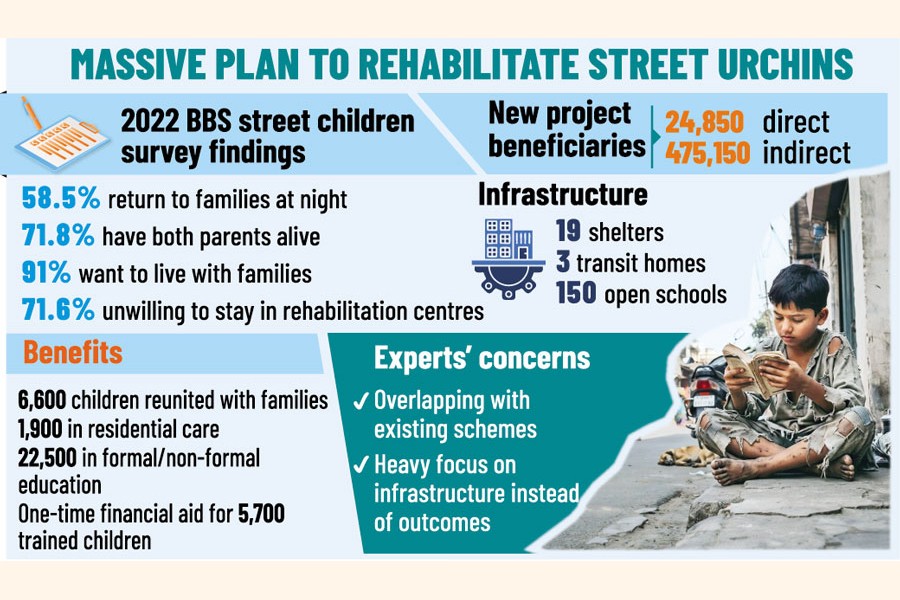
The government is planning to invest nearly Tk 4.2 billion in a five-year nationwide rehabilitation programme for street children, establishing 19 shelter homes, three transit homes, and 150 open schools, officials at the Planning Commission say.
The proposed scheme targets 24,850 direct beneficiaries and 475,150 indirect ones through family reintegration, education, vocational training, and cash support across 12 city corporations, eight municipalities, and 34 upazilas in 31 districts.
The Ministry of Women and Children Affairs on Sunday sent the Development Project Proposal (DPP) titled "Rehabilitation of Street Children and Children at Risk with Accommodation Facilities". Bangladesh Shishu Academy will implement the project.
Experts and economists have raised questions over whether the ambitious programme can deliver value for money and avoid overlapping with the existing social protection schemes.
The proposal seeks to tackle one of Bangladesh's most persistent social challenges by providing accommodation, education, health services, psychosocial support, vocational training, and family reintegration for street-connected children.
It also aims to reduce the number of children living on the streets by addressing poverty, family violence, natural disasters, and social exclusion - the major factors identified in the Bangladesh Bureau of Statistics (BBS) 2022 Survey on Street Children.
Under the programme, 6,600 children separated from their families will be reunited with their households or communities, while 1,900 will receive residential care in shelter homes.
The project also plans to bring 22,500 children under formal and non-formal education, provide technical and vocational training to interested children living in shelters, offer one-time financial assistance to 5,700 trained children, and extend conditional cash transfers to 5,500 vulnerable children or their families to discourage school dropouts.
A biometric database and birth registration system will also be developed to improve identification and service delivery.
Foster families will be encouraged through govt incentives, while community organisations and private donors will be engaged in rehabilitation efforts.
Although the programme includes infrastructure, staffing, education, awareness campaigns, and nationwide outreach, Dr Mustafa K Mujery, former director general at the Bangladesh Institute of Development Studies (BIDS), argues that policymakers should clearly demonstrate how the spending translates into measurable improvements in children's welfare rather than focusing primarily on physical outputs.
This appears to be another project that focuses heavily on spending and infrastructure rather than outcomes. Building shelters and distributing cash are relatively easy, but ensuring that children permanently leave street life is much more difficult, he tells the FE.
The proposal needs a much stronger framework for measuring long-term impacts, he says.
The proposal allocates substantial resources for vocational training, education stipends, foster family incentives, awareness campaigns, health services, and project management.
It also envisages extensive outreach activities ranging from cultural programmes and sports competitions to billboards, newsletters, and public awareness campaigns across 125 unions.
Bangladesh already operates several child-focused social protection programmes through the Ministry of Women and Children Affairs, the Department of Social Services, and local government institutions, including cash transfers, child protection services, and shelter facilities, reveals the DPP.
The proposed project introduces many of the same interventions -- conditional cash transfers, vocational training, foster care, counselling and shelter services -- but the DPP offers limited explanation of how duplication will be avoided or how beneficiaries will be screened across multiple programmes.
According to the 2022 BBS survey, 58.5 per cent of street children work on the streets during the day but return to their families at night, while 71.8 per cent have both parents alive and more than 91 per cent express a desire to live with their families.
jahid.rn@gmail.com
© 2026 - All Rights with The Financial Express

