 In the history of Dhaka University Central Students' Union (DUCSU), women's leadership has been rare--only two ever elected vice president (VP) - Begum Jahanara Akhter in 1960-61 and Mahfuza Khanam in 1966-67. Since then, female representation at the union's top tier has been absent.
But in the post-uprising atmosphere, this year's DUCSU election has taken a different turn. For the first time in decades, a significant number of female candidates are contesting top positions, including VP, general secretary (GS) and assistant general secretary (AGS), alongside several other posts.
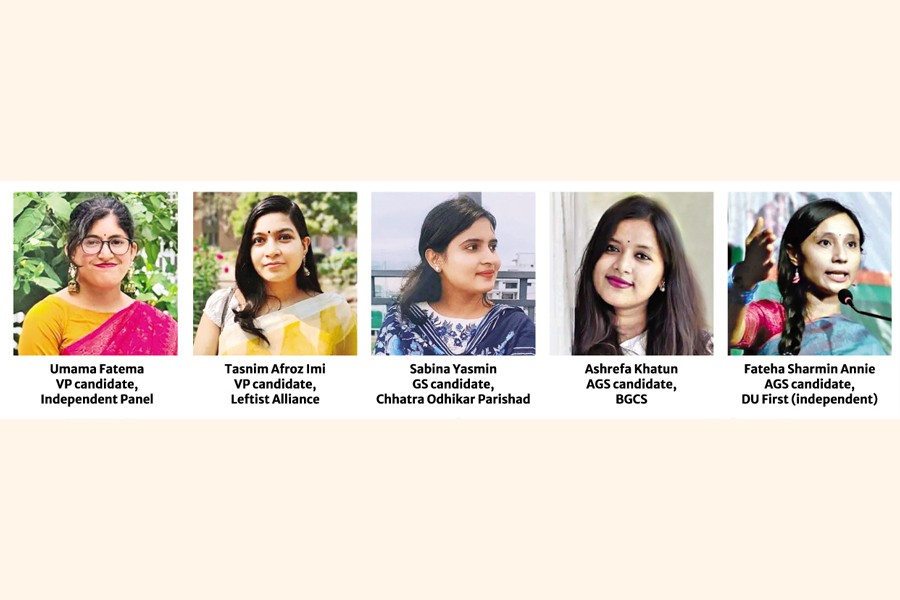
One of the most prominent contenders is Umama Fatema, an independent VP candidate, widely known for her role in the 'July Uprising' of last year that changed Bangladesh's political landscape.
Fatema previously served as coordinator of the Quota Reform Movement, and later distanced herself from student politics after resigning as member-secretary of the Bangladesh Students' Federation Dhaka University unit.
She was the first to announce an independent panel, which also includes Mohiuddin Mujahid Mahi, president of Dhaka University Journalists' Association, as its GS candidate.
Another VP aspirant is Tasnim Afroz Emi, running from the leftwing coalition Protirodh Porshod. A sociology student, Imi had earlier been elected VP of the Shamsunnahar Hall Students' Union, and was active on the Jatiya Nagorik Committee before resigning.
For the GS post, only one woman is in the field - Sabina Yasmin, contesting from the Bangladesh Student Rights Council panel.
Meanwhile, the AGS race has attracted two women candidates. Fateha Sharmin Annie, an independent candidate, is known for her activism on women's rights and social issues.
Annie, currently pursuing an MPhil in Islamic Studies, has served in various leadership roles, including as the first elected president of the Lakshmipur District Students Welfare Association and central organiser of the Bahnishikha, a women-and child-rights platform.
The other AGS hopeful, Ashrefa Khatun of Bangladesh Ganatantrik Chhatra Sangsad (BGCS), has been involved in multiple movements since 2018--from the Safe Roads protests to the July Uprising. She is now BGCS's central spokesperson, and has faced repeated physical attacks during her activism.
Beyond these key positions, women have found space across nearly every panel. According to student groups, JCD has nominated two female candidates, Islami Chhatra Shibir four, Left Coalition eleven, Islami Chhatra Andolan (ICA) four, and BGCS six, while independents have also put forward several women contenders.
One of the most symbolic candidacies is that of Sanjida Islam Tonni, who was critically injured in the uprising. She is independently contesting the Research and Publications Secretary. Out of respect for her role, both JCD and BGCS have refrained from nominating anyone for that position.
Many observers see this surge of female contenders as a long-awaited shift in Dhaka University's political culture.
Commenting on the trend, AGS hopeful Fateha Sharmin Annie said, "DUCSU is a fair platform for practicing student leadership, and in the 2025 election we are witnessing vibrant participation from all sides. A significant number of female candidates are stepping forward this time, contesting important positions like VP, GS, and AGS."
She adds: "If women take part in DUCSU leadership, it will strengthen their role in national leadership and youth politics. From student life itself, women can contribute to political practices and play an influential role in shaping our power structures in the future."
armanhossen7971@gmail.com
© 2026 - All Rights with The Financial Express

