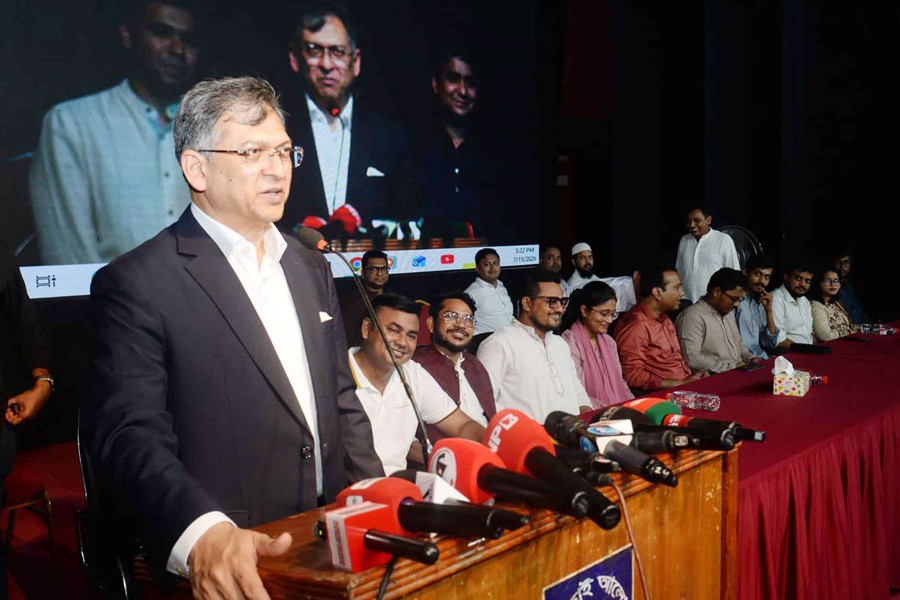
 Home Minister Salahuddin Ahmed addressing a discussion titled 'The Day that Changed the Course of the Mass Uprising' , organised by Jatiyatabadi Chhatra Dal at the TSC Auditorium of Dhaka University on Wednesday. — PID
 Home Minister Salahuddin Ahmed has said there would be no opportunity for former prime minister Sheikh Hasina to surrender voluntarily, asserting that she would be arrested immediately upon her return to Bangladesh and that any court verdict against her would be enforced in accordance with the law, report agencies.
He made the remarks while addressing a discussion titled 'The Day that Changed the Course of the Mass Uprising' as chief guest at the TSC Auditorium of Dhaka University on Wednesday. The event was organised by Jatiyatabadi Chhatra Dal as part of its month-long programme marking the second anniversary of the July-August mass uprising.
"We have consistently sought her return through legal channels. During the interim government's tenure, a request was sent (to the Indian government) under the extradition treaty, followed by subsequent reminders. We want her repatriated so that the court's verdict can be carried out," he said.
The minister noted that he had already clarified the government's position in Parliament a day earlier.
Salahuddin Ahmed also said efforts were underway to repatriate former ministers, lawmakers and government officials associated with the previous Awami League administration who are currently residing abroad.
"We have secured Interpol arrest warrants against individuals who have taken refuge in various countries. Benazir Ahmed has already been detained through that process, and we expect to bring him back soon to face trial," he said.
Emphasising the government's commitment to justice, the minister said due process would be upheld even for those accused of the gravest crimes.
"Those implicated in genocide and those who attacked the freedom-loving people of Bangladesh, much like the Pakistani occupation forces, are also entitled to due process. We will ensure they are brought to justice," he added.
Addressing students, Salahuddin highlighted Dhaka University's historic role in leading democratic movements, from the Language Movement of 1952 to the struggle for independence and subsequent campaigns for democratic rights.
"Students of Dhaka University have always been at the forefront of Bangladesh's democratic movements. Around the world, students have played decisive roles in shaping history and driving political transformation," he said.
He paid tribute to Abu Sayeed, Wasim Akram, Mugdha and others who lost their lives during the July movement, describing the uprising as 'a chapter written in blood.'
The minister cautioned that safeguarding democracy would prove more challenging than securing it.
"We must ensure that democracy is never again undermined by authoritarian forces. That is why constitutional and institutional reforms are essential," he said.
He added that BNP's previously announced 31-point state reform proposal had subsequently been incorporated into the party's election manifesto.
Referring to the Awami League's political future, Salahuddin said it should be determined through judicial proceedings rather than executive action.
"We do not believe in proscribing a political party through administrative orders. Such matters must be resolved through judicial and legal processes," he said.
Drawing a parallel with the post-Second World War Nuremberg Trials, he argued that political organisations found responsible for atrocities could also face legal consequences.
Salahuddin urged all political forces to refrain from exploiting the spirit of July for partisan gain.
"July embodies our shared spirit and collective resolve. No single group can claim exclusive ownership of its legacy. The credit belongs to the people of Bangladesh, who stood united against authoritarianism," he said.
He stressed the need to preserve the unity forged during the anti-authoritarian movement to prevent any recurrence of authoritarian rule.
BNP Joint Secretary General Habib Un Nabi Khan Sohel, Parliament's Chief Whip Nurul Islam Moni and BNP Student Affairs Secretary Rakibul Islam Bakul attended the programme as special guests, alongside leaders of various student organisations.
© 2026 - All Rights with The Financial Express

