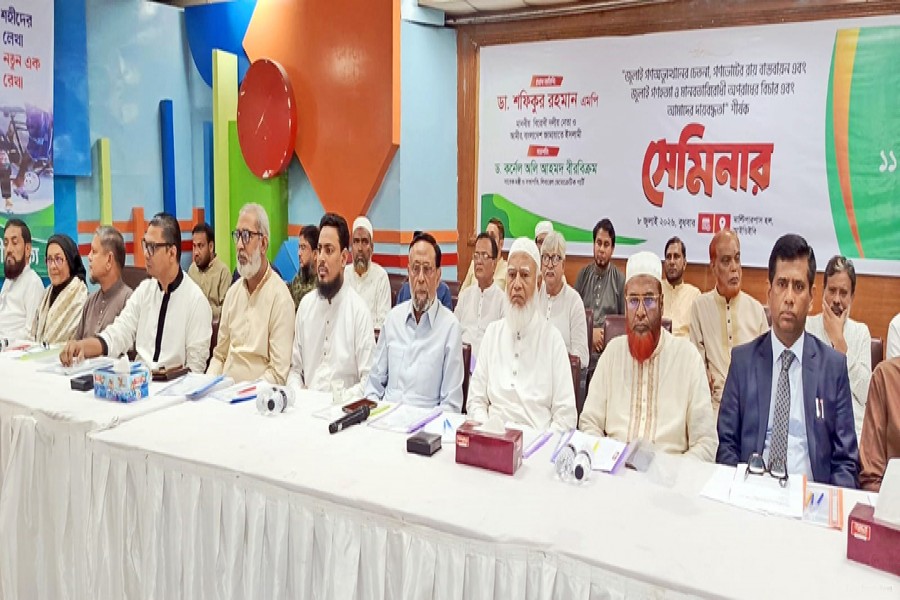
 Leaders of 11-Party Alliance including Opposition Leader and Ameer of Jamaat-e-Islami, Dr. Shafiqur Rahman, at a seminar titled 'Spirit of the Mass Uprising, Implementation of the Referendum Verdict and Trial of the July Genocide and Crimes Against Humanity' at the Institution of Diploma Engineers, Bangladesh (IDEB) in the capital's Kakrail on Wednesday. — Focus Bangla
 Opposition Leader and Ameer of Jamaat-e-Islami, Dr. Shafiqur Rahman, has alleged that that a conspiracy was carried out to defeat 11 political parties in the 13th Jatiya Sangsad (JS) election, claiming that the interim government was also involved in the process, reports UNB.
"We wanted an election, but we did not want a conspiracy in the name of an election," he said while speaking at a seminar titled 'Spirit of the Mass Uprising, Implementation of the Referendum Verdict and Trial of the July Genocide and Crimes Against Humanity' at Kakrail in the capital on Wednesday.
"There was a conspiracy, and we condemn it. The interim government, which presented itself as a neutral and non-partisan administration, was also involved in this conspiracy. They themselves have admitted that 11 parties were defeated through such a conspiracy," he alleged.
Referring to the election process, Shafiqur Rahman said there had been 'many dramas' surrounding the national election, with two elections being held on the same day under the same order.
He said opposition parties accepted the election results and took their oaths, while the ruling party took the oath immediately and another party delayed doing so before later clarifying its position.
He alleged that their acceptance was only a strategic move to overcome the 'electoral hurdle,' not a sincere acceptance of the process.
"If political parties or institutions deceive the nation in this way, people will eventually lose respect for politicians. They will think that politicians' words have no value and that they forget their promises once they come to power," he said.
Shafiqur said he was 'astonished' to witness what he described as an admission of deception in the national parliament, adding that parliamentary proceedings become part of history.
He also referred to remarks made in parliament describing the July Charter as 'an endless document of deception,'alleging that those making such statements had themselves deceived the nation.
Criticising remarks questioning whether people understood four referendum questions, he said if people were capable of understanding 31 questions, they were certainly capable of understanding four.
He alleged that such comments effectively labelled the public as 'foolish' and said questioning the people's judgment was contrary to democratic principles.
"If you believe in democracy, you cannot question the people's wisdom," he said.
Explaining why the opposition accepted the election results despite alleging irregularities, he said one speaker at the seminar had emphasised reconciliation, patience and protecting the nation from civil conflict.
He argued that if the 11-party alliance had rejected the results and revolted after what he described as 17 and a half years of struggle, the country could have descended into chaos.
© 2026 - All Rights with The Financial Express

