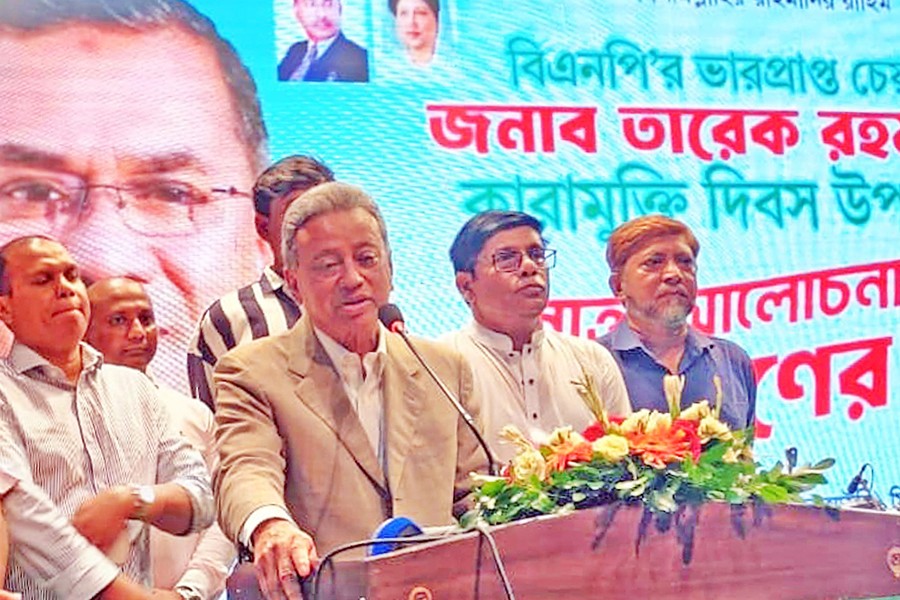
 BNP Standing Committee Member Amir Khasru Mahmud Chowdhury speaking at a discussion organised by Jatiyatabadi Samajik Sangskritik Sangstha at the Krishibid Institution Bangladesh (KIB) in the capital on Wednesday., marking the Prison Release Day of the party's Acting Chairman Tarique Rahman. — Focus Bangla
 BNP senior leader Amir Khasru Mahmud Chowdhury has expressed frustration that Bangladesh continues to slide backward as it could not secure a democratic order, even after one year of the mass uprising, report agencies.
"One year is actually a long time. The country should have transitioned to a democratic order through the electoral process long ago. Because of this delay, Bangladesh is moving backward day by day," he said.
The BNP leader made the remarks while speaking at the seminar, titled 'Post-July Political Thoughts: Which Direction Bangladesh is Walking?' organised by the School of Leadership USA (Bangladesh Chapter) at a hotel in the capital on Wednesday.
Khosru pointed out that historically, countries establishing democracy through elections immediately after a revolution or mass uprising tended to achieve greater stability.
In contrast, the BNP leader warned that countries failing to do so often experience economic collapse, social unrest, and even civil war.
"The countries that created trouble after their uprisings, making various demands and excuses, lost their democracy and riuned their economies. These countries also experienced civil wars, leaving their society deeply divided. This is why elections must be held without further delay," he explained.
Khosru, a member of the BNP standing committee, remarked that the situation is becoming increasingly difficult due to the absence of democracy and an elected government in Bangladesh.
He emphasised the growing gap between the interim government and people, noting that that there is no connection between them.
"This gap is causing law enforcement agencies and government officials to fail in their duties. We are witnessing a collapse in law and order, lack of security, and a business environment that's simply not viable. Factories are not receiving new investments because no one is willing to invest their time, money, or resources in this uncertainty," the BNP leader said.
Khosru warned that the country has already lost over a year without a proper democratic process, which is pushing Bangladesh deeper into political and economic instability.
Despite hosting international summits and discussions, he pointed out that the coutrhas failed to attract real investment.
"At a recent summit, no new investments were made, even though many current investors attended. However, now, with the announcement of the election, we are starting to see some signs of hope. It is clear that investors are waiting for the elections to make their decisions. They are closely watching the situation and preparing to invest after the election," the BNP leader said.
Khosru urged all political parties to recognise the shift in the people's mindset following the mass uprising.
Meanwhile, BNP Senior Joint Secretary General Advocate Ruhul Kabir Rizvi expressed the hope that the Jatiyatabadi Chhatra Dal (JCD) panel will win the Dhaka University Central Students' Union (DUCSU) election, provided it is held in a free and fair manner.
"Chhatra Dal is a student body of struggle, movement and ideals. If Dhaka University students can cast their votes fairly and freely, the JCD panel will surely come out victorious," he said.
Rizvi made the remarks while speaking at a rally in Dohar, organised by Dhaka district BNP to mark the party's 47th founding anniversary.
He hoped that the Dhaka University authorities will take all necessary steps to ensure a credible and fair election.
Turning to the national election, Rizvi said a vested quarter is trying to disrupt the polls scheduled for early February next year.
"Suddenly some political parties are talking a lot about the PR (proportional representation) system. But what is this PR system? Can any ordinary person understand it?" he said.
The BNP leader said the people of the country do not want the PR system to be introduced as they have never practised it.
Addressing party leaders and activists at the rally, he asked, "Do you want elections under the PR system?" The activists responded loudly in unison "No, no".
Rizvi said the people of Bangladesh want only the direct voting system which they have practised for long.
He urged BNP leaders and activists to stay alert and resist any attempts to derail the election and the democratic process.
© 2026 - All Rights with The Financial Express

