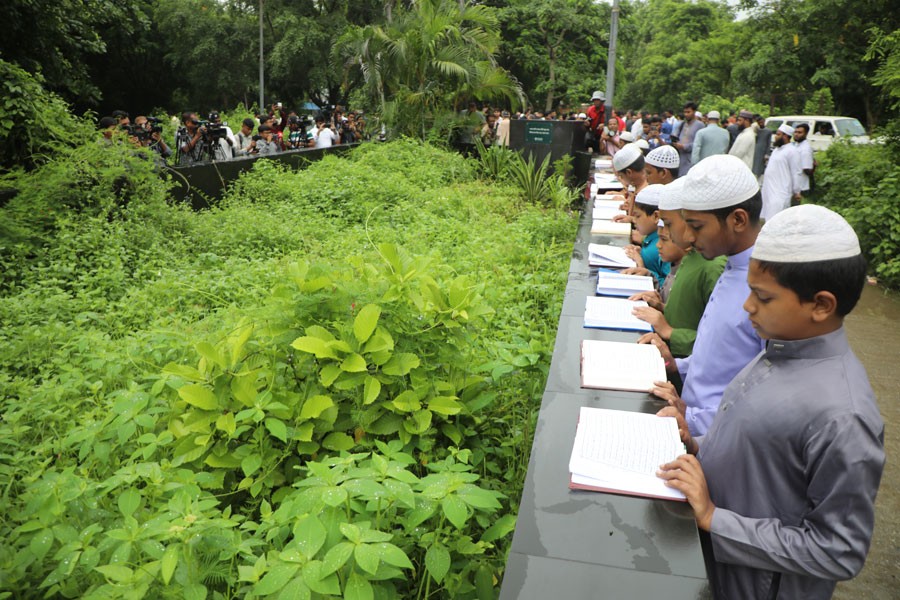
 Different organisations paid tribute to the July Uprising martyrs by offering prayers at the Rayerbazar Graveyard in the capital on Wednesday, marking its second anniversary. — FE Photo
 Opposition Chief Whip Nahid Islam has demanded the immediate opening of the July Mass Uprising Memorial Museum to preserve, research, and exhibit the history, relics, and documents of the 2024 movement, reports bdnews24.com.
Giving the government a deadline that coincides with the anniversary of the fall of the Sheikh Hasina administration, the mass movement leader said on Wednesday that the museum must be opened to the public by Aug 5, warning that people will otherwise open the gates themselves.
He spoke to journalists after paying respects and offering prayers at the graves of those killed in the July Uprising at Rayerbazar, marking its second anniversary.
Following the ouster of the Awami League government on Aug 5, 2024, when Hasina fled to India, crowds stormed and vandalised her official residence, Ganabhaban.
The subsequent interim government led by Muhammad Yunus decided to turn the complex into a museum, getting advisory council approval on Dec 24, 2024, followed by public works clearance on July 15 last year.
The museum is designed to showcase the 36-day final phase of the Uprising alongside relics from the preceding long "misrule", under an ordinance later passed with amendments as a bill in the 13th Parliament.
Nahid argued that the government must do more than observe the anniversary superficially.
The National Citizen Party (NCP) convenor urged the ruling authorities to prove their commitment to the uprising by executing structural reforms, fulfilling the July National Charter, and implementing the mandate of the recent referendum for a "discrimination-free Bangladesh".
Referring to Tuesday's verdict against Jatiya Samajtantrik Dal (JaSaD) President Hasanul Haq Inu in a crimes against humanity case, Nahid, whose NCP is a partner in the Jamaat-e-Islami-led alliance, said the ruling had failed to satisfy the public. He argued that those who took part in the July Uprising, the families of those killed and those injured had not received justice.
Calling Inu an ally of the Awami League who had directly supported the killings during the uprising, Nahid said the 10-year prison sentence was not enough.
© 2026 - All Rights with The Financial Express

