
$100m human trafficking bonanza thru bay boat trips
Saturday, 9 May 2015
FE Report
As stories of mass graves of aspiring migrants to Malaysia kept unfolding, a UN agency reports an estimated $100 million is transacted annually by human traffickers using bay boat trips bound for that country.
In local currency, the amount transacted in the smuggling of job-seekers through the Bay of Bengal and the Andaman Sea comes to Tk 7.80 billion, according to the United Nations High Commissioner for Refugees (UNHCR) report released Friday.
The UN agency report came hot on the heels of bizarre discovery of mass graves in Thai jungles. A ruthless police action shooting down three suspects in such racketeering in the coastal district of Cox's Bazar also took place in a close succession.
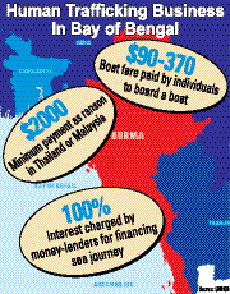
It says each individual has to pay US$ 90 to US$ 370 (Tk 7020 to Tk 28,860) to board a boat in the Bay of Bengal on a risky ride, often without knowing that they (the travellers) will have to pay up to US$ 2,000 (Tk 156,000) for their freedom upon arrival in Thailand or Malaysia.
The UNHCR report, titled South-East Asia, Irregular Maritime Movements (January to March 2015), said in the first quarter (Q1) of 2015, an estimated 25,000 people departed in irregular maritime movements from the Bay of Bengal-- almost double the number over the same period in 2014.
The periodical report said between 40 and 60 per cent of the departed people from the Bay of Bengal in the Q1 were thought to have originated from the Rakhine State of Myanmar, though many embarked on their maritime journeys from Bangladesh.
"Virtually all other passengers on such journeys were Bangladeshi," it says.
The increase in such movements has been attributed to a variety of factors, including more Bangladeshis embarking on the maritime journey, political developments in Myanmar, and the previously reported exodus of young men to Malaysia, which has led both relatives and young women to now also departing in hopes of joining or marrying them.
It said initial boarding fees are often low and in some cases people are given free passage on condition that they repay the debt with future earnings in Malaysia.
There may be false promises of work and even small cash incentives offered.
"Those who change their minds and ask to be let off the boats are forced to remain. We heard of children being abducted off the streets or while fishing, and forced onto boats. People are unaware that money will be extorted from them later in the journey and what started with being smuggled soon turns into trafficking in persons," the report says.
Based on interviews with those who have reached Thailand and Malaysia, it said 300 people are estimated to have died at sea while attempting such maritime journeys in the first quarter of 2015 and as many as 620 since October 2014 primarily as a result of starvation, dehydration and beatings by boat crews.
A few interviewees also told of entire boats sinking, but there was no way to verify such reports or if and how many lives were lost.
The predominant route of irregular maritime movements in South-East Asia continues to originate in the Bay of Bengal from where tens of thousands of persons of concern to the UNHCR leave Bangladesh and Myanmar by sea in hopes of ultimately reaching Malaysia.
Passage along this route takes place year-round, but traditionally increases following the end of the rainy season in October.
At the same time, sexual and gender-based violence were reported by many individuals who have made this journey, as well as an increasing prevalence of possible human trafficking in the form of abductions and marriages arranged without the consent of women whose passage was ultimately paid for by prospective husbands, according to the findings.
In the first quarter of 2015, UNHCR interviewed over 150 recent maritime arrivals in Thailand and Malaysia who had departed since October 2014 on boats that cumulatively carried an estimated 7,000 passengers. Interviewees reported an average of 408 passengers on such boats, an 11 per cent increase over the average passenger loads reported by interviewees who travelled of boats that departed from January-September 2014.
Considering the growing scale and severity of the boat exodus, the UN refugee agency calls on countries in the region to work more closely together to counter the smuggling and trafficking of vulnerable people.
Regarding the much-needed efforts to crack down on this illicit trade, international law prescribes an important distinction between smugglers and traffickers involved in criminal activities on the one hand and the victims of smuggling and trafficking on the other.
Law-enforcement measures must also be accompanied by efforts to reduce the need for migrants and refugees to turn to smugglers in the first place, including by addressing the root causes driving people to undertake these dangerous journeys and providing safe alternatives for them to access asylum and protection.
In Myanmar's Rakhine state - where many of the smuggling victims originate - the UNHCR has long advocated for and stands ready to support concerted efforts to stabilize the situation through reconciliation, the realization of rights for all, socio-economic equality and addressing issues related to citizenship.
jubairfe1980@gmail.com