
$50b apparel export mark not a mirage
Monira Munni | Thursday, 27 November 2014
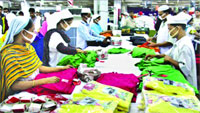
Apparel manufacturers have set a target of fetching $50 billion worth of export earnings by 2021--Bangladesh's golden jubilee year. Although the dream seems to be an 'ambitious' one, sector players believe they are capable of getting to the goal.
But question arises as to whether the present infrastructure is sufficient as the launch pad. Simply, the answer is no. Country's existing infrastructure, according to many of the manufacturers, could at best get them up to $35 billion.
Exporters also are of the opinion that the target is very much possible to achieve provided, according to them, '5Ps'are in place. The five keys to unlocking the potential are: healthy politics, power, port, place for relocation and increased productivity and skilled manpower.
A healthy political situation is the foremost requirement to continue the growth and increase the export earnings.
Export earnings continued to grow despite the tragedies in Tazreen fire and Rana Plaza collapse last fiscal. It was possible because, for the first time, private sector, especially foreign apparel buyers and manufacturers, along with international rights groups joined hands for the improvement of the workplace safety and labour standards.
The western buyers launched two separate initiatives under two line-ups, namely, Accord and Alliance, to assess the fire, electrical and structural safety of the garment factories in the country.
The government also devised National Action Plan under which a joint project was taken up with the International Labour Organization (ILO) so that the manufacturing units remaining outside the inspection purview of either Accord or Alliance were also streamlined into a new look.
The government, the EU, the US and the ILO signed an agreement styled Sustainability Compact aimed at ensuring better workplace and other labour standards.
All the initiatives helped the foreign buyers to rethink Bangladesh as a suitable sourcing destination though some large buyers, in the meantime, started developing alternatives beyond Bangladesh.
But the sector was hit hard by confrontational political situation last year over electoral issue that triggered many hartals and strikes, resulting in a significant rise in transportation cost, uncertainty over timely shipments.
Manufacturers were forced to make air shipments to maintain the lead time. These had increased their cost of doing business.
The buyers again felt discomfort in placing orders during that doldrums. Manufacturers, as such, don't want a repeat of such political activities as it seriously hit both investment and foreign-currency earnings.
The second priority comes to power. Many manufacturers want to shift their units but power is the main hurdle in their way to relocation. They demanded their existing gas and electricity connections to the new locations they want to move to.
To increase export, there is hardly any alternative to developing the transportation system, and constructing and developing the existing highways and ports.
To sustain the growth, raising productivity will be the next challenge as Bangladesh is far behind competing countries in terms of productivity. At the same time the workforce need to be turned into skilled ones.
Bangladesh's business diplomacy should also be updated. A third out of the 183 export destinations recorded negative growth during the first quarter of the current fiscal. The foreign missions need to address the reasons, in particularly, the demand side, through their diplomacy.
Branding the image of the sector is also important. The sector is undergoing a massive transformation to ensure compliance and improve on other safety issues.
However, the present scenario, especially after the completion of inspections by the western retailers, is that the manufacturers are still in the dark about the remediation.
Accord and Alliance experts have identified thousands of deficiencies and are providing corrective action plan showing what to do to fix the problems.
But repair involves a huge amount of money as they need fire doors, sprinklers, auto-hydrant systems and so on. Few of the large units have already started fixing the flaws. But fund matters for the small-and medium- sized factories.
But, to date, none of the major brands or retailers has made a public commitment to fund the upgrades and repairs that are needed.
Again nothing has been made clear about the sub-contracting factories, how they would be regulated and the shared responsibility, including the buyers, manufacturers who place work orders to those units.
The government is assessing those at a slow pace.
Besides those, what happens when Bangladesh becomes a middle-income country by 2021. As an LDC, it now enjoys duty-free, quota-free access to different countries, especially in the largest destination-the EU--under the EBA arrangement.
But the country will lose the benefit when it graduates to mid-income country. Time comes to think whether Bangladesh would be benefited by the GSP-plus arrangement, how much and how.
Bangladesh will not be eligible for consideration by the EU to get GSP- plus until and unless it complies with a combination of stringent conditions. GSP-plus trade cake is an incentive for those countries that have signed, ratified and are properly implementing 27 international Core Conventions in the areas of human rights, labour rights, environment and governance.
The EU top officials on different occasions have suggested starting work from now on to that end, saying that 2021 is not that far away.
The government, exporters in consultation with experts should fix the priorities and address them within a year-on-year timeframe for the sustainable growth of the industry through weathering the adversities that appear to be oncoming.
The writer is FE Staff Reporter. She can be reached at: munni_fe@yahoo.com