
6th anniversary of Rohingya crisis
1.0 million refugees in a fix, as return home uncertain
No repatriation since August 25, 2017
MIR MOSTAFIZUR RAHAMAN | Thursday, 25 August 2022
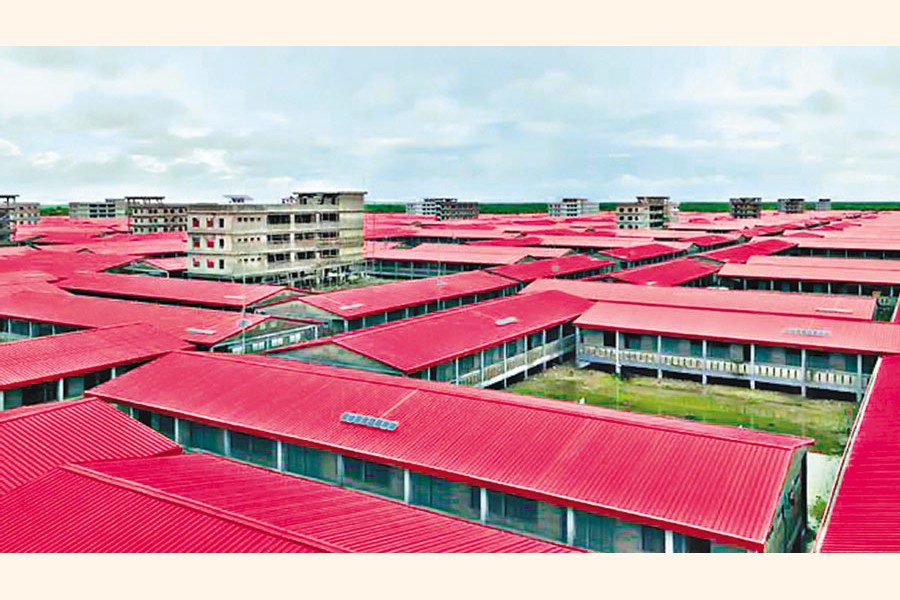
With no hope in sight to return to their homeland in Rakhine State of Myanmar, nearly one million Rohingyas, who fled to Bangladesh five years ago, are living an inhuman life in refugee camps.
To date, not a single refugee can be repatriated since August 25, 2017, when thousands of Rohingyas fled Myanmar in one of the fastest forced movements of people in recent history.
Almost all of them fled to Cox's Bazar, Bangladesh - now home to the world's largest refugee camp.
A repatriation mechanism was set up by Myanmar and Bangladesh in November 2017 - followed by China-brokered trilateral negotiation - but things had not rolled.
Ministry of Foreign Affairs Secretary Masud Bin Momen admitted that although five years have passed, the government does not see any possibility to resolve the crisis very soon.
"But we are working, so that the repatriation process can start even in a symbolic manner. We hope that something of this kind may be done at the end of this year," he told the FE.
Chinese Foreign Minister Wang Yi, during his recent Dhaka visit, also pointed finger at the domestic situation in Myanmar while reasoning the delay in starting the repatriation despite China's involvement.
There were two failed attempts, in 2018 and 2019, to convince thousands of refugees to return. But those selected were unwilling to join the process.
Analysing the cause behind the failure, a report by the International Crisis Group (ICG), a platform of the international agencies, said even prior to the Myanmar's February 2021 coup, progress on official repatriation efforts had been scant.
After the two failed attempts, the COVID-19 pandemic derailed further discussions between Bangladesh and Myanmar, which was then governed by Aung San Suu Kyi's National League for Democracy (NLD).
Moreover, the Myanmar government showed no sign of addressing the refugees' concerns on key points, such as citizenship, security and livelihoods.
"Naypyitaw failed to provide proper information on even the most basic questions, such as where the refugees - many of whom came from villages that the military razed to the ground after the 2017 exodus - would be sent after arriving at transit camps on the Myanmar side of the border," the ICG report observed.
To complicate the situation further, the Myanmar military began fighting a new war in Rakhine State in December 2018 against insurgents from the Arakan Army, a pro-Rakhine ethnic armed group.
The heavy fighting that raged in the state over 2019 and 2020 meant that the repatriation was virtually impossible for security reasons, above and beyond the Rohingyas' other concerns.
Although Rakhine State was largely been spared from the post-coup violence that engulfed much of Myanmar since February 2021, the military's power grab was a further setback to any prospect of repatriation.
Despite the junta's public claims that it was committed to moving ahead with the process, Naypyitaw showed little inclination to do more than pay lip service to repatriation efforts. Pressure from the western governments, several Muslim countries and China appeared to have little impact.
In January, bilateral talks between Myanmar and Bangladesh finally resumed. But so far there has been little progress. Most refugees are, in any case, wary of returning to Myanmar - when it is ruled by the very generals who orchestrated the 2017 violence against them.
The conflict between the Arakan Army and the Myanmar army also hindered the process. Maungdaw Township in northern Rakhine State, where many of the refugees originated, appeared to be a particular hotspot for the conflict.
"There have been several clashes in the area in recent months. These events do not bode well for the Rohingyas' ability to return to Rakhine State," noted the ICG report.
Meanwhile, a survey of the Save the Children revealed that the Rohingya refugees in Bangladesh continued to live in fear.
Two-thirds (66 per cent) of children surveyed and nearly all parents and caregivers (87 per cent) said they did not feel any safer now than when they arrived.
The findings exposed that the international community's efforts, despite being significant, fell short of what was needed to adequately respond to the needs of the Rohingya refugees.
The humanitarian agencies said the rising cost of living globally would impact the ability of the humanitarian community to continue to provide necessary aid to the Rohingya refugees, and that increased desperation would lead to further increase in child marriages.
Onno van Manen, Country Director for Save the Children in Bangladesh, said, "The world may have turned its attention to other crises, but five years later, almost half a million Rohingya children are still growing up in overcrowded camps."
"They're showing worrying signs of depression and anxiety, and, with limited access to schooling, they're losing any hope that they had of a better life," he added.
International Federation of Red Cross and Red Crescent Societies (IFRC) Regional Director for Asia Pacific Alexander Matheou said: "What you see on the surface in the camps has improved over five years - thanks to the work of the Bangladesh government along with multiple national and international partners.
"But below the surface, in people's lives, where the future is uncertain and there is no work or movement, there are less obvious but important risks - of depression, trafficking and violence, including gender-based violence."
Living conditions for the refugees are poor and worsening. Most live in Kutupalong, the largest refugee camp in the world. They have a few job opportunities and little access to formal education, while crime and violence, including killings of the Rohingya community leaders, are on the rise.
It is believed by many that factions within the Arakan Rohingya Salvation Army (ARSA), have long been fighting with rival groups for control of the camps.
Partly in response to this violence, Bangladesh has been imposing tighter restrictions on the refugees, including limiting their ability to come and go from the camps, gain access to the internet, and mix with locals.
Almost 30,000 Rohingyas have also been relocated to Bhasan Char, a small silt island in the Bay of Bengal, which the government has spent millions of dollars - developing specifically to host up to 100,000 refugees.
It is admitted by all quarters that for a country that still has high levels of poverty and unemployment, hosting over a million refugees is clearly an enormous challenge, particularly for the communities hosting them in Cox's Bazar.
The rise in crime and violence in and around the camps has heightened public pressure on the government to adopt a tougher stance.
mirmostafiz@yahoo.com