
1814 - The birth of Norwegian democracy
Saturday, 17 May 2014
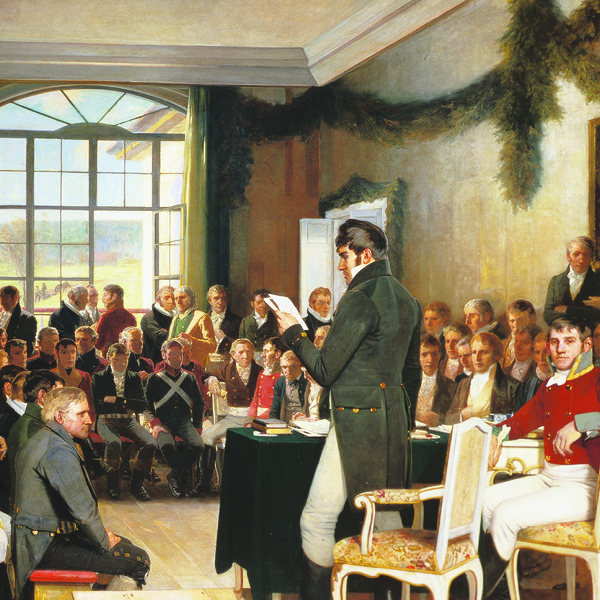
1st January 1814. Norway was firmly under the rule of Denmark. All the important decisions that affected Norway were made in Copenhagen, and the state was an absolute monarchy. Just one year later, the picture was quite different. Norway was an independent nation. Though it formed part of a union with Sweden, Norway now had a huge degree of autonomy, its own capital city, and a completely new political system. How was this possible? Historic circumstances opened up for this radical change. After the Napoleonic Wars (1803-15), Denmark found itself on the losing side and their grip on Norway weakened. In this power vacuum Norway was able to gather the people and write its first draft of the Constitution.
After 400 years under Danish rule, the hasty drafting of a Norwegian Constitution must be viewed as a strategic move to liberate the country, perhaps more than a wish to embrace democratic principles. Nevertheless, the 112 men in the Constituent Assembly produced one of the most liberal constitutions in the world at the time. The first draft of the Norwegian Constitution, written by Johan Gunder Adler and Christian Magnus Falsen, began along these lines: "All people are born free and equal: they have certain natural, essential and imprescriptible rights. These are liberty, security and property."Inspired by the United States Declaration of Independence and the French Constitution, the Norwegian Constitution was crafted around three principles: separation of powers, the safeguarding of civil rights and sovereignty of the people. These are still key values, and form the backbone of our democracy. Today Norway promotes these values through various UN bodies, including the Human Rights Council, and other global forums.
We celebrate our Constitution every year on 17 May. The Constitution is a national icon - a unifying symbol of freedom, independence and democracy. Our celebration of 17 May is one of the world's oldest continuous traditions of marking a country's national day, and it is one of the traditions we are most proud of. Instead of military parades, the streets are full of children dressed in national costumes and waving flags. The celebration is an all-day event with special traditions and songs typical for this day. People gather in the streets and in their local communities to celebrate with parades, games and good food, much like Bangladeshis celebrate Pohela Boishakh. This year's celebration is special because the Constitution is 200 years old. The bicentenary will be celebrated throughout the year with various events, shows, concerts and presentations all over Norway and wherever Norway is represented abroad. In addition to being a year of festivities, the Bicentenary of the Norwegian Constitution raises awareness of what the Constitution means today and what role it will play in our future democracy.