
2011 B\\\'desh dirty money flow tops $1.0b
FE Desk Report | Monday, 13 October 2014
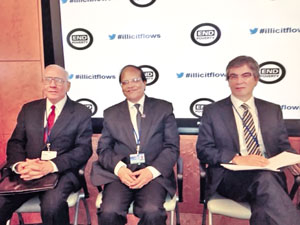
With tepid trends of foreign aid flow, countries like Bangladesh should beef up efforts to mobilise domestic resources, panelists said at a discussion in Washington Saturday.
They said one "window of opportunity" for broadening the domestic resource base is to plug leakages through illicit financial outflows, which amounted to US$1.17 billion from Bangladesh in 2011.
Illicit financial outflows from Bangladesh accounted for about 11 per cent of gross tax revenues, and about 78.5 per cent of gross foreign aid.
Citing the World Financial Integrity (WFI) estimates, they said the global flow of tainted flow reached a staggering $946.7 billion, far exceeding the levels of gross overseas development assistance. ODA was $165.4 billion in 2009.
Bangladesh Bank (BB) Governor Dr Atiur Rahman attended the discussion on 'Illicit Financial Flows and the post 2015 Development Agenda' held on the sidelines of the annual meetings of the World Bank and International Monetary Fund, according to a statement.
The meeting was told that Bangladesh has remained "proactive" from the beginning in curbing both inward and outward financial flows, legislating an Anti-Money Laundering (AML) Act back in 2002, well ahead of regional neighbours.
An Anti terrorism law with provisions countering financing of terrorism (CFT) was enacted in 2008. Both legislations have undergone rounds of subsequent upgrading to FATF guided global best practice standards.
Implementation infrastructure for the AML/ CFT legislations including an FIU with state of the art IT platform, and appropriate suspicious transactions reporting, investigation and adjudication processes have been put in place; several cross border information exchange and mutual cooperation arrangements between the local FIU, prosecution and investigation authorities and their counterparts in jurisdictions abroad have by now been established.
More recently the Bangladesh authorities have set up a unit in the country's National Board of Revenue (NBR) for surveillance on transfer pricing practices of multinationals and other corporate engaged in cross border businesses, towards detecting illicit financial flows through this mechanism, the meeting was told.
Benefitting from the mutual information exchange and cooperation arrangements with FIUs and other authorities in various jurisdictions, Bangladesh authorities have succeeded in securing stolen asset recovery from abroad in one case, and processes are ongoing in two other such recovery efforts.
In another case, Bangladesh authorities have cooperated with AML/CFT authorities in a jurisdiction abroad in effecting refund of an earlier illicit fund inflow into Bangladesh. Sums involved in these recoveries and refunds of illicit finance flows are modest (a few million dollars in total), but are nevertheless important as strong signal of stance of the authorities against illicit fund flows.
Bangladesh is a founder member of the FATF style Asia Pacific regional AML/CFT group (APG).
The country's proactive AML/CFT stance has already earned recognition abroad, getting off from FATF's grey list and its FIU getting admitted into the Egmont Group.
Bangladesh will be hosting the 2016 APG annual meeting in 2016, and will be the co-chair of the APG in 2018. There are however lots more to do in Bangladesh and other developing countries in plugging domestic resource leakages through illicit financial outflows; and assistance from global initiatives will be useful and welcome.
The WFI estimates of illicit outflows from developing economies are admittedly on the very conservatively low side, not capturing miss invoicing of trade in services, same-invoice transfer mispricing, hundi/hawala transactions, and bulk cash dealings on drug and human trafficking.
Investigative and enforcement capacity building in these areas are quite challenging tasks in terms of knowhow and physical resources, and external multilateral assistance will be much welcome.
Orchestrating effective cooperation for cross border information exchange and mutual legal assistance between taxation authorities in different countries would go a long way in combating outflows of tax dodging funds. More disaggregated information from such sources as the BIS on cross border capital flows would be of much help in identifying illicit fund flows.
To help plug leakages through illicit financial outflows, the donor countries are committing a specified percentage of their ODA for this purpose may also be a good idea.
The panel also included Hans Brattskar, State Secretary of the Ministry of Foreign Affairs, Norway; Minister for Trade and Development Cooperation, Denmark; Leonard Frank McCarthy, Integrity Vice President, World Bank Group; Mario Marcel, Senior Director, World Bank Group; Nena Stoiljkovic, Global Practices Vice President, World Bank Group and Raymond Baker, President of Global Financial Integrity.