
62m Bangladeshis vulnerable, risk sliding back into poverty: WB
Warns BD's growth pattern has become less inclusive in recent years
Wednesday, 26 November 2025
FE REPORT
Bangladesh's 62 million people -- half of the non-poor population -- are now at risk of falling back into poverty as progress in reducing poverty faces its toughest period since 2016, the World Bank (WB) said on Tuesday.
Some 21 million people remain poor in 2025, while another 62 million sit just above the poverty line with weak consumption, low savings, and limited safety nets, the global lender said in its new assessment.
The World Bank unveiled the report titled "Bangladesh Poverty and Equity Assessment: Navigating the Road to Prosperity" in Dhaka, where senior economists, development experts, and policymakers discussed shifting poverty dynamics and the urgency of a renewed policy approach.
The event was jointly organised by the World Bank and the Policy Research Institute (PRI), with PRI Chairman Dr Zaidi Sattar in the chair.
The WB warns that Bangladesh's growth pattern has become less inclusive in recent years.
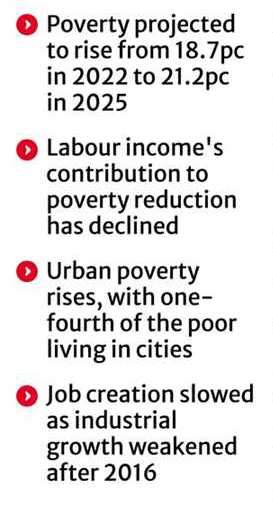
Labour income -- previously the main engine of poverty reduction -- has weakened sharply, with its contribution falling from 89 per cent during 2010-2016 to just 51 per cent over the next six years.
Agriculture drove rural poverty reduction, but urban poverty has become more entrenched, with one in four poor Bangladeshis now living in cities, the report said.
Between 2010 and 2016, rapid industrial expansion and modest agricultural growth generated 1.1 million jobs annually, with poverty reduction concentrated in non-agricultural sectors.
From 2016 to 2022, agriculture rebounded while industrial growth slowed, creating 1.5 million jobs per year, with agriculture accounting for 63 per cent of the gains, according to the assessment.
The report shows Bangladesh made strong progress between 2010 and 2016, before the pace of poverty reduction slowed markedly.
Extreme poverty fell from 12.2 per cent to 5.6 per cent, and moderate poverty from 37.1 per cent to 18.7 per cent over 2010-2022 -- lifting 34 million people out of multidimensional poverty. But the momentum has weakened, the international development organisation noted.
Poverty is projected to rise from 18.7 per cent in 2022 to 21.2 per cent in 2025, driven by falling employment and inflation that continues to outpace wage growth.
"Women, youth, and low-skilled workers are bearing the brunt. Urban female labour-force participation has dropped from 34 per cent to 24 per cent. Youth unemployment remains high, particularly among educated young women," the report said.
Migration remains a key poverty-reducing mechanism, with domestic remittances among the poorest 40 per cent rising significantly. But international migration remains costly and inaccessible for low-income families.
Although the government expanded social assistance, targeting remains weak.
In 2022, half of the poorest households received no benefits, while 35 per cent of the richest did. Subsidies -- especially on electricity and fuel -- continue to favour urban, better-off groups, the World Bank said.
With 13.3 million people projected to be displaced by 2050 due to climate impacts, climate-driven shocks could cut agricultural GDP by one-third, deepen rural poverty, and widen regional disparities.
"For years, Bangladesh has been known for its success in poverty reduction," said Jean Pesme, WB division director for Bangladesh and Bhutan. "But a business-as-usual approach will not accelerate poverty reduction. Job creation -- especially for youth and women -- is the fastest path to restoring progress."
Sergio Olivieri, senior economist and lead author of the report, said Bangladesh must turn growth into broad-based opportunities. "Innovative policies can restore and accelerate poverty reduction -- better connectivity, quality urban jobs, value-chain integration, and effective safety nets are key."
Dr Hossain Zillur Rahman, executive chairman of PPRC, said the period from 2022-2025 has seen a worrying reversal in poverty reduction, with significant job losses -- particularly among women -- and rising extreme poverty.
He said these trends reflect structural challenges, including governance weaknesses, poor policy implementation, and the need for a more inclusive growth strategy.
He emphasised revitalising agriculture, improving technical and vocational education, and ensuring women's participation, including safe transport.
He also underscored the need to translate educational expansion into real human capital, warning that more skills programmes alone will not succeed without addressing structural gaps.
Dr Rahman called for a new "coalition of activists, entrepreneurs, and professionals" to implement the report's recommendations.
Dr Selim Raihan, executive director of SANEM, said surveys in 2021 had already flagged a sharp rise in poverty.
He questioned why poverty reduction and job creation have slowed for nearly a decade despite strong GDP growth, citing the pandemic, the Russia-Ukraine war, and persistent inflation as key drains on resilience.
"Growth alone cannot deliver equity. We need stronger investments in education, infrastructure, and social protection. Structural transformation is lagging," he said.
Dr Mustafizur Rahman, distinguished fellow at CPD, said the report's focus on growth with equity echoes long-standing concerns over Bangladesh's increasing vulnerability.
He pointed to rising poverty and extreme poverty as indicators of "fragile gains", along with persistent regional disparities, especially the underdeveloped western belt.
He said Bangladesh's weak revenue mobilisation -- with one of the world's lowest tax-to-GDP ratios -- remains a major constraint. "No development plan will be sustainable if built entirely on borrowing," he said.
Senior Economist Dr Zaidi Sattar said Bangladesh's growth is not inclusive as job elasticity remains poor.
The World Bank's roadmap calls for stronger foundations for productive jobs, better employment pathways for poor and vulnerable groups, market-enabling reforms including support for agricultural value chains, and better-targeted social protection with more progressive fiscal policy.
The report concludes that Bangladesh stands at a critical inflection point. Converting growth into resilience -- through jobs, human capital, and better governance -- will determine whether the country can protect its most vulnerable citizens and sustain long-term development.