
85.9pc students mentally sick due to internet use
ABU RAKIB | Sunday, 11 June 2023
Among 1,773 students, 72.3 per cent have faced some mental problem in their life due to use of internet and 85.9 per cent suffer from mental illness for the same reason, according to a survey conducted by Aachol Foundation.
Aachol Foundation revealed findings of the survey titled "Impact of internet use on students' mental health: How much caution is necessary?" at a press conference on Saturday.
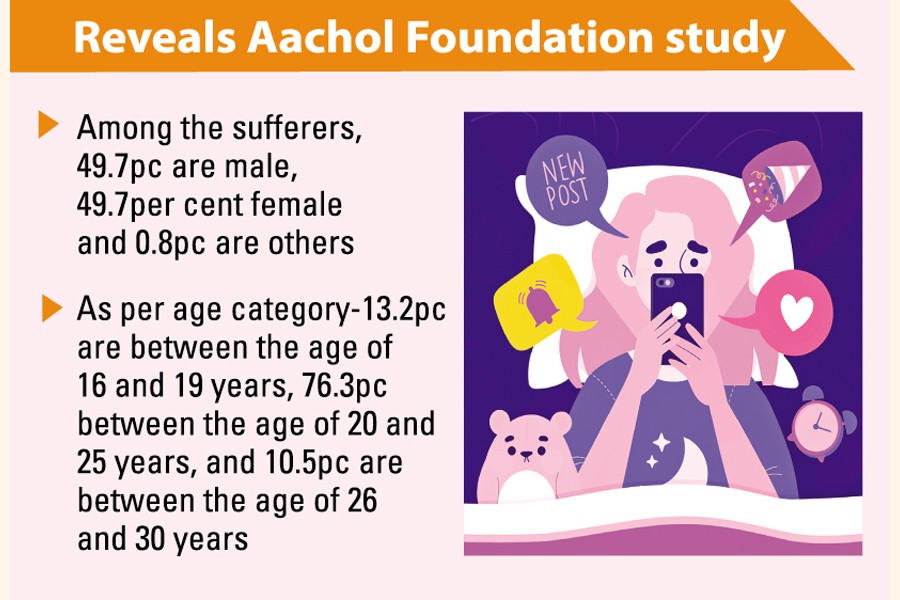
According to the survey, among the sufferers, 49.7 per cent are male, 49.7 per cent female and 0.8 per cent are others.
As per age category- 13.2 per cent are between the age of 16 and 19 years, 76.3 per cent between the age of 20 and 25 years, and 10.5 per cent are between the age of 26 and 30 years.
Dhaka University (DU) Clinical Psychology Department Professor Kamal Uddin Ahmed Chowdhury, Programmer of Information and Communication Division Mr Biplab Chandra Sarkar, Deputy Civil Surgeon of Tangail Dr Maruf Ahmed Khan and President of Aachol Foundation Tansen Rose were present at the conference.
Research and Analysis Unit Leader of Aachol Foundation Farzana Akhtar Labani revealed the data of the survey
that was carried out over the course of these five months, from December 2022 to May 2023, and prepared by enthusiastic and diligent young researchers of the organisation.
Among the respondents- 18.6 per cent were madrasa level and English medium higher secondary level students, 64.3 per cent graduate level students, 8.4 per cent post-graduate level students, and 8.7 per cent were looking for work or an income.
Around 34.3 per cent of the students who were surveyed said that their everyday life was being negatively impacted by their use of internet; 57.2 per cent claimed that it had a 'slightly negative' impact on everyday living; 59.6 per cent of those who examined the detrimental outcomes believed that their inability to concentrate on their schoolwork was caused by time spent online; 17.8 per cent of people faced online bullying, betting, cybercrime, and pornography.
According to the survey, 23 per cent of respondents gradually became more introverted, 35.6 per cent underwent various forms of stress, including depression, and 20.3 per cent developed social isolation.
The survey results also have showed that 23.6 per cent isolated themselves and made a virtual world.
Around 19.5 per cent have trouble finding people to talk openly.
Besides, 9.9 per cent of them have trouble blending in socially, 9 per cent are frequently bothered by others, and 8.7 per cent are concerned with people.
On the other hand, 29.3 per cent of students informed that their social relationships are not affected by their internet use.
From the survey, 58.7 per cent of respondents admitted that they did not get enough sleep.
Among them 30.4 per cent of students attributed their inability to sleep only to their usage of the internet.
The students suffered a variety of medical issues as a result of using the internet for extended periods of time, with 53.6 per cent experiencing sleep disturbances, 34.5 per cent experiencing discomfort and dizziness, 19.2 per cent experiencing appetite loss, and 24.3 per cent experiencing eye problems, 27.8 per cent haziness and fatigue.
However, 10.4 per cent of the students are dissatisfied with others' success.
Additionally, 10.5 per cent of people are envious of others' success on social media while 18.7 per cent feel inferior, 34.4 percent of pupils feel motivated by the news.
On the other hand, it is known that the news had no impact on 26 per cent of pupils.
Deputy Civil Surgeon of Tangail Dr Maruf Ahmed Khan said, "As Bangladesh steps towards the 'Digital Bangladesh', internet is becoming the essential element of life. At the same time, it's side effects are also emerging. Internet addiction is one such emerging problem. Internet addiction is recognised as a disorder in the DSM-5 guideline. It is seen that depression is double in person with internet addiction."
aburakibdu420@gmail.com