
A battle between liberalism and extremism
Maswood Alam Khan | Wednesday, 26 April 2017
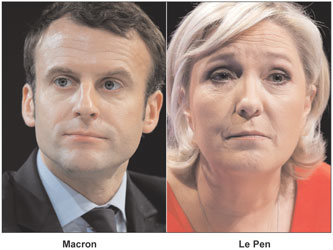
An earthquake high on Richter scale has shaken the French political domain! For the first time in the history of France, no mainstream political party has entered the run-off for the presidency, an extraordinary outcome that has put two party outsiders into the final round. The election result was a full-throated rebuke of France's two traditional mainstream parties-- the Socialists and the Republicans.
The quake has been brewed by France divided between who favour European Union, continuity of tradition, free trade, free movement, immigration, religious tolerance and globalisation, and who don't. The French is in a political battle between people sticking to European values and people eager to unleash a new force of disruption. It's a tug of war between populists and elitists. It's a combat between politicians and non-politicians, a competition between the young and the old. It's a contest to prove whether American people were right in electing Donald Trump, whether British people were wrong in favouring Brexit. It's a battle between liberalism and extremism, a battle that will decide the fate of not just a country but a continent.
The first round of the French election held on Sunday, April 23, was the most stressful in living memory. Turnout was about 80 per cent, roughly the same as in 2012. About 50,000 police and 7,000 soldiers were deployed across France for the vote. Anti-National Front demonstrators clashed with police in Paris. At the end, centrist leader Emmanuel Macron and far-right leader Marine le Pen have come out victorious to contest the second round on May 7.
Marine Le Pen has been the leader of the party National Front since 2011 when she took over from her father. She led the party to big electoral gains in regional elections in 2015. Her victory in the first run was for those who want to see more "France First" policies. Her people want to restrict immigration, protect French industry, and limit public signs of Muslim faiths. She wants negotiation with Brussels on a new EU, followed by a referendum. "Automatic" expulsion of illegal immigrants and legal immigration cut to 10,000 per year following an immediate total moratorium are few of the many goals she is looking at. She wants to see "extremist" mosques closed and priority to French nationals in social housing. She will ensure retirement age at 60 and a 35-hour week for French workers.
On the other hand, Emmanuel Macron is an ex-banker who has never stood for election before. His party ideology is an eclectic blend of left and right policies. He was an economic adviser to the current President Francois Hollande, and then the economic minister. He deregulated some industry sectors and allowed shops to open for longer hours on Sundays as well as championing digital start-ups. He worked for a socialist government but some on the left of the party opposed him. He wants a €50bn (£43bn; $53bn) public investment plan to cover job-training, exit from coal and shift to renewable energy, infrastructure and modernisation. He will be liberal in medical aid to the French people and ensure big cut in corporation tax and a more flexibility for companies to renegotiate 35-hour week. He hopes to cut unemployment rate to 7 per cent (now 9.7 per cent). And, interestingly, he will ban mobile phone use in schools for under-15s.
Marine Le Pen will fight a hard campaign, but it is almost inconceivable that she will win. Of course, she will get support from those who favour Frexit (an exit of France from EU) and many international sterling figures like Russian President Vladimir Putin may have a soft spot for her. But support from controversial quarters may hurt her rather than help.
Macron is an overwhelming favourite to win the run-off on May 7. He is not only popular in his own right, but two of the losing candidates, Francois Fillon and Benoit Hamon, have already endorsed him. Not a single opinion poll has suggested that the Front National leader Le Pen can beat him in the second round, and most polls predict a 2-1 margin victory for Macron. A drama is unfolding as to who among the two will win the hearts of the majority of voters to become the new French president. Emmanuel Macron is the favourite. But, not always a favourite wins a horse race as was the case with Hilary Clinton in 2016 US presidential election.
By choosing Macron to lead, the people of France have rejected the temptation to give in to populists from both the right (in the form of Le Pen) and the left (in the form of Jean-Luc Mélenchon). They have chosen a candidate who embraces the realities of the modern world- a candidate who will favour technology and will feel the need to cooperate with other countries, notably Europe, rather than pursue an illusion of national security and well-being in isolationism and nationalism.
Today's state of affairs in France was unthinkable just a few months back. Who could imagine that Macron, a former investment banker with no political experience or backing, is poised to become the next president?
Macron, however, was smart enough to smell the political zeitgeist of the present era and wasted no time to reach out especially to the young, the disillusioned, the optimistic, and the Europe-lovers whose votes made the ultimate difference.
At 39, Emmanuel Macron, if he wins, would be the youngest president of the Republic of France since Louis-Napoleon Bonaparte. Louis Napoleon was 40 when he came to power in 1848. Macron's meteoric rise seems like a fairy tale about a sleeping prince suddenly becoming a king.
Macron's success tells us that despite multiple terrorist attacks in France recently, a message of outreaching to immigrants and acceptance of Muslims has still some currency in France. Ms. Le Pen campaigned stridently against Muslims and immigration, linking both to security threats, and she may have benefited from a final surge of support after a terrorist attack in Paris on Thursday.
But what is next? How will Emmanuel Macron ensure a majority in parliament? He may hope the "logic" would prevail and the France will elect a majority of candidates from his En Marche movement. But that hope is far-fetched. The parties like centre-right Republicans will invariably take their revenge, and do everything to ensure they keep up their numbers in the National Assembly. A President Macron then would be bent to negotiate his programmes through parliament. Power would shift to a third entity and it would be a very different Fifth Republic.
Emmanuel Macron is, for sure, the next French president, unless something super dramatic happens like what happened in some developed countries in the recent past.
French people who belong to opposing camps have already started digging Macron's family history to discover foibles. A distracter who won't like to see Macron as the next captain of France may sarcastically say: "The man who could be France's next president, you know, married his school teacher 25 years older than him!" The story is true. While such a relationship could affect campaigns in other countries, most people in France aren't really blinking. Some say, such extraordinary relationship between spouses would rather help Macron to win more votes.
maswood@hotmail.com