
A celebration of Bengalee culture
Shihab Sarkar | Saturday, 21 February 2015
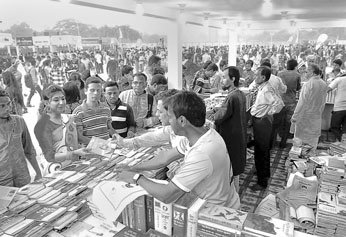
By way of the rugged course of history spanning more than sixty years, the month of February eventually became a month of books and readers to the people of this country. Some prefer to call it a month of celebration of literary achievements. Broadly speaking, the event has assumed the proportions of a celebration of Bengalee culture. The latent spirit that keeps the urban Bengalees in Bangladesh close to books and reading, especially in this month, was sparked by the 1952 Language Movement. The movement, however, had an explicit political undertone. It took shape after the two provocative and arrogant speeches by Muhammad Ali Jinnah, Pakistan's founder, and the then governor-general, in Dhaka.
Mr Jinnah was on a 9-day visit to the eastern wing of Pakistan. Of the two meetings, one was held at the then Race Course Maidan in Dhaka -- the other at Dhaka University's Curzon Hall.
The fate of a united Pakistan was sealed in those speeches. Mr Jinnah in his speech at a public rally at Dhaka Race Course ground on March 21, 1948, declared Urdu would be the state language of the united territory of Pakistan. Calling those who were demanding Bangla be one of the state languages of the new-born state 'quislings' and 'fifth columnists', the governor-general said: "Let me make it very clear to you that the state language of Pakistan is going to be Urdu and no other language." People present at the rally became stunned. Moments later, shouts of protest followed.
Muhammad Ali Jinnah demonstrated a similar pro-Urdu, virtually anti-Bangla, stance at the special convocation at Curzon Hall at Dhaka University on March 24. He had miserably failed to grasp the sentiment of the Bengalees, the major segment of population in Pakistan, and also their distinctive and rich linguistic heritage as he kept eulogising the virtues of Urdu. At the convocation gathering of Dhaka University students, the reputedly shrewd politician called the 'elements' promoting the case for Bangla as a state language 'enemies of Pakistan' and 'traitors'. He said, " … there can, however, be one lingua franca, that is, the language for inter-communication between the provinces of the state, and that language should be Urdu, and cannot be any other … the state language, therefore, must obviously be Urdu." Mr Jinnah's speech was almost drowned by loud protests saying, "No … No."
After a series of protests and agitations in Dhaka and other parts of the province in 1948 and the following years, it was the historic Language Movement of 1952, along with the martyrdom of language heroes, that later shaped all the mass upsurges in the then East Pakistan. All these mass movements culminated in the 1971 Liberation War against the Pakistani occupation forces. Bengalees won the war. They got an independent and sovereign Bangladesh. And also the freedom to take the mother tongue, Bangla, to its long deserving height.
In fact, it was Muhammad Ali Jinnah who, unwittingly, sowed the seeds of discontent in the then East Pakistan. In the following years it snowballed into the demand for autonomy, and later independence.
That the month of February, 1952, which witnessed the zenith of the Language Movement on the 21st, would one day become an occasion to celebrate Bangla was a foregone conclusion.
In independent Bangladesh, the month has seen the rebirth of Bangla as the state language that helped blossom creativities, and also a renewed resolve to safeguard it. Since the early seventies, the unique feature of a book fair has been taking shape alongside the events surrounding the language martyrs' day. In the last 30-35 years, the commemorative book fair has emerged as a major event organised by Bangla Academy.
The fair is officially called Amar Ekushey Gronthomela. With the participation of local publishers, the fair began its journey on the premises of Bangla Academy. With a sharp increase in the number of participating publishers, as well as book lovers, the fair was shifted to the nearby Suhrawardy Udyan last year. Like in the previous years, the fair this year began on February 01 and would continue until the last day of the month.
With the country's literacy rate standing at 57.7 per cent, that mostly include primarily literate persons -- the dream of having book lovers or passionate readers in remarkable numbers is a pipe dream. Then, how come the hype and hoopla, and also genuine enthusiasm for books, still continues in full force? To some, visiting the largest book fair in the country is like an annual ritual. But many of those visiting the fair ground also buy books, move from stall to stall to get the books of their choice. Then there are others, who go to the fair only to collect books, mostly fictions, written by their favourite writers. Although still at a minuscule level, the crowded book fairs in Dhaka and other cities point to the love for books in a large section of the urban educated people. A major portion of them comprises both male and female youths. School children and tiny tots tirelessly moving around the fair ground with their parents have long become a common spectacle there. These and a lot of others constitute the overall montage of our Ekushey Book Fair.
Given the country's messy economy, the concomitant poverty, and its endemic political unrest, the love for books, a highly refined one at that, appears ironical. But it's true - the way is true the people in remote tiny villages enjoying mystical songs throughout a chilly, winter night. This love for the arts has passed down to the nation through ages. The economically lackadaisical nation has a lot of things to feel proud of. It has a long cultural heritage. The Bangla language has evolved from the Indo-Aryan sub-group of the Indo-European family of languages.
Modern Bangla had its roots primarily in Sanskrit, then in Eastern Prakrit, Shouraseni and Magdhi languages of the sub-continent. Ethno-culturally, Bengalees have had a number of great sons since the pre-Christ days. In the area of literature, they find themselves to be a fortunate nation to have Rabindranath Tagore, whom they lovingly call Visva Kavi (World Poet). Prior to Tagore and Kazi Nazrul Islam, the National Poet of Bangladesh, they had Michael Madhusudan Dutt, the medieval poets Alaol, Syed Sultan et al, the Vaisnava and the Charyapada poets --- the latter being the earliest Bengalee lyricists. They belonged to the times of Beowulf, the ancient epic written in old English. Charyapada lyrics, too, were written in a Bangla in its formative days, while the Vaisnava poetry used Brajobuli as its medium of language. With many a turning point and the emergence of great poets, novelists, social reformers and politicians, the love for both pleasure reading and scholarly pursuits, and, thus freedom, have been innate with the Bengalees for centuries.
The repeated socio-political, and, to some extent, economic, crises notwithstanding, the love for books and the arts in general may one day help the nation overcome its woes. Writers, singers, painters, performing artistes -- all have a special place in the people's hearts. Unlike the European country, where the minister for culture cannot name a single book by a recent Nobel Prize-winning writer of theirs, in Bangladesh many commoners can recite a stanza or two from Tagore or Nazrul. Here lies the inherent strength of Bangladesh and its people.
Coming to books, what we need at the moment for raising the number of true lovers of books, and, in the process, enhancing enlightenment, is a renewed emphasis on literacy and education. Despite the fast advancing electronic outlets worldwide, including Bangladesh, printed books are still in wide circulation. They will be on tables at home and in the library shelves in their full glory for many days to come.
shihabskr@ymail.com