
A collective showcase of women and nature
Tanim Asjad | Friday, 26 September 2025
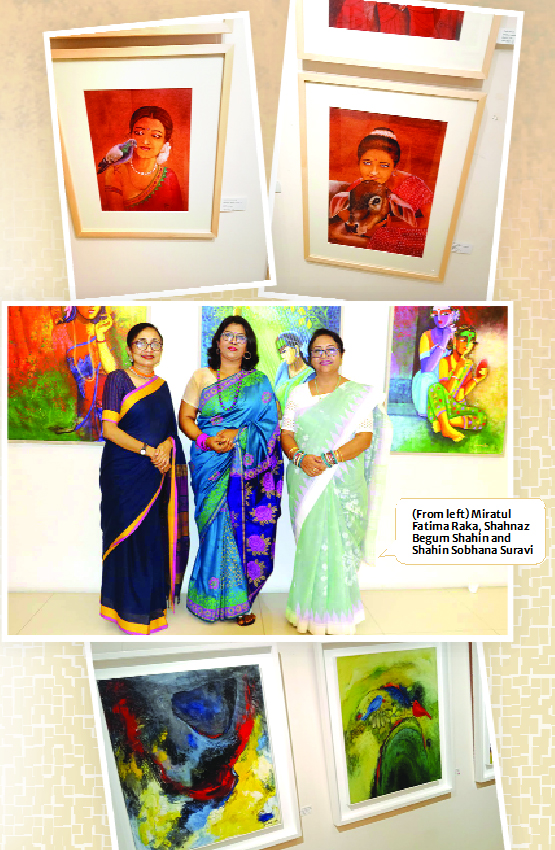 The three women, who have been close friends since their time on the campus of the then Institute of Fine Arts, the University of Dhaka, have a journey that resonates with many. The institute, which was transformed into the Faculty of Fine Arts of Dhaka University in 2008, saw them studying in three separate departments. Over three decades, they have worked on their respective areas of art with diversity despite some obstacles and disruptions. And now, for the first time, they have joined hands to showcase their selected works under the banner 'Troyee (trio)'.
The group art exhibition was inaugurated on September 5 and concluded on September 18, after being extended for two additional days, at Gallery Chitrak in Dhaka.
All the artworks of the trio, displayed at the two-week exhibition, focused on women. "Is it coordinated?" "No," replied Shahin Sobhana Suravi, one of the three. "You may say that it is a coincidence. We did not discuss, among others, selecting our works for the exhibition. But, when we get ready for the display of our works, we have found the theme common, and that is women," Survai explains to this scribe while visiting the exhibition one evening.
Having graduation degree from the Department of Craft at the Institute of Fine Arts, she also has a good command of oriental style. Her series of works on 'Shakuntala' provides deep feelings of women's joy and sorrow over the centuries. The saga of Shakuntala is presented in the Mahabharata and popularised by classical poet Kalidasa in his Sanskrit play Abhijnanashakuntalam (The Recognition of Shakuntala) in the 4th or 5th century AD.
Two others of the trio are Shahnaz Begum Shahin and Miratul Fatima Raka, each with their unique style and perspective.
At the exhibition, Raka displayed some of her works on nature series, alongside women, making it more opulent. Being a student in the Drawing and Painting Department, she is accustomed to paying attention to sharpness with colour variations. Her paintings of nature are characterised by deep colours that reflect the sounds and rhythms of natural beauty and diversity. These are more about feelings than seeing or observing. The surfaces of women in her paintings are a blend of eastern and western influences. Raka attempts to portray Bengali or oriental women in various looks, utilising attire and ornaments from other cultures. Thus, her women sometimes become representatives of globalised customs.
Shahnaz Begum Shahin, academically trained in oriental art, primarily uses the watercolour-wash method in her works. Maintaining the traditional trend of oriental art, she keeps her subjects within women, pets, and birds etc. A woman's affection for her pet is vividly presented in her works, while the women are coloured with softness and simplicity. The viewers feel an attachment to Shahin's women as if they were their near and dear ones. She mostly gives priority to red or reddish colour with balanced light and shade.
Eminent Bangladeshi-Spanish artist Monirul Islam attended the inaugural ceremony as the chief guest, while Professor Mostafizul Haque, an artist and chairperson of the Board of Trustees at Shanto-Mariam University, attended as a special guest. The opening event was presided over by Luva Nahid Chowdhury, Director-General of Bengal Foundation.
Artworks are not always easy to understand and considered an area of limited interest to people with adequate knowledge on various schools of art, but there is no bar for anyone to go through such an exhibition as this and witness the paintings as a means to escape the daily rut for an hour or more. That's why the 'Troyee' was visited by family members, friends, fellows, well-wishers, teachers and students of Shahin, Raka and Suravi, along with some ordinary visitors like this scribe.
asjadulk@gmail.com