
A deluge that drowns a dynasty
Ismail Hossain | Tuesday, 5 August 2025
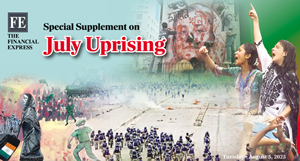 It began not with a bang, but with the whispers of rain on Dhaka’s concrete skin. The froth of human wrath soon keeps rolling on in a centripetal flow, until it engulfs the citadel of absolutism in power.
It is the 1st of July 2024, in a fast-unfolding chronicle. Students with soaked sandals and hopeful hearts gathered at the gates of Dhaka University. Their voices were uncertain. Their protest—against the discriminatory civil-service quota system—felt routine, just another ripple of youthful defiance doomed to break against the granite walls of an entrenched regime. No  one, not even in their boldest imaginings, foresaw that these first raindrops would swell into a deluge—a monsoon of fury that would wash away a dynasty built on fifteen years of iron rule, fear, and blood.
The regime they confronted was that of Sheikh Hasina and her Awami League—a political machine that had perfected the art of ruling through a suffocating blend of manufactured stability and breathtaking brutality. Democracy meant little to them; their grip on power was emboldened by the quiet support of neighbouring India. To the outside world, Hasina was the matriarch of development—the builder of bridges, the driver of GDP. But to her people, that “development” was a gilded cage.
For years, international watchdogs like Human Rights Watch and Amnesty International had laid bare the horror beneath the sheen: enforced disappearances, extrajudicial killings, systemic torture et al. The Rapid Action Battalion (RAB), a paramilitary force sanctioned by the United States (US) for its human-rights abuses, and the Detective Branch (DB) of police functioned as death squads. The names of the disappeared became ghostly incantations in grieving households—husbands, sons, brothers—after being taken by unmarked vans, never to return. The UN High Commissioner for Human Rights repeatedly called for independent investigations, but the pleas fell on the deaf ears of a regime that considered itself untouchable.
This was the Bangladesh the students inherited: a kleptocracy cloaked in democratic garb, where merit was irrelevant, and dissent could be fatal.
But these students are a different stuff. They are not of the generation that feared in silence. They are Gen Z—children of the internet, fluent in the language of global rights movements, and acutely aware of their stolen future. They had watched their educated brothers ride motorcycles for food delivery apps, their sisters—armed with degrees—rejected from jobs reserved for party loyalists. When they marched, they marched not only for themselves, but for everyone who had been muzzled.
At first, the state responded with contempt. Hasina, ensconced in her palace, dismissed them with a scornful wave. Her ministers mocked them, branding the country’s brightest minds “disoriented,” “infiltrated,” and “childish.” But when the crowds swelled, the regime’s true face exposed.
The hiss of teargas canisters became the serpent’s call to war. Rubber bullets fell like a hard rain on the unarmed. Police, joined by plainclothes enforcers from the ruling party’s student and youth wings—the Chhatra League and Jubo League—unleashed medieval cruelty. Girls in saris were clubbed with batons. Boys with backpacks were dragged onto vans that vanished into the midnight of the state’s secret prisons.
Still, the Prime Minister remained unmoved. On 14 July, in a televised address that will live in infamy, she committed an unthinkable act of political sacrilege: she called the protesting students—the grandchildren of liberation -war heroes—Razakars, the term used for local collaborators of the Pakistani military during the 1971 war of independence. The insult was a dagger to the nation’s soul. It was no longer about quotas. From the bloodied streets rose a cry for something deeper: Dignity.
In defiance, hundreds took to the streets, declaring themselves ‘Razakars’ in bitter irony.
Then came the spark that fired up a movement into a revolution—the July Revolution, a neo political terminology to go down in textbook.
On 16 July, a video spread like wildfire—of Abu Sayeed, a student of English at Begum Rokeya University, Rangpur (BRUR), standing his ground as police advanced. In a moment of fearless defiance, he spread his arms wide—unarmed, unwavering. From just 15 metres away, two officers raised their 12-gauge shotguns and fired. He falls.
His killing, captured on camera, tore through the nation’s conscience.
Shock turned to fury. Grief turned to resolve. From the villages to the capital, people from all walks of life rose. What began as a demand for reform became a full-scale revolt against the Awami League’s rule. It was a defining moment—when students led, and the nation followed, in their millions.
In the days that followed, Dhaka and other major cities resembled war zones. The air was thick with humidity, smoke, and fear. The scent of burnt tyres mingled with the sharp sting of teargas. The internet—Gen Z’s lifeline—was severed: first broadband, then mobile data. In this digital darkness, monsters roamed. Every night, regime forces stormed student hostels and homes, dragging young men from their beds. Sirens became city’s lullaby. Parents waited at police stations with clean clothes and bribe money, praying their children were only arrested, not disappeared.
The dead began to have names.
Sayeed. Mugdho. Wasim. Shanto. Their deaths struck like thunderclaps.
Mugdho was shot in the chest while handing out water to fellow protesters in Azampur, Uttara. His blood, mingled with monsoon rain in a roadside drain, became a sacred offering. The protest becomes something more than political. It becomes spiritual.
Selim Talukder, shot multiple times during the movement, fought for his life for 12 days. He completed his honours degree from the BGMEA University of Fashion and Technology and began working at a factory. He was awaiting admission to a Master’s programme. Selim died never knowing that he was to be a father.
The regime could no longer hide its massacres. On 25 July—ironically, the anniversary of the 2018 quota protests—Dhaka Medical College Hospital quietly admitted 85 bullet-riddled bodies over just three days. Most were shot in the head and chest. Executions, not crowd control! Still, state television insisted all was calm.
In what would become her last public appearance, Hasina descended a platform at the Mirpur Metrorail—a project she had touted as her crowning achievement. Surrounded by layers of security, she called for “peace” even as her forces gunned down teenagers just a few miles away. Her portraits were torn down across the city, replaced with crude sketches of nooses and a single slogan in red: Murderer Must Go.
But she didn’t go. Not yet.
Her inner circle begins to fracture. Party elders, sensing disaster, reportedly plead with her to end the violence and speak with the students. She refuses. To her, power was not a duty—it was a fortress. And she would rather be buried in its ruins than surrender it.
Then comes August—and with it, the final, terrifying unity of a nation.
On 03 August, a single demand thundered across the country: Hasina Must Resign. Everyone joined the students in the streets. Teachers walked out of classrooms. Journalists defied their muzzled editors. Singers and artists flooded the streets. Farmers from Rangpur, madrasa students from Sylhet, garment workers still in their factory uniforms from Narayanganj—all began a long march on Dhaka. The monsoon had come not just to cleanse, but to reclaim.
On 5th August, history cracked open.
Millions begin march on Ganabhaban, the Prime Minister’s residence. A sea of humanity—armed with nothing but linked hands, defiant chants, and tear-reddened eyes. In the early afternoon, helicopters circled above. There was no warning. No speech. No resignation.
Comes thereafter the whisper that becomes a roar: She has fled.
The matriarch of power boarded a helicopter with her sister and vanished into the clouds, bound for the country that had long backed her rule—unmistakably, India. No press release. No explanation. Just an empty chair in a palace gone cold.
What followed was rage.
Crowds stormed the palace, vandalising its gilded gates and marble halls—unleashing years of sorrow, anger, and betrayal in one collective howl. Demolished gigantic statue of Sheikh Mujibur Rahman- father of Sheikh Hasina.
But the regime wasn’t finished. That very afternoon, loyalist commanders ordered a final bloodletting. In Chankharpul, Jatrabari, Uttara, Ashulia and elsewhere, peaceful protesters were gunned down while kneeling for evening prayers. In Ashulia, six bodies were burned. A final offering from a regime already buried.
That night, a general addressed the nation. His tone was grave. He promised an interim administration—and, above all, justice.
Now, as the first anniversary of the Monsoon Revolution approaches, the air still carries the scent of cordite and freedom.
An International Crimes Tribunal, repurposed to try the atrocities of the past fifteen years, has begun its solemn work. The names of the dead are read like scriptures. The files of the disappeared are being reopened. Dozens of survivors have emerged from secret prisons—broken but alive. They are beginning to speak. Each testimony is a eulogy, each name a reckoning.
Bangladesh changed. Changed it not through ballots or diplomacy but through blood, grit, and a sacrifice so profound that it reshaped the soul of the nation.
In the ashes of a fallen dynasty—amid the charred banners, bullet holes, and rain-washed slogans—the names of the dead are still whispered like prayers.
The people won.
They paid with everything.
But they won—in the end.
bdsmile@gmail.com