
A grim view of the Gaza crisis
Shihab Sarkar | Tuesday, 17 October 2023
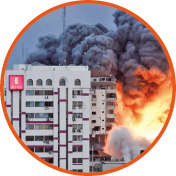 The timing of the Hamas group's launch of a ground offensive as well as a blitz-like air attack on Israel October 7, and the latter's start of retaliations on October 8 onwards, couldn't have come at a worse time. The Hamas attack later proved to be the cover for an infiltration of its fighters into Israeli soil around that time. Amid the threats of escalation in tension, especially in the Gaza Strip, the region now witnessing death and destruction caused by the Israeli bombardments. Israel is preparing for full-scale ground attacks, prompting the fear of a mass-scale exodus by the Gaza residents. On many occasions, the weaker Palestinians have had to concede defeat in battles against the powerful Israel. Israel held sway; and continued to persecute and, finally, annihilate the Palestinians. But on reaching the end of their tethers, Palestinians struck back with whatever weapons they could lay their hands on. It prompted the launch of the first Palestinian Intifada in 1987 --- a fierce form of frontal protests and confrontation. Many called it a milder form of 'guerrilla' warfare. The venues comprised mostly the Israeli-occupied territories, especially the West Bank --- filled with the daredevil Palestinian youths. The Oslo Accords signed in 1993 brought an end to the first phase of Intifada on the West Bank.
Following the occasional flare-ups of violent confrontations between the Gaza-based Palestinians and the Israeli army, there were few major signs of any attack from the Hamas-ruled Gaza Strip. The recent lighting air and ground attacks by Hamas on Israel took the Jewish state's military machine by utter surprise. It took only a day for Benjamin Netanyahu to opt for an effective option. He chose for an all-out retaliatory operation against the Gaza Strip residents, many being innocent civilians. The Gazans are not sitting idle. The death toll on both sides continues to rise.
In the history of Palestinian-Israeli hostilities, few have broken out amid a tense global situation marked by political and economic crises now besetting the world. The world at present remains almost overwhelmed by these grim developments. A few of the impasses may have led to polarisations having newer regional ramifications. Most of those are centred on the Russian invasion of Ukraine, and the US and European Union powers throwing their weight behind the former Soviet republic.
The following period of global recession prompted by sanctions imposed on Russia has complicated the situation. The last almost two years passing through different global fronts, especially those related to economy and the birth pangs of the new alliances, proved quite difficult. In such a global volatility, the Gaza-based Palestinian Hamas group's declaration of a war-like campaign has stunned many. Displacement of the Palestinians is about to start, which might result in the fanning out of these stateless people into different Middle Eastern countries. The process started in 1948, after the creation of the Israeli state followed by an all-out territorial war. In the midst of the explosive developments of the latest Hamas-Israel conflict, many wait eagerly to see how many of the new-generation Palestinian refugees are finally allowed to enter the recession-hit ME territories. In the present situation, many feel tempted to recall the bitter days of eviction of the Palestinian refugees from a couple of ME countries.
A total of 5.9 million Palestinians are currently registered as refugees by the authorities of international organisations like Red Cross. It's implied that following the escalation of tension in the Gaza Strip enclave, the number of would-be refugees is feared to increase manifold. Already a menacing threat came from the Israeli Prime Minister Benjamin Netanyahu when he said he would change the map of Middle East. It's worth noting that despite being beleaguered in internal politics, the Israeli extremist leader hasn't backed out from his hawkish stance. Given the belligerent attitude of the Israeli politicians and the military, the scattered Palestinians may have to be prepared for another phase of refugee life. In the present highly changed context, the refugees may have to fall into a more dreadful situation.
The scourge of Palestinian refugees is feared to return with fresh miseries. In a world radically different from the times of the 1970s, 1980s and the 1990s, new politico-economic realities continue to surface. The now-dismantled USSR and its allies who were steadfastly behind the Palestinian causes have long left the global scenario. The emergence of new global powers and their stances on the Palestinian statehood differ widely. The new geopolitical realities are identified as being responsible for these shifts. All this is responsible for the fraying of the integrity of the Palestinians' existence as a 'different nationhood' in the Arab world.
There is another aspect of the Palestinian reality which has been in existence since times of the PLO chairman Yasser Arafat. He enjoyed unflinching popularity among the general Palestinians; and also among the party rank and file. The death of Yasser Arafat at the age of 75 dealt a severe blow to the Palestinian interests. Apart from being uncompromisingly committed to the reality of Palestinian statehood, Arafat was pragmatic and accommodative. Many of the Palestinian leaders proved to have been gifted with just bellicosity, and their oratorical skill. Lots of experts ascribe the current plight of the Palestinians to this drawback, i.e. the absence of leaders having the outstanding qualities of Yasser Arafat. It's also true that despite their all-out attempts to ensure their safe survival in a land free of hostilities, the Palestinians have long been drawn into many an unwarranted situation. A few of those are known to be their own creation. Many have, however, been thrust upon them by outside forces bent on driving wedges between the leaders.
shihabskr@ymail.com