
Empowered yet unprotected
A journey through shadows and light
Farzana Nahid | Sunday, 8 March 2026
The progress of any nation is inseparable from the dignity, safety, and opportunities afforded to its women. A society may celebrate economic growth, educational achievements, and technological advancement, but its true measure lies in how freely and safely its women can live, learn, and lead. This reality invites a difficult yet necessary question-one that societies across the world, including Bangladesh, must confront with honesty: have we truly ensured equality and protection for women, or have we merely become comfortable celebrating their achievements while overlooking the insecurities that still surround their lives?
Each year, as the world observes International Women's Day, nations pause to acknowledge the resilience, determination, and contributions of women who sustain families, strengthen communities, and drive economies forward. Social media overflows with tributes, institutions organise seminars and panel discussions, and symbolic gestures of appreciation fill the public sphere. In Bangladesh, this day carries a profound resonance. It becomes not merely an occasion for celebration but also a moment of national reflection-an opportunity to recognize the remarkable strides women have made in education, leadership, entrepreneurship, and public life.
Indeed, the progress of Bangladeshi women over the past few decades is nothing short of transformative. A generation ago, many girls struggled to cross the threshold of a classroom; today they are excelling in schools, universities, and research institutions. Women are increasingly visible in corporate offices, development organizations, public administration, media, and academia. From rural classrooms to urban boardrooms, Bangladeshi women are contributing to national progress with determination, resilience, and intellect.
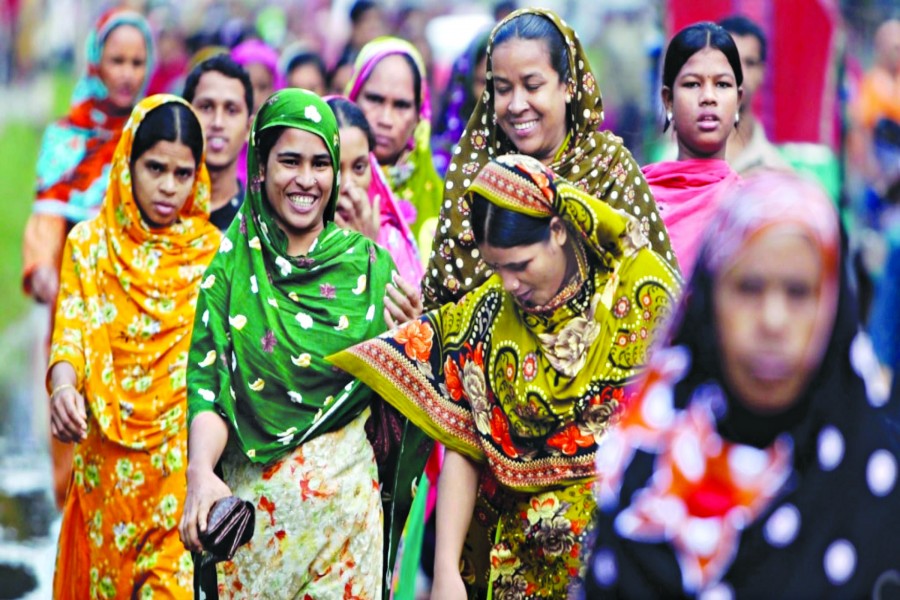
Perhaps no sector illustrates this transformation more vividly than the country's garment industry. Millions of women-many of them once confined to limited domestic roles-now form the backbone of one of Bangladesh's most vital economic engines. Their labor has not only propelled national growth but has also altered the social imagination of what women can achieve. For many families, a daughter's income has become a source of dignity, stability, and hope, gradually reshaping long-standing perceptions of women's roles within society.
Yet these advances were neither accidental nor effortless. They are the outcome of decades of struggle, social reform, policy initiatives, and the quiet yet powerful courage of women who refused to accept the boundaries imposed upon them. Over time, families that once invested primarily in the futures of sons have begun to recognize the promise of their daughters as well. The idea of gender equality-once distant and abstract-has slowly entered classrooms, workplaces, and public conversations, challenging norms that historically confined women to the margins of opportunity.
However, acknowledging these achievements must not prevent us from confronting a more complex and uncomfortable truth. The story of women's empowerment in Bangladesh is not one of uninterrupted triumph. Behind the inspiring statistics and celebratory narratives lies a reality that is far more layered and contradictory.
For many Bangladeshi women, empowerment exists alongside vulnerability. A young woman may excel academically yet still hesitate to walk alone after sunset. A professional woman may lead teams in her workplace while navigating unspoken expectations and social scrutiny. A girl may dream of becoming a doctor, an engineer, or a leader, yet grow up hearing subtle reminders about the limits society places on her freedom.
Thus, the narrative of progress, while genuine, remains incomplete. The empowerment we celebrate often shines brightly in certain spaces-schools, workplaces, and national statistics-while shadows persist in others. It is within this coexistence of advancement and insecurity that the true story of Bangladeshi women unfolds: a story of remarkable strength, but also of challenges that continue to demand our collective attention and conscience.
Yet, beneath this narrative of triumph lies an unsettling truth. While we celebrate empowerment, the stark reality of violence against women and girls looms large, casting a shadow over our achievements. Headlines frequently recount tales of despair-rape, harassment, domestic abuse, and exploitation-reminding us that many victims are innocent children, deprived of safety and trust in their formative years. These painful incidents often erupt in the sanctuaries meant to protect-the very homes and communities that should cradle young girls in safety instead become sites of violation.
This dissonance compels us to confront uncomfortable questions: If women are truly empowered, why do so many still walk in fear? If our daughters excel in classrooms and boardrooms, why do they remain vulnerable on the streets and even within their homes? If society pauses to celebrate women on one day, why does it neglect to shield them for the remaining 364 days? Such reflections do not diminish our accomplishments; rather, they challenge us to examine the depth of our empowerment. True empowerment cannot coexist with fear; education alone does not guarantee safety, nor does economic participation ensure dignity. Legal frameworks, while vital, cannot transform a society if the hearts and minds of its people remain unchanged.
The essence of women's empowerment extends far beyond employment statistics or enrolment figures. It embodies a society where a woman can traverse the streets without trepidation, articulate her thoughts without hesitation, and live without the incessant need to prove her right to exist with dignity. It signifies a world where the value of a girl child transcends academic success, recognizing her inherent worth as a human being. It calls for a generation of boys raised to respect women, not solely as mothers or sisters but as individuals deserving of equal reverence.
As the former United Nations Secretary-General Kofi Annan articulated, "There is no tool for development more effective than the empowerment of women." However, this empowerment cannot flourish where fear and violence persist. Achieving this transformation requires more than policies; it demands a profound moral awakening within our society. Families must emerge as the first bastions of equality, teaching children about respect, boundaries, and empathy-not through textbooks, but through the behaviours they witness at home. When sons observe their fathers treating women with dignity, they internalize that lesson. When daughters grow up in environments where their voices are cherished, they learn that their opinions hold weight.
Communities must rise to reject the culture of silence that too often shrouds violence against women. Victims, fearing stigma or social backlash, are frequently silenced, while society protects the perpetrators rather than the dignity of the harmed. True empowerment necessitates courage-from women and men alike. Institutions, law enforcement, educational bodies, and civil society must unite to ensure that laws protecting women are not just written but actively enforced. Justice must be swift, visible, and unwavering; only then can a culture of deterrence take root.
Perhaps the most significant transformation must occur within the collective conscience of society. Respect for women should not be a fleeting sentiment that surfaces each March but a daily practice woven into the fabric of our lives. Empowerment cannot be distilled into slogans or ceremonial events; it must be etched into our everyday existence.
As we gather to commemorate International Women's Day, we must pose a difficult yet vital question: What do we truly celebrate? Are we acknowledging progress while turning a blind eye to persistent injustices? Do we recognize achievements while remaining silent about the ongoing violence that shadows them? Or are we using this day as an opportunity for genuine reflection-a moment to measure how far we have come and how far we still have to journey?
Ultimately, the true purpose of this day transcends mere celebration; it demands conscience. It is a reminder that empowerment is not a destination we have reached but a pilgrimage we must continue. Bangladesh has shown the world that change is possible, demonstrating that extraordinary strides in women's education, economic participation, and leadership can be achieved when society chooses to move forward. Yet, the measure of a society's advancement lies not only in how high its women can rise but in how safe they feel while standing firm on the ground.
A truly empowered society is one where no girl fears the path home, no woman hesitates to voice her thoughts, and no victim is left in silence. Until that day dawns, International Women's Day must remain more than a celebration; it must be a clarion call to conscience-a reminder that empowerment is incomplete until every woman and every girl can live in safety, dignity, and freedom. Only then will the celebration be deserving of our heartfelt tribute.
Dr Farzana Nahid is the Director, Career and Placement Center (CPC) and Associate Professor, Department of Marketing & International Business, North South University. farzana.nahid@northsouth.edu