
Redirecting sustainable growth
A lens on regional growth in Islamic SME financing
Md. Touhidul Alam Khan | Saturday, 4 October 2025
Small and medium enterprises (SMEs) have persisted as vital engines of economic diversification and employment creation for the last few years. However, the rapid growth of this sector has accelerated remarkably with dedicated support of international institutions like the Islamic Development Bank (IsDB) and its subsidiaries. Such rigorous support to SMEs and entrepreneurs is a manifestation of the notable expansion of the Islamic finance industry to mobilize capital using Shariah-compliant financial instruments.
IsDB's role in strengthening economic resilience amidst a dynamic global horizon becomes evident with its commitment of US$ 40 million to Uzbekistan's resilience programme in January 2025, extending up to 2027. Another strategic step of the bank to augment SMEs is allocating US$30 million of the fund to Murabahah-based SME financing to foster business engineering and capacity-building initiatives.
Correspondingly, Turkey's SME financing has boosted due to the commodity Murabah facility through a US$ 145 million closing by Islamic Corporation for the Development of the Private Sector (ICD) for Turk Exim Bank in April 2025. The unbound possibilities this deal, supported by Gulf Cooperation Council (GCC), brings to Turkey's economic landscape is beyond question. The ICD protracted similar allocation of EUR 15 million to Credit Communautaire d'Afrique in Cameroon that will undoubtedly reinforce the continent's multisectoral investments.
More than 1500 SMEs profited from ICD's financing that exceeded US$ 663 million in 2024 only. In addition, the Sukuk market witnesses ICD's re-entry with a US$ 500 million that demonstrates its utilization of innovative Islamic finance mechanisms for the enhancement of the private sector.
Shifting towards regional scenario, the year 2025 has witnessed multiple intensive approaches witnessed by various financial institutions to empower SMEs in Indonesia, Iran, the United Arab Emirates, Egypt, Malaysia, etc. For example, Bank Indonesia and the National Committee for Shariah Economics and Finance hosted a collaborative event to promote Islamic financial inclusion for 85 MSMEs through digital platforms and targeted credit support. Iran, too, has fostered SMEs' access to capital by launching a digital platform facilitating short-term Sukuk Murabahah, supported by Novin Investment Bank.
Egypt and Malaysia also showcased the utilization of innovative Islamic instruments in diverse sectors. While Egypt's Shariah-compliant financing product, Wakalah Bil Istithmar, introduced by Fawry MSME has been an epoch-making shift within its ecosystem, Malaysia's strategy to support local merchants through low-interest financing, Halal certification and technological upgradation reflects its unwavering drive. OCBC Al-Amin Bank's RM 100 million Islamic Portfolio Guarantee-I further exemplifies efforts to empower indigenous and women-led enterprises.
An astounding strategy was showcased by the United Arab Emirates through its innovative financial technology initiatives. Tabadulat received authorization to provide Sharia-compliant investment services, successfully securing US$2.3 million in funding. Meanwhile, UAE Islamic bank Ruya collaborated with fintech firm Peko to launch an integrated digital platform aimed at simplifying multiple business processes, from registration to financial management.
The Kafalah SME Loan Guarantee Program that issued guarantees worth SAR 0.8 billion in Saudi Arabia paved the way for Shariah-compliant financing. With emphasis on SME Sukuk and infrastructure-related financing, a new Shariah-compliant credit fund in the country is set to raise SAR 1 billion (approximately US$266 million). Meanwhile, the partnership between open banking platform Tarabut and payment solutions provider Geidea are working to create tailored financing offerings, further broadening the reach of the financial ecosystem.
With an aim of enhancing financial literacy, entrepreneurship, and capacity-building efforts, Pakistan launched the Centre of Islamic Finance at the University of Agriculture Faisalabad. This initiative, developed in partnership with Meezan Bank played a remarkable role in shaping the evolving landscape.
Amidst the tide of Islamic SME financing mechanisms worldwide, Bangladesh also denies remaining static. The country's initiatives to expand access to Shariah-compliant financing for MSMEs is evolving its position as a growing hub for Islamic finance in South Asia. Numerous banks and financial institutions in Bangladesh are rolling out innovative Islamic banking solutions, specifically designed for micro, small, and medium-sized enterprises. These strategies are not only promoting entrepreneurship but also driving socio-economic growth in rural and marginalized communities.
Islami Bank Bangladesh PLC, the country's largest Islamic bank, has played a significant role in the stride, following the guidelines and regulations set by Bangladesh Bank, by focusing on key SME-oriented sectors and launching SME specialized and agriculture branches. The entrepreneurs of small businesses can now access them unhesitatingly as these branches aim to better their access to Shariah-compliant financing. Islami Bank Bangladesh PLC intends to launch more such branches in future to extend this support in additional SME-prone areas. The global SME market for goods and services enjoy more than $6 trillion worth of value yearly where countries like Vietnam, Thailand, and Malaysia hold significant shares. SMEs influence these shares essentially by 40% to 50% through their export sector.
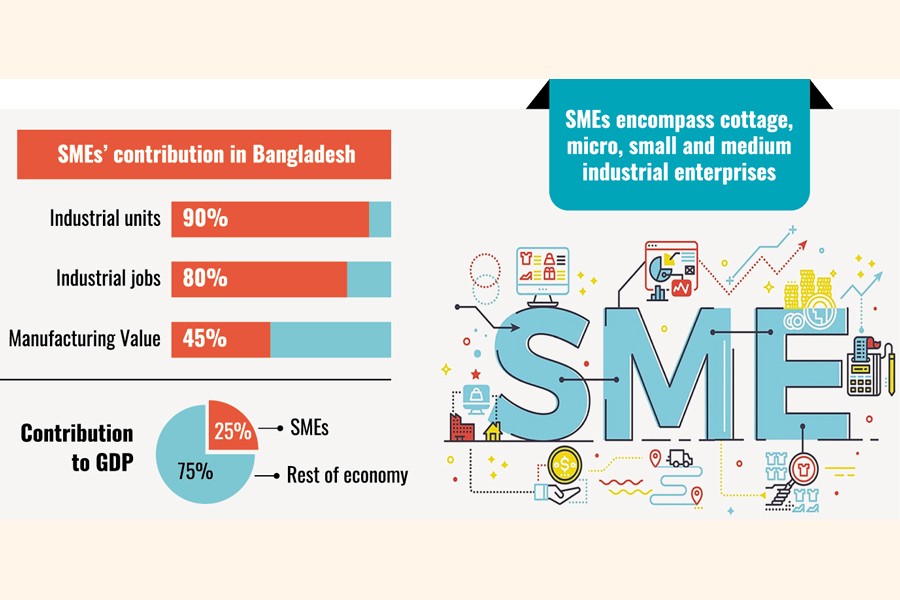
In the case of Bangladesh, the Small and Medium Enterprise (SME) sector plays a foundational role in the economy, yet remains underleveraged for export growth. SMEs encompassing cottage, micro, small and medium industrial businesses account for approximately 90 per cent of industrial units, contribute around 80 per cent of industrial employment and generate roughly 45 per cent of manufacturing value added. Despite this significant domestic impact, SMEs contribute only 25 per cent of the national GDP, highlighting a stark mismatch between their domestic economic footprint and the potential for export-driven growth.
The Islamic SME-Financing sector holds the possibility of rapid expansion in near future through collaborative efforts of syndicated Murabahah facilities, digital Sukuk platforms, targeted incubators, and microfinance initiatives. The ongoing partnership between multilateral institutions, regulatory bodies, and private entities will be vital in closing current financing gaps and further embedding SMEs into the Islamic financing landscape. With the advancement of the sector, maintaining the drive and promoting inclusive economic development globally will be its ultimate motto through innovation and adaptation.
Dr. Md. Touhidul Alam Khan is Managing Director & CEO of NRBC Bank PLC