
A life that refused to bow
Serajul I Bhuiyan | Wednesday, 31 December 2025
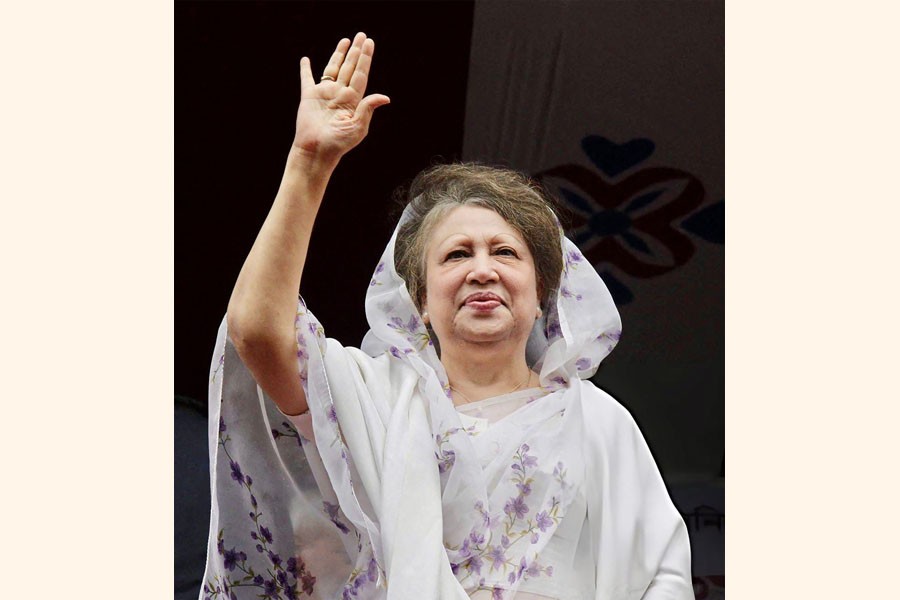
With the demise of Khaleda Zia (1945-2025), Bangladesh is not only bidding farewell to a former prime minister but also to an era. It is an era that encapsulates not only the political struggles but the moral fabric of this republic. It is an era born of resistance, an era in which its dreams of democracy were constantly challenged by attempts at authoritarianism. Rarely would one come across a leader in South Asia who not only resisted power but also suffered so much that could have been avoided by submitting.
Khaleda Zia’s life was a constant moral struggle, from the pinnacle of electoral success and her reign as state leader to years of political marginalization, imprisonment, and ill health. The politics Khaleda pursued was never expedient or set out to accommodate others. It was a politics that was defined by her endurance. She persisted when others retreated to the comforting path, when they kept quiet to remain within the sheltering walls of safety.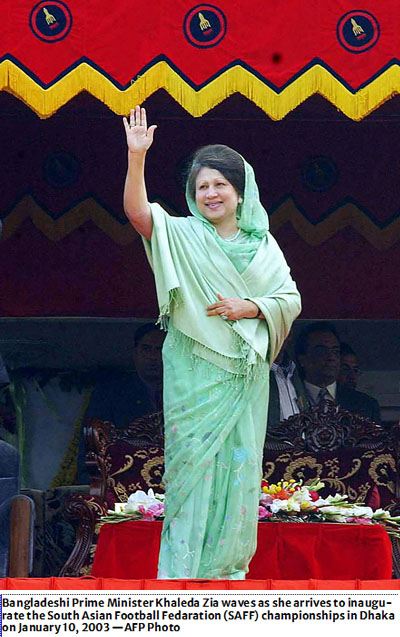 However, her political career was never merely a biographical journey through and within office. It was also characterised by street movements, popular campaigns, and protracted exclusion, making it an odyssey in which personal suffering was inextricably bound up with national politics. She paid a staggering price for challenging repression disguised as stability and for defying those who believed that democratic legitimacy must be extracted, not imposed, through coercive state power. It is, therefore, essential that this article resists biographical form and function, taking up instead the task of analysing Khaleda Zia’s leadership style and symbolic legacy at a moment in which backsliding in democracies has become an explicitly global problem.
The Private Citizen to Political Flag-Bearer: History does not make people great. People make history. Khaleda Zia’s entry into politics is not to be ascribed to any personal ambitions; in fact, history called her to do so. After the assassination of President Ziaur Rahman, there was political turmoil in which Bangladesh stood at a crossroads, where stability and legitimacy in politics were lost. At this moment of national tragedy and crisis, Khaleda Zia appeared not only as the guardian of political ideology but also as the embodiment of people’s aspirations to embrace diversity and constitutionalism.
Her ascendance challenged the deep-rooted stereotypes in a traditionally patriarchal political setup. She did not require extensive politicking, as politics did not predominate in her ideology. She learned politics the hard way through mass politics, rebuilding an organisation, and constantly engaging in election battles. This practical learning gave shape to her political style, which is characterized by instincts, tenacity, and moral fiber. What she lacked in structured learning is made up for by tenacity in politics and an intuitive grasp of people’s feelings.
Leadership Ethos: Khaleda Zia, as the Prime Minister, operated in a highly polarised and fragile institutional setting. It is important to note, of course, that her administrations have neither remained untouched by circumstances of controversy and incompetence, and there will, of course, be debates about the outcomes of her policies in the annals of time. However, merely measuring her administration on the technocratic yardstick of governance and administration will miss the bigger picture of what she brought to the table.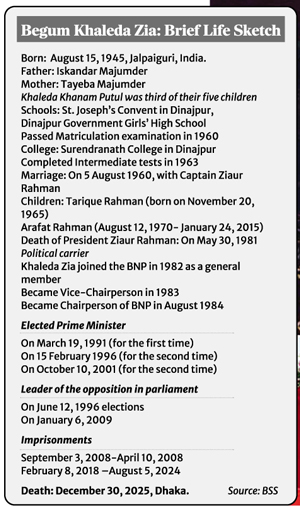 However, the most important thing she achieved was to maintain the element of competitive democracy, the notion that power is a contestable thing and that it finds its legitimacy in election results. Indeed, even after losing power, she refused to accept either co-option or silence—that is, either the managed democracy in its co-optionist variant or the negotiated irrelevance in its managed variant—and even refused to legitimise political processes, choosing, on the other hand, to accept political isolation and persecution in exchange for upholding the notion that a vital democracy requires a credible opposition.
Resistance Under Repression: Khaleda Zia’s latter years are emblematic of a sort of resistance that overcame the boundaries of public office itself. She was imprisoned for extended periods of time, denied proper medical treatment, and barricaded from society as a whole when she became the embodiment of Bangladesh’s diminishing democratic sphere itself. Her incarceration was meant to punish but also to eliminate, to make opposition impossible. However, repression led to the exact opposite. Her imprisonment brought her greater renown, making her a moral beacon. She was silenced but not eliminated from the political consciousness, symbolizing the very thing a regime like the authoritarian state loathed: the people’s legitimacy rather than the state’s.
A Woman Against the Tide of History:
In South Asia’s politics, women succeed in power but never redefine its moral syntax. Khaleda Zia did both. She made feminine rule a reality in a conservative setup and then redefined leadership as a virtue of endurance over being a show of bravery. That was leadership in composure. She eschewed rhetorical flourishing and ideological extremism in favor of showing how commitment might be a political discourse in itself. The common man saw in her suffering an echo of their own limited freedoms. It was through such an identification that she sustained her link with the people.
The Moral Architecture of Steadfastness: Khaleda Zia’s leadership philosophy has never been performative. Her approach always stems from her firm belief that popular will is not imposed by institutions but by mass consent. This is in contrast to the norms of some of her modern-day contemporaries, whose discourses were flexible enough to suit shifting power equations but refused to take shortcuts that went against democratic principles in politics. This commitment was especially evident in her opposition politics. She refused to take part in choreographed elections, rubber-stamp parliaments, and the semblance of democratic processes altogether not because she was obstructive, but because she opposed the normalization of authoritarianism. Doing so posed a clear but subtle philosophical stance: democracy sans choice was not democracy.
Refusing the Comfort of Compliance: Khaleda Zia’s politics have been characterised, among other things, by her refusal to be accommodated. In authoritarian politics, legitimacy is very often maintained through selective incorporation, in which opposition leaders are granted room, power, or shelter in exchange for their compliance. Khaleda Zia refused such an offer. It marked her apart from leaders who absorbed the imperatives of authoritarian order. Arousing suspicion and defiance, she recognized that to comply, whether through pragmatism or not, undermines institutions and public confidence in them. By operating beyond the structures that would console and legitimize the wielding of power, she built her strongest suit on distance.
Politics Under Repression: The latter years of Khaleda Zia’s life were characterised by increasing repression legal harassment, imprisonment, and delegitimisation. Nevertheless, even in those circumstances, she did not renounce her position or legitimize narratives of repression as a guarantee of stability/development. Her silence became proof, her endurance resistance. In an authoritarian regime, power demands not only compliance but also validation. Khaleda Zia denied it both.
Leading Without Compromise: What is remarkable about Khaleda Zia in Bangladesh’s political history is not that she was an opposition leader but rather in how she led that opposition. Khaleda Zia led with restraint, with equanimity, with dignity. This is not a quality that is normally associated with being an opposition leader. It is likely that people who oppose governments tend to find it.
Refusal to resort to demagoguery and mindless escalation maintained a crucial moral boundary in national politics. Leadership without compromise meant her adherence to the ideology of democracy, even in the face of personal comfort provided by compromise. It was not inflexibility; it was integrity.
The Gendered Burden of Defiance: Khaleda Zia, as a female leader of a massive political movement in a deeply patriarchal society, faced an additional level of scrutiny and resentment. Arrogance was what her dignity was often equated with, and obstinacy what her firmness was equated with. However, she remained undeterred, redefining what strength in leadership entails. It was her ability to hold her head high under pressure and to resist becoming a victim that gave her stature beyond the political divide.
Legacy - Dignity as Democratic Memory: The legacy of Khaleda Zia cannot be reduced to electoral cycles or administration. This is a moral memory of a people, by and large, when the spirit of democracy wavered, with fascist tendencies finding expression. She passes on to posterity a lesson which seems to be increasingly lost on contemporary politicians: that dignity is not a decoration of power, but its ethical foundation; that leadership is not defined by survival in unjust structures, but by ability to stand apart from them.
an Uncompromising Leader: From the period of military rule to the opposition, Khaleda Zia remained steadfast in her opposition to autocracy and hegemony. National sovereignty is precious to her rather than party politics or personal rule. Khaleda Zia’s unswerving nature in politics earned her a long-lasting reputation in the country as the “Uncompromising Leader” in Bangladesh politics, with her prolonged fight in democracy as one of its defining events in history.
History will judge her policies and her alliances. It is a necessary exercise. But history will also remember something that cannot be measured in numbers: her willingness to resist when it was easier to capitulate, when it was safer to do so, when it was also far more profitable. When a country’s opposition is fractured and cowed, her life reminds us of a fundamental tenet of democracy: resistance, no matter how defeated, draws the lines of morality in a nation.
Beyond Death: Khaleda Zia’s death does not make her less relevant; it merely arrests it. Her existence is a question: Can democracy coexist without opposition? Her politics of dignity is an opposition narrative that is silent yet very strong in opposition to the normalness of authoritarian politics.
Non-negotiation in leadership, she illustrated, comes at a price: isolation, repression, and a steep personal cost in terms of health and even life. However, it also sustains a far more precious quality than power: the integrity of democracy itself. Khaleda Zia paid the price of liberty in exchange for her liberty, her health, and her life itself. Doing so, however, has secured Bangladesh’s democratic legacy it will not be forgotten; it will survive in the annals of conscience, not in power.
Dr Serajul I Bhuiyan is a Professor of Journalism and Mass Communications at Savannah State University, Georgia, USA. sibhuiyan@yahoo.com