
A national action plan brooks no delay
Rahman Jahangir | Thursday, 27 November 2014
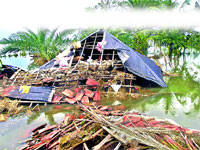
The issue of imminent grave fallout of climate change on Bangladesh is nothing new. Seasons are changing. Hundreds of seminars and studies have already identified the country as the most vulnerable one in the world facing adverse effects of climate change. All these highlight the need for total national mobilisation to adapt to the fast changing climate and mitigate the adverse effects of the freaks of the nature. This can only be done through a coordinated manner under a National Action Plan (NAP).
When a farmer needs rains, drought lingers. Rivers are drying up, sapping up sources of water for irrigation and household chores. When a farmer needs a certain degree of heat for better crops, he gets just the reverse. The last few months saw heavy rains at a time when such rain was scarce in the past. Even late last month, all on a sudden cold winds started blowing everywhere when winter is yet to set in. Only the farmers know where the shoe pinches. He now badly needs to adapt to such fleeting changes.
It is painful that Bangladesh is yet to wake up from slumber with regard to climate change. Needed now very badly is the adoption of the National Action Plan (NAP) in this regard. Although a draft plan was recently formulated and discussed, it is yet to be publicised well for scientists, researchers and farmers to savour and give suggestions.
Experts have already emphasised the need for launching a robust consultative process in formulation of the real NAP in a participatory, inclusive and inter-ministerial process based on science with clear baseline, modeling and future projections on different time scales and various temperature scenarios. They also have called for aligning the NAP with the 7th Five-Year Plan, sectoral plans and policies as well as Sustainable Development Goals (SDGs), a framework on disaster risk reduction. They have put emphasis on formulation of local and city adaptation plans with clear implementation, monitoring and evaluation process and institutional, financial and technological arrangements.
Even a recent British study has put Bangladesh at the top of the list of 32 countries in terms of colossal damage set to be caused by climate change. But it does not evoke any surprise. The study by research group Maplecroft says countries facing threat from climate change all depend heavily on agriculture, which accounts for 28 per cent of their combined economic output relying on farm-related revenue and 65 per cent of the working population employed in the sector. The study warns of the greatest danger of civil conflict due to the climate risk combined with food insecurity which acts as 'threat multipliers'.
Whatever funds Bangladesh has mobilised so far are in some cases being misused. Corruption has been reported in most cases. Even environment and forest minister Anwar Hossain Manju has admitted the fact and said he is trying to regain his ministry's image lost because of allegations of ministry officials' involvement in illegal logging, clearing forest and gobbling up project money. The minister also admitted that the allegations about the mismanagement of climate fund were not without a basis.
"Not all the allegations of misusing climate fund are wrong. We have found a project in which money was allocated but we do not know the current status of the project," the environment minister said at a seminar organised by the Transparency International Bangladesh (TIB). Mentioning that the case is being investigated, the minister said his ministry has taken initiatives to audit all climate projects to ensure transparency in expenses so that the donor agencies do not have any confusion regarding climate finance governance.
It is time that the government forms a high-powered climate financing commission comprising public servants, climate experts, representatives of affected communities, civil society members and media personnel. The Transparency International Bangladesh (TIB) has also asked the government to bolster diplomatic efforts to get grants and aid committed by donors.
Bangladesh has two climate funds - the Bangladesh Climate Change Trust Fund (BCCTF) and the Bangladesh Climate Change Resilience Fund (BCCRF). The first one financed by the government and the second one by donors. Starting from 2010, the Bangladesh government on its own has allocated Tk 27 billion till 2013-14 fiscal. Sixty-six per cent of the fund was allocated to different short-term projects. The remaining 34 per cent has been reserved to tackle aftermaths of disasters, should there be any. As for the foreign funding, Bangladesh has so far received $188.2 million of which $146.2 million has been released. The TIB recommended that the government bring rationality and coordination in fund distribution.
The local government, rural development and cooperative ministry is implementing 30.7 per cent of the total fund, the energy, power and mineral resources ministry 17.5 per cent, the water resources ministry 16.9 per cent while the ministry of women and children affairs got an allocation of only 0.1 per cent of the fund.
The fallout of climate change will be of catastrophic nature. Only the other day, a seminar organised by the Palli Karma Sahayak Foundation (PKSF), which liaise with grassroots level rural poverty alleviation organisations, was told that Bangladesh is not properly handling money that has been allocated for adaptation and mitigation of climate change.
Senior minister Rashed Khan Menon, who addressed the seminar, complained about wastage of allocations made for meeting the challenges of climate change. There are reports of corruption in different projects undertaken so far, he regretted.
Well-known economist and PKSF Chairman Quazi Kholiquzzaman Ahmed has complained the money for facing climate change is being misused. "There's a lack of transparency in this regard, "he told the seminar.
Bangladesh is set to suffer more from climate change by 2025 than any other country. Rising sea levels, severe storms and other extreme climate-related events will also threaten the future of the country's capital Dhaka.
Maplecroft's 2013 Climate Change and Environmental Risk Atlas reveals that 31 per cent of global economic output worth US$ 44 trillion is likely to face 'high' or 'extreme' risk as a result of global warming. "With global brands investing heavily in vulnerable growth markets to take advantage of the spending power of rising middle class populations, we are seeing increasing business exposure to extreme climate related events on multiple levels, including their operations, supply chains and consumer base," said James Allan, one of the authors of the report.
While the news that Bangladesh is at high risk may not surprise many analysts, the country's government appears increasingly concerned at its acute vulnerability to climate change. In 2010, Prime Minister Sheikh Hasina opened a climate adaptation fund amid fears the country will face devastating storms on an annual basis. Of particular concern to the business community are the growing risks faced by the world's leading emerging economies, China and India. By 2025, China's GDP is estimated to treble from current levels to $28 trillion, while India's is forecast to rise to $5 trillion - totaling nearly 23 per cent of global economic output between them. Maplecroft says China's manufacturing heartland, encompassing the cities of Guangzhou, Dongguan and Foshan are among the most exposed to physical risks from extreme climate- related events.
The Bangladesh prime minister is equally concerned. She took up the issue at the UN General Assembly's 67th session wherein she told the international community that no challenge is as complex, widespread and formidable as climate change to countries like Bangladesh. Referring to a recent Asian Development Bank (ADB) report, she said, the report estimated the mean economic cost of climate change and adaptation for Bangladesh to be between 2 per cent and 9 per cent of GDP by 2100.
One degree Celsius increase in temperature is estimated to a meter rise of the sea-level, submerging a fifth of Bangladesh. That might force 30 million of our people to move elsewhere as 'climate migrants'. For Bangladesh, climate change is a matter of bare existence. Sheikh Hasina said, adaptation remains particularly key for us. "We have a crucial need for adequate, predictable and additional climate finance, access to locally-adaptable technologies, and support to capacity and institution-building," she said.
Disasters due to climate change can hit any time and at any place. But always the poor people are hit the hardest. And for poor people, climate change is not just another cause of economic loss. It threatens the very possibility of their escape from poverty. If poor communities in Bangladesh do not adapt to a changing climate, these events could well keep on increasing their distress.
...............................................................
The writer is Editorial Consultant of The Financial Express.
arjayster@gmail.com