
A nation's pledge to never relive the darkness
Serajul I Bhuiyan | Wednesday, 28 January 2026
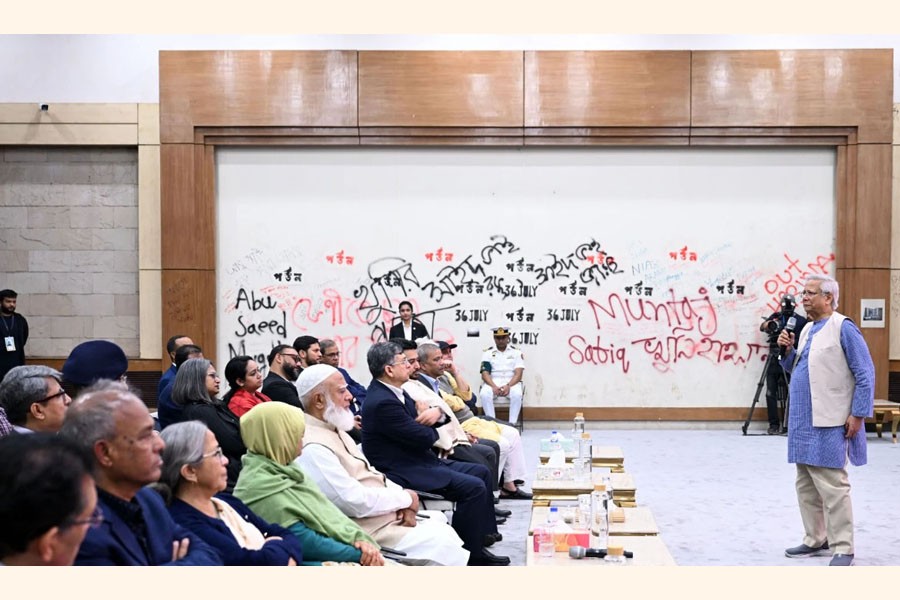
When Professor Muhammad Yunus stepped through the corridors of the July Mass Uprising Memorial Museum, the act itself transcended the protocol of a state visit. This was not a symbolic tour or a courtesy call on the museum. This act itself is a statement of historical accountability. In a nation that has just liberated itself from a period of authoritarian rule, moments such as these become a crucial test of a society’s determination to face up to its darkest moments or to let those moments be blurred, distorted, and ultimately effaced. Bangladesh, in opening itself up to a museum such as this, has made a statement about facing up.
The museum represents a clear-cut turning point in the political evolution of Bangladesh the July 2024 mass uprising that signaled the end of a regime maintained through fear, oppression, and the deliberate dismantling of a democratic framework. That uprising was not a random incident of unrest but the endpoint of a series of forced disappearances, repressed freedoms, rigged elections, and government-backed intimidation that had cumulatively weakened the democratic ethos of the republic for so long. In keeping with a democratic ethos that resists a common authoritarian trend to rewrite history with a change in government, the museum freezes a truth in time so that the horror of the past is not only preserved but made visible, indubitable, and exemplary so that Bangladesh’s democracy is restored on a foundation not of forgetting but of remembering.
Sixteen Years of Systematic Democratic Erosion: The displays do not allow any ambiguity in determining what form of politics was in place prior to the July uprising. Bangladesh had been experiencing a failure of governance in isolation for sixteen consecutive years under a non-democratic regime headed by Sheikh Hasina, when what transpired was a progressive erosion of its democratic character, in which its forms had been retained.
The parliament, which was conceptually designed as the highest accountability mechanism of the people, was reduced to a rubber-stamp parliament with scripted debates and marginalised opposition. Elections, which were the bedrock of people’s sovereignty, were turned into ritualistic exercises marked by voter intimidation, uncontested seats, challenged mandates, and a lack of public credibility. Independent election observation, both domestic and foreign, raised several concerns, which were considered interference from hostile elements.
The judiciary and law enforcement bodies, the very foundations that were expected to safeguard the citizen from the abuse of power, became increasingly politicised. The rule of law became the norm, where opponents were subjected to prolonged persecution through the law, while supporters were granted complete immunity. The security apparatus became an instrument of political control, further entrenching a culture of governance by fear rather than consent.
This is carefully chronicled in the gazettes, court cases, and news coverage of the time, but most importantly through the testimony of victims themselves. Such evidence points to a system in which dissent is made a crime, peaceful protest is labelled sedition, and alternative political discourse is deemed a threat to national security. The violence and repression were not anomalies but were instead intentional and systematic.
What comes from this archive is not the image of careless misrule or incompetent management. Rather, it is the dissection of a meticulously planned authoritarian intent to wield power, nullify opposition, and secure domination through the façade of electoral mandate. Through the revelation of such intent, the museum fulfils the crucial role of a democratic institution, laying bare the mechanisms by which democracy can be eroded step by step and the importance of vigilant, not complacent, citizenship as the true guardian of liberty.
Enforced Disappearances as a Policy of States: One of the most tragic parts of this museum has to do with enforced disappearances, which are perhaps the most terrifying feature of a fascist regime. This part of the museum has been brought to life by groups like Mayer Dak and by people like Barrister Mir Ahmad Bin Qasem Arman.
These were not isolated incidents of individual misbehaviour. The modus operandi of abduction at midnight, denial of custody, prolonged silence, and then reappearance or death suggests an institutionalised process that occurred with impunity. The international community of human rights organisations has been aware of this for years, but it took the uprising to bring about an end to this culture of fear. By preserving these accounts, the museum makes enforced disappearance a matter of history, not of politics.
Where Fear Switched Sides: The July uprising is at the centre of this museum’s moral universe. Images and videos capture young, ordinary people facing armed forces with only their belief in their hands. The July Uprising was significant not only in its numbers but in its nature: overwhelmingly peaceful, youthful, and moral. It was through the student movement that the nation’s conscience emerged. They rejected the idea that oppression is the norm. The defiance by the students showed an important aspect of democracy. A dictatorship will fall not when it runs out of guns, but when it lacks legitimacy. The defiance shown by the students in July removed the invincibility myth that protected the government.
The Aynaghar: Perhaps the most chilling and soul-crushing part of this museum is its recreation of the Aynaghar, the secret prisons of interrogation that have come to embody the blackest moments of repressive violence. These were no ordinary cells for holding people in legal custody. They were designed as zones of psychological dismantling, as places to destroy not just the body but the spirit as well. They were windowless and acoustic-tight, places where time and space were erased, and thus a form of punishment that existed outside the purview of law and humanity.
In this small cell, the prisoners were left to endure the torture of isolation, sensory deprivation, and complete uncertainty about the reason for their detention, the duration of it, or if they would ever again feel the rays of the sun on their skin. Even the identity of the prisoners was destroyed, as their names were replaced by silence, their dignity was replaced by fear, and their hope was destroyed to leave only despair in its wake. The Aynaghar was no accident of excess but was instead an instrument of terror to silence the dissent in the heart of the individual.
To be inside Aynaghar, even if it is only for a brief period, is to shrink the distance that separates history from the present moment. It is to experience, if only fleetingly, the crushing burden of fear and loneliness that once characterized the lives of so many imprisoned there.
At that point, the tourists stop being mere spectators of history and become witnesses to it. The Aynaghar holds a lesson that no textbook can, and that is that authoritarianism is not merely a political ideology but a reality of humiliation, loneliness, and dehumanization. By holding on to these sites, the museum ensures that the pain suffered there is not forgotten or negated, and that future generations learn, in their flesh and in their minds, why such sites should not exist in a democratic Bangladesh.
Evidence, Not Rhetoric: Perhaps the strength of the July Mass Uprising Memorial Museum lies in its refusal to compromise on fact over opinion. The July Mass Uprising Memorial Museum is not a museum of slogans or of opinionated claims of what ought to have been done; it is an archive of truth. Every room of this museum is grounded in an archive of artefacts that has an authority that no political speech ever will. They form an archive of truth that makes denial impossible.
The walls are also filled with newspaper articles from around the same time that are quite censored but reflect a certain consistency of oppression, disappearance, and violence. Alongside these are government files: court documents that went nowhere, detention documents that acknowledged detention but denied accountability, and correspondence marked by silence and circumlocution. These are the paper trails of authoritarianism, the documents that reveal how violence became institutionalized through process and paper.
But no less chilling is the personal effects exhibit. The blood-soaked robes of martyrs, left as they were when they were uncovered, shock the viewer to the realization of what has been lost to state terror. The handwritten letters—a few secreted out of prison cells, others penned in the final hours of life recapture the voices which regimes sought to extinguish once and for all. The letters are full of longing, not for revenge, but for family, freedom, and a homeland which might someday reveal its children’s fate.
The evidentiary value of this is reinforced by the museum’s vast audiovisual collection. Unedited video recordings reveal the peaceful protesters being fired on, security forces moving against unarmed crowds, and the ensuing chaos that erupted as a result of orders being given with impunity. Audio recordings capture chants from crowds, final telephone conversations, and unvarnished, very moving survivor accounts. History is not merely told here but is heard and seen.
Youth, Memory, and Democratic Education: The importance of the July Mass Uprising Memorial Museum lies not only in the gesture of remembrance itself, but also in its transformative power as the national institution of democratic education.
Within those walls, Bangladeshis learn a truth that no civics book could possibly impart: that democracy is not a legacy received unchanged from the past but a hard-won gain that each generation must fight to preserve. This truth is imparted through lived history—the voices of students who led the July uprising, the pictures of unarmed youth facing off against guns, the personal belongings of those who made the ultimate sacrifice for their voices to be heard. All these stories reinforce that political action does not spring from power or privilege but from conscience.
Through this institution of collective memory, the museum serves as a bulwark against historical revisionism. The July Museum makes it impossible for future generations to be convinced of the exaggeration of repression, the existence of forced disappearances as mere fiction, or the pointlessness of any form of resistance against the state. In newly freed societies from authoritarian states, this form of revisionism is not uncommon as a means of reviving discredited power systems.
More importantly, the museum fosters critical citizenship. It calls upon students, scholars, and artists to examine how democratic systems fail, how fear becomes normalized, and how silence becomes complicity. In so doing, it makes memory a living resource—one that shapes debates over policy issues, inspires artistry, and forges a political culture grounded in accountability and empathy. Only if Bangladesh is to sustain its democracy will its youth be taught not only about the promises of freedom but also its losses as well.
Never Again: Finally, the July Mass Uprising Memorial Museum is more than a museum of memory; it is a symbol of democracy between the state and the people. The museum will be a reminder of the fact that Bangladesh will no longer normalise violence, rationalise oppression, or sacrifice hard-won freedom, an integral element of democracy. The museum remembers the truth about the damage inflicted on the country by authoritarianism. This is a democracy’s first truth: Liberty exists only where vigilance is ever present. Where silence prevails, injustice triumphs. So long as this museum stands unwavering in its evidence, uncompromising in its truth, and deeply humane in its narratives, so long will Bangladesh’s democracy have a guiding star that points unwaveringly away from the darkness of its past. It will serve as a reminder to each and every generation of the terrible cost of forgetfulness: repetition, and of the ultimate responsibility of a free people not simply to remember what has happened but to see to it, in word and deed, that it never happens again.
Dr Serajul I Bhuiyan is a professor and former chair of journalism and mass communications at Savannah State University, Savannah, Georgia, USA.
sibhuiyan@yahoo.com