
A paean for youth: Bangladesh context
Shihab Sarkar | Thursday, 27 November 2014
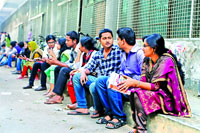
Since the march of civilisations began, youth has been regarded as the prime time in one's life. It is the age of setting sails, i.e. throwing oneself into the uncharted territory with the resolve to overcome all hurdles. This is time for facing up to challenges, unforeseen adversities, and, finally, tasting victory. Many a conquest and heroic feat have been accomplished during youth. In the world of arts and letters, philosophy and science a lot of legendary greats reached the zenith of their careers at this crucial period of life.
Coming to people on the mundane plane, too, we watch how youth has been given a special place in man's life. On the other hand, in many social milieus the most vibrant, creative and productive age in human life just dies away. To their misfortune, the youths in different societies remain unsung and neglected -- giving way to both despair and anger. In the modern times, they are increasingly being deprived of their due rewards. Many find themselves eventually on the fringes of society. This is encountered mainly in the developing world. Bangladesh is among them on several counts.
With the progress in their economies and statecraft, the richer countries have long been capable of efficiently utilising the energy, creativity and the productivity of the youths; their young population in general is assured of opportunities coming from state establishments. The better placed emerging nations have also realised the need for tapping the latent potential of their young people. It is the developing countries, like Bangladesh, where the strength of youth is not properly utilised. Many of these countries have formal provisions that might enable the governments to make use of the potent force of the youths. But the openings are, finally, found to be lying trapped in policy-papers only. To scores of youths, these ritualistic formalities hardly carry any purpose. The only outcome that results from the state-sponsored ventures is benefiting a select few. In Bangladesh and many other Third World countries, these benefits include rewarding the youths who appear to be faithful to the powers-that-be or the vested interests. Thus the great resource of youth is frittered away by the governments at the helm.
That Bangladesh has all along been failing to turn its youths into a formidable force needs no elaboration. At times, those in power deal with the country's young people insensibly. Our successive governments remain conveniently oblivious of the fact that it is the very youths who played the most decisive role in the nation's Liberation War in 1971. Without the resolve and courage of the then younger generation, the nation's cherished goal of freedom might have been left unmet. The youths of that period have reached their middle-age, the time for reflections on, as well as a dispassionate judgement of their heroic deeds four decades ago. Who will understand the value of youth better than the young people of the yesteryear?
To our woes, we have miserably failed to cater to what our youths require for a decent and meaningful survival. It becomes amply clear in a recent ESCAP (Economic and Social Commission for Asia and the Pacific) survey on the youths in the region. The study, which also included Bangladesh, observes that more than 80 million people in the Asia-Pacific region are unemployed. It finds that the young people are seven times more likely to turn unemployed than the adults. The UN agency identifies 'frustrating consequences' of this high incidence of joblessness, which will also impact on the next phase of the universal development agenda. The survey was placed at a meet in Bangkok under the title Asia-Pacific Forum on Youth Volunteerism to Promote Participation, Development and Peace. The meet was organised by ESCAP in collaboration with UNESCO, Global Peace Foundation and Global Young Leaders Academy. Representatives from government agencies dealing with youth-related issues, civil societies and development partners and the private sector took part in the meeting.
Shifting away from the conventional thrust on economic empowerment, the ESCAP colloquium has focused on a wider area. It comprises the fields in which the young populace of the region may find itself engaged fruitfully. Befitting the demands of new realities in the twenty-first century, the meet stressed enhancement of partnership in the sectors of environment, health, disaster response, peace and development, entrepreneurship and education. With many countries in the ESCAP region now out of the LDC (Least Developed Country) category, and a few others donning the sobriquet of emerging economies, they have cogent reasons to put emphasis on issues beyond the confines of pure economy. From a casual point of view, the inclusion of Bangladesh in such an upscale forum might obfuscate people acquainted with the country's realities. But, then, the ESCAP-sponsored meet has underscored the need for shaping a shared destiny. As the UN regional commission's Executive Secretary Dr Shamshad Akhtar put it, "Harnessing youth energy, enthusiasm and expertise is vital for global and regional productivity and prosperity. For ESCAP and the United Nations, a dynamic youth agenda is vital to ensuring the success of post-2015 sustainable development."
Bangladesh has a great stake in the achievement of sustainable development goals (SDGs) following its engagement in the programme of millennium development goals (MDGs). The moot point should be ensuring a positive change in the lot of our youths, and a better future for them. A holistic regional stance will take a lot of burden away from an individual country's ventures in youth development. It will not mar a country's home-grown drive for the uplift of its youth resource.
Yet a much-lagging country like Bangladesh ought to address individually some of the typical problems facing its youths. Being an LDC, the realities of Bangladesh are quite unique to it. The large population, widespread unemployment, though declining, among both male and female youths, little entrepreneurial breaks, early marriage of girls etc have played dominant roles in the country's socio-economic matrix. Besides, the history of Bangladesh is strewn with events that do not resemble those of other Asia-Pacific nations. Its socio-political, as well as economic and cultural, realities are different. Moreover, its goals in global perspective also are not similar to many of the region's nations.
Bangladesh population comprises a sizable number of youths. In spite of their pervasive marginalisation and the following despondency and moral deviations, our youths have all along shown strong and unequivocal commitment. It is one of overcoming hurdles and hostilities. They proved it in 1971 and on many occasions in the later days on socio-economic fronts. Those in power should stand by this indomitable force, and explore its untapped prospects.
.............................................................
The writer is Associate Editor of the Financial Express.
shihabskr@ymail.com