
RAJSHAHI'S PABA UPAZILA
A remote village hanging on to the century-old clay craft
OUR CORRESPONDENT | Tuesday, 14 April 2026
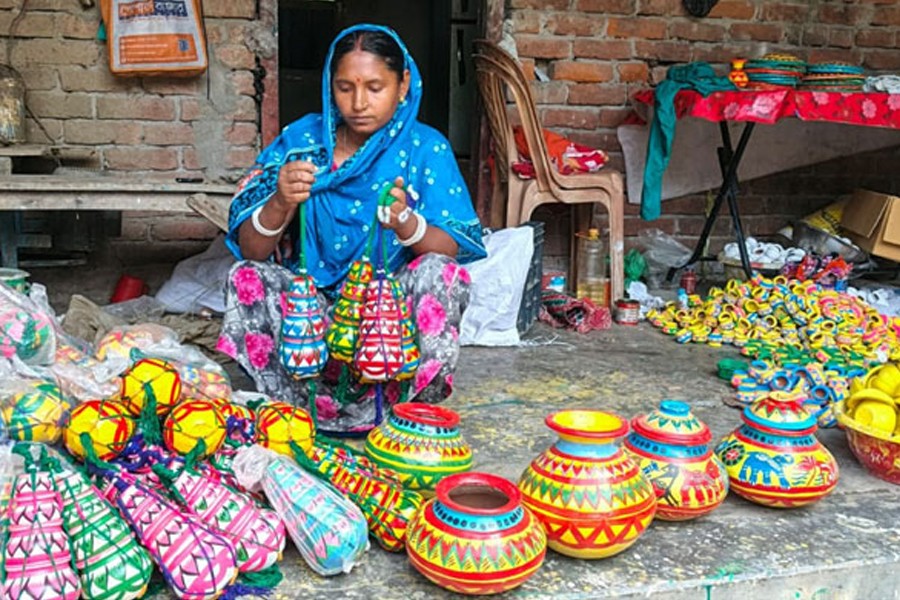
RAJSHAHI, Apr 13: With the Bangla New Year Pahela Baishakh around the corner, a small village in Rajshahi becomes vibrant and exciting with colour and activity.
In Bosontopur village under Nowhata municipality in Paba upazila, artisans are working tirelessly to produce shokherhari-traditional decorative clay pots that once played an integral role in rural Bangal's daily life.
Courtyards are filled with pots kept in rows for drying in the sun, while artisans carefully paint intricate designs.
The Bangla New Year brings a seasonal surge in demand, offering a short-lived economic boost to families engaged in this declining craft. Traditionally, shokherhari served both functional and cultural purposes. They were used for storing food and sweets and were commonly presented as gifts during weddings and other social ceremonies. However, their practical use has diminished over time due to the widespread availability of plastic, glass, and metal products. Today, these clay items largely survive as decorative pieces and symbols of cultural heritage. The pottery tradition in Rajshahi, particularly in the Barind region, dates back centuries. Once sustained by thousands of artisan families, the sector has shrunk drastically. In Bosontopur's Palpara, where almost every household was once involved in pottery, only a single family now continues the production of shokherhari.
Sushanta Kumar Pal, a veteran artisan with nearly 38 years of experience, is among the last bearers of this tradition. His work has earned recognition both at home and abroad, including participation in exhibitions in Japan, Sri Lanka, and Nepal. Despite such achievements, he says the craft offers little financial security.
"This craft has given me identity, but not stability," he says, citing limited market access and inconsistent income as key challenges. The production process is labour-intensive and involves the entire family-from preparing clay and shaping pots on the wheel to drying, firing, and painting them.
Demand peaks ahead of Boishakh, with prices ranging from Tk 20 to Tk 1,000, but declines sharply after the festival season.
The lack of year-round demand, combined with declining interest among younger generations, poses a serious threat to the sustainability of the craft. Many young people are unwilling to pursue a profession with uncertain income. Artisans also point to inadequate marketing, limited government support, and the absence of structured market access as major barriers to growth.
Each shokherhari reflects elements of rural Bangla, featuring motifs such as lotus flowers, paddy sheaves, fish, and birds. While modern acrylic paints are now used, traditional design patterns remain largely unchanged.
Industry observers believe the sector still has potential if properly supported. According to Safiuddin Ahmed, president of Sujan's Rajshahi divisional committee, the market for these products depends heavily on seasonal fairs, including Boishakhi and trade fairs, which have seen reduced activity in recent years.
anaetru@gmail.com