
Reserve money more than doubles YoY
A surfeit of 'high-powered' money stokes inflation concern
JASIM UDDIN HAROON | Saturday, 25 April 2026
A surfeit of 'high-powered' money in the economy stokes concern about inflation upturn as reserve money more than doubled in terms of year-on-year growth as of February.
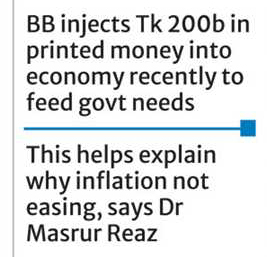
The central bank of Bangladesh has injected Tk 200 billion in printed money into
economy recently to feed government expenditure needs, economists say.
Bangladesh Bank officials, however, play down such concern as they claim the regulator has got a stronger rise in its net foreign assets (NFA), including foreign- exchange reserves, during the current fiscal year.
The increase in reserve, dubbed 'high-power money', signifies a sharp expansion of liquidity on the money market. Data released from the central bank show reserve money grew 13.35 per cent in February 2026, up from 6.16 per cent in the same month a year earlier.
The BB attributes the increase largely to a stronger rise in its net foreign assets, including foreign-exchange reserves, during the fiscal year 2025-26, compared with only a marginal increase in the previous year.
Reserve money is also referred to as the monetary base that comprises currency in circulation and commercial banks' reserves held with the central bank.
It forms the foundation of the broader money supply and can have significant implications for inflation and credit conditions, economists explain.
People familiar with the developments told The Financial Express that the recent surge in the net foreign asset reflects sizeable dollar purchases by the Bangladesh Bank.
The central bank bought more than $5.50 billion from the market during the fiscal year, boosting its foreign-asset holdings and in turn expanding reserve money.
They also say inflows of foreign grants and assistance from some international lenders, for example, the World Bank and the Asian Development Bank, also contributed to the rise in net foreign assets in the state treasury.
Some economists strike a note of caution that the increase in high-powered money could add fuel to inflationary pressures if not managed carefully.
"We believe the situation remains under control," says Dr Md Ezazul Islam, director- general of Bangladesh Institute of Bank Management.
He says a potential increase in private-sector imports in the coming months could help moderate reserve-money growth.
Others appear more concerned about the inflationary impact.
"This helps explain why inflation is not easing," says Dr M Masrur Reaz, chairman and chief executive officer of Policy Exchange Bangladesh.
He adds that the central bank has recently injected around Tk 200 billion in the economy, amplifying liquidity through multiplier effects and contributing to persistent price pressures.
jasimharoon@yahoo.com