
Abe beats economic drum that ‘Japan is back’
Monday, 15 December 2014
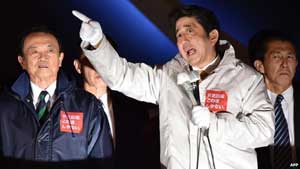
TOKYO, Dec 14 (AFP): Prime Minister Shinzo Abe's easy victory in Sunday's general election marks another chapter in the career of a man who has enjoyed rare individual success in Japan's consensus-driven politics.
The conservative ideologue, written off in 2007 when his first stint as premier ended in scandal and illness, has brought a reformer's zeal to the role since his return two years ago.
Japan's long-slumbering economy has stirred under a flood of easy money and fiscal largesse that sent the yen plunging and the stock market soaring.
The deflation that has plagued manufacturers, depressing wages and hampering investment over more than a decade, has shown signs of easing.
But the cost of his pro-business initiatives, say critics, is growing inequality and a stupendous pile of public debt.
Sixty-year-old Abe swept to power in 2012 as a disillusioned public dumped a three-year experiment with the Democratic Party of Japan.
The DPJ's promise to remake the country after more than half a century of almost unbroken rule by the Liberal Democratic Party disappeared under a wave of scandal and ineptitude.
Abe's promise of competence and his vision for reinvigorating the world's number-three economy was welcomed by voters, despite wariness over his nationalism that many centrist and liberal voters found distasteful.
For Abe, the grandson of a wartime cabinet minister who was briefly jailed-but never charged-for war crimes, a strong economy is a means to an end.
With a refrain of "Japan is Back", he has pushed for his nation to take a strong stance on the world stage, and has been a turbo-charged salesman-in-chief for Japan Inc., visiting dozens of countries to sell its wares.
Unable to muster public support for a revision of the US-imposed constitution that commits Japan to pacifism, he settled instead for reinterpreting the relevant clause and declaring the military should have more leeway to act.
Abe has campaigned to "restore Japan's honour" by redefining the narrative of its aggressive wartime behaviour and promising to instil patriotism among schoolchildren.
He has repeatedly picked at the diplomatic scab left by the institutionalised system of sex slavery that saw up to 200,000 women from Korea, China and elsewhere forced into service during the conflict.