
Acquiring Chinese fighter aircraft
A prudent investment or a strategic gamble?
Mudassir Hussain Khan | Sunday, 5 July 2026
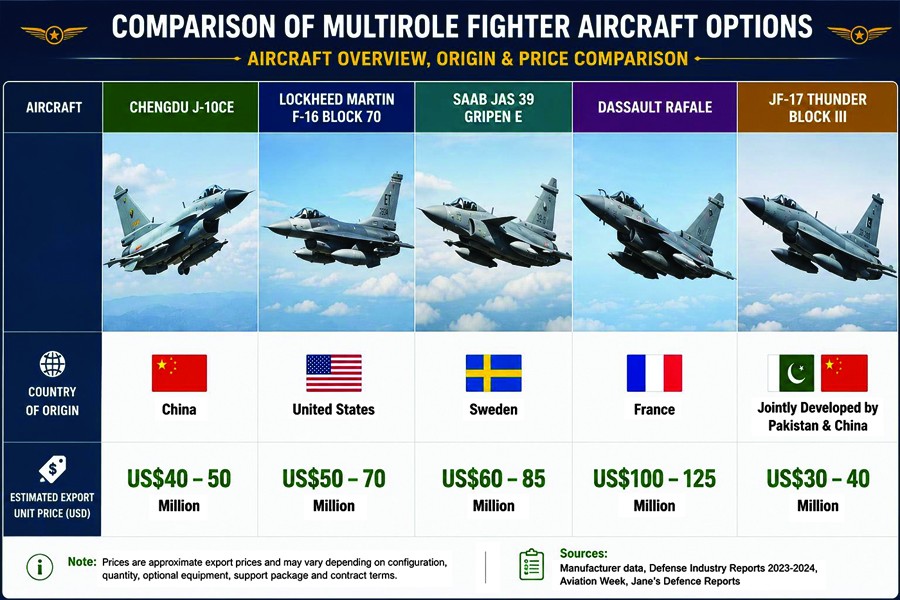
Bangladesh's reported decision to procure J-10CE Chinese multirole fighter aircraft marks another important step in the modernization of the Bangladesh Air Force under the Forces Goal 2030 programme. Given the rapidly evolving security environment in South Asia, strengthening the country's air defence capability is a legitimate national objective. However, the acquisition should be examined from both military and geopolitical perspectives.
From a military standpoint, modern multirole fighters would significantly enhance Bangladesh's capability to defend its airspace, conduct precision strikes and improve surveillance and deterrence. Nevertheless, even few squadrons of advanced aircraft would not fundamentally alter the regional balance of power. India's overwhelming numerical superiority in combat aircraft, airborne early warning systems, aerial refuelling capability and integrated air defence network would continue to provide New Delhi with a decisive strategic advantage. Thus, the procurement would serve primarily as a credible deterrent rather than a game-changing military equaliser.
The cost-benefit ratio appears reasonable only if the aircrafts are acquired at competitive prices with comprehensive technology transfer, pilot training, maintenance support and long-term logistics packages, in the absence of which the high life-cycle costs associated with modern combat aircraft could place considerable pressure on Bangladesh's development expenditure, the defence budget in particular.
Diplomatically, China would certainly welcome the deal as another milestone in expanding its defence cooperation with Bangladesh. India on the other side, is likely to monitor the development closely, refraining though from strong public criticism, given Bangladesh's sovereign right to procure defensive equipment. The United States (US) may express concern if the acquisition deepens Bangladesh's military dependence on China, particularly in the context of the Indo-Pacific strategic rivalry. Other neighbouring countries are unlikely to react strongly unless the procurement significantly alters the regional military balance.
Challenges tied with the procurement will emerge after completion of the delivery. Sustaining sophisticated fighter aircrafts requires uninterrupted supplies of spare parts, regular software upgrades, highly trained technicians and pilots, modern maintenance infrastructure and long-term financial commitments. Any deterioration in bilateral relations with the supplier or disruptions in the supply chain could adversely affect operational readiness of the aircrafts.
Whether there were better alternatives remains open to debate. Aircraft from the USA and other Western developed countries generally offer superior interoperability and advanced avionics but are considerably more expensive and often accompanied by harsh political conditions. Other options, such as the JF-17 Block III or Sweden's Gripen, could also have been considered depending on Bangladesh's financial resources and strategic priorities. Ultimately, no fighter aircraft is universally "best"; the optimal choice depends on operational requirements, affordability and long-term sustainability.
Generally speaking, if carried out with careful planning and supported by adequate training, logistics and maintenance infrastructure, the procurement would strengthen Bangladesh's defensive capability. Bangladesh must however continue pursuing a balanced foreign policy, diversify its defence partnerships and avoid excessive dependence on any single supplier, thereby preserving both its military readiness and strategic autonomy.
Lt Col Mudassir Hussain Khan (rtd) is a Bir Protik