
Adopting a cross-border approach to flood management
Farid Hasan Ahmed | Sunday, 31 August 2014
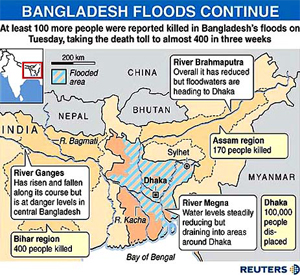
Floods are natural events in many parts of the world each year. The southwestern summer monsoon occurs from June through September. The Bay of Bengal outlet of southwest monsoon flows over the Bay of Bengal heading towards northeast India and Bengal, picking up more moisture from the Bay of Bengal. The winds arrive at the eastern Himalayas with heavy showers of rain. Bangladesh and certain regions of India frequently experience floods during this season.
Given the hydrology, climatic factors and the geology, Bangladesh is naturally prone to floods. Floods are an annual phenomenon, taking the most severe toll during the months of June to September. Floods in this country cause huge devastation, affecting the most impoverished who live on the fringes, at great risk from flooding. The poor always face sufferings and difficulties to cope and overcome the losses incurred.
Flood refers to any destructive movement of water on a large scale. It may include flash floods particularly in higher reaches, inundation resulting from heavy rain, dam releases, embankment breaches etc. The floods damage property, assets, road, community affairs, shelter; livestock's, crops and trees adding miseries and vulnerabilities to the poorest people. For example, in 2007 flooding made nine million people homeless and approximately 1,000 people died from drowning and from flood-borne diseases. River bank erosion often accompanies floods which is a perennial problem in Bangladesh. It displaces over 100,000 people annually with devastating social and poverty impacts along the major rivers, where poverty is heavily concentrated (ADB). The Padma, the Ganges and the Jamuna have taken away around one hundred thousand hectares or 1,000 square kilometers of arable land, which is more than the size of Dhaka city, according to a study of the Centre for Environmental and Geographic Information Services (CEGIS). It causes families to lose land leading directly to poverty and forced migration. It increases vulnerability significantly. Now a days, flooding in urban areas is an unavoidable problem for main cities in Bangladesh. Daily activities in the cities become nearly paralysed and heavy traffic congestions take place due to stagnant water on the streets and unplanned
settlements.
In the past couple of weeks, almost one million people of riverine areas of the country have been affected by floods. Media reports have pointed out shortage of food and drinking water causing sufferings to the most vulnerable people in the certain areas. The relevant government authorities should ensure the emergency relief and rehabilitation assistance for the neediest people without undermining people's own dignity and ability. Ensuring quick and effective management process from village to national level with the involvement of NGOs and other relevant actors is the prime responsibility of the ministry of Disaster Management and Relief at this moment. Proper targeting, programming, monitoring and coordination should be ensured in line with Standing Orders of Disasters and Disaster Management Act 2012.
The government authorities and other development actors should think how their initiatives in flood-prone areas are resistant to the current state of flooding (not severe like 2007, 2004 and 1998) and what more should be done in integrating flood risk management in their programmes and activities for mitigating future hazards.
There are concerns regarding embankments and their maintenance and cost efficiency. Limitations such as difficulties of active and quick engagement, weak management set-up for operation, maintenance and protection, environmental consequences and lack of intervention by people and local government bodies need to be addressed effectively by Bangladesh Water Resource Ministry/Bangladesh Water Development Board. Appropriate allocation, rapid flow of fund and effective monitoring and supervision of these kinds of infrastructures/activities should be ensured by authorities responsible at different layers.
True, Bangladesh has developed capacities in flood management and demonstrated some success in this regard. But there are still gaps, retrograde practices, limitations and challenges such as deficiency in appropriate resource mobilisation and its effective utilisation, sustaining community efforts and replicating good practices to reducing overall flood risk of the country. Some suggestions are drawn below for an enhanced Flood Risk Reduction system in Bangladesh.
Early flood forecasting and warning system should be strengthened, with active participation of community leaders. Proper linkage among Bangladesh Water Development Board, community based organisations, local government bodies is needed to get periodical river water rise/ fall data, relevant to the area, as soon as the monsoon sets. Selected and interested persons of vulnerable community might be involved in sharing the same with the community at large to assist in their alertness and over-all preparation. Local NGOs' direct intervention in conjunction with local government bodies might be encouraged. Existing cross country cooperation on early warning systems should be strengthened.
Contingency planning at different levels for emergency flood response should be developed and updated at least once a year, focusing on (i) risk area and vulnerability status and (ii) availability of resources and capacity, apart from other requisite elements that feature in such a plan. Emergency fund mobilisation needs to be encouraged by relevant actors particularly NGOs with proper management and accountability plan. Emergency stores need be established and maintained by local government organisations. Emergency stores should contain emergency shelter materials (quality polythene sheets), tents, life jackets, water purifiers, medical supplies (including intravenous fluids and oral rehydration salts) and sufficient equipment for emergency personnel to facilitate their quick movement in an emergency and also latrines for emergency installation, processed bamboo for the rebuilding of houses, megaphones, kerosene lanterns, hachaks (large kerosene lights) and pipes and other equipment for raising tube wells.
Basic training courses on Flood Risk Reduction is needed after a proper gap analysis and planning for volunteers, managers, workers, government officials, local government representatives and media personnel, of whom 50 per cent should be women. Specialised training sessions are needed for relevant personnel in respective fields.
Before constructing embankments and taking river protection initiatives, appropriate feasibility and cost benefit analysis of independent authorities should be undertaken. Public hearing and consultation is important in this regard. Extensive river dredging programme should to be taken up with proper technical and economic analysis, and community participation to remove the sediments from the river bed deposited during flood to increase the water holding capacity of the drainage systems and to increase the water flow capacity. The sediments may be used to raise the level of land with proper planning.
The Disaster Management Act and Standing Orders on Disasters (SOD) of the government should be understood and applied by all concerned with appropriate resources, planning, monitoring and accountability mechanism.
Vulnerability of communities living in the most flood prone areas could be reduced by the construction of community-managed, women and children friendly flood shelters with basic water and sanitation facilities.
New initiatives are required by NGOs and relevant government departments to identify alternative income-generating activities and livelihood opportunities with proper risk reduction analysis and consultation with vulnerable communities. Feasibilities of enterprise development and market avenues need to be done for the affected area. Enterprise development activities require large amount of financial involvement. Therefore, linkage development with financial institutions to ensure the financial support is important.
Integrating flood risk reduction in existing development works and future initiatives of different government departments and others working in the area is a must. Concerned authorities should develop disaster data-base which is very important to carry out detailed study and planning.
There is also the need to ensure sufficiency of livestock and poultry vaccines as well as extension support of agriculture in the flood prone areas, particularly in remote areas.
Replication of tested flood preparedness interventions could reduce the vulnerability of the most flood-prone communities to floods and river erosion. The media should play a more sensitive and effective role in highlighting the vulnerabilities and potential risks of the flood stricken areas as well as the tested flood risk reduction initiatives for appropriate attention of policy makers and implementers.
Big river systems like the Ganges and Brahmaputra do not recognise political borders as they flow across Nepal, India and Bangladesh. A cross-border approach to flood management is very much needed to sustain the development gains and protect vulnerable communities of Bangladesh and neighbouring countries.
The writer is a practitioner in disaster risk reduction and climate change adaptation. Views expressed in the article are his own and not the
organisation he works for.
farid.hasan2008@gmail.com