
ADP cut at every fiscal’s fag end costs quality of work
FHM Humayan Kabir | Monday, 23 June 2014
A perennial practice of overestimating the annual development programme (ADP) outlay and then cutting it down later downgrades the quality of project implementation and financial management, experts have said.
Development analysts and government officials said the efficiency of the government's project-execution agencies had not improved over the years as they could utilise nearly 90 per cent of the ADP funds even after downward revision of original allocations every year.
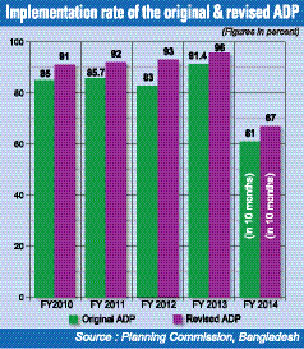
In the last financial year (FY) 2012-13, the public agencies could spend the highest 96 per cent of the revised allocation. The spending was much lower in the previous fiscal years, according to official data.
In the current fiscal's first 10 months from June 2013 to May 2014, the government agencies could implement only 67 per cent of the trimmed ADP outlay of Tk 600 billion or 61 per cent of the original outlay of Tk 658.72 billion.
The original ADP outlay of the current fiscal was trimmed by 8.91 per cent to Tk 600 billion in April last.
The government slashed the original ADP size of Tk 550 billion by 6.60 per cent to Tk 523.66 billion in the FY2013 while the original outlay of Tk 460 billion was cut by 11 per cent to Tk 410.80 billion in the FY 2012, Tk 385 billion outlay was cut by 9.40 per cent to Tk 358.80 billion in the FY 2011, Tk 305 billion cut by 6.6 per cent to Tk 285 billion in FY 2009 and Tk 256 billion cut by 10.16 per cent to Tk 230 billion in FY 2008.
Development analyst Dr Mirza Azizul Islam said the government's ADP- revision culture in the third quarter of every fiscal year (FY) created room for waste of public money, low-quality work and financial mismanagement.
"The government should frame a realistic ADP with more functional and administrative oversights aiming to ensure quality expenditure for development work," he told the FE.
Former Planning Division Secretary Habibullah Majumder said although the government agencies put their ADP fund-utilisation capacity at over 90 per cent of the revised outlay, their real capacity was about 80 per cent.
"The original ADP is always made dependent on the demand for funds from ministries and divisions. Had the government evaluated project- implementation capacity as per the fund allocations, their real strength could be shown. But this does not happen at the end of the day, resulting in financial mismanagement and the absence of quality work," he said.
In the last FY2013, the government executed the highest ever 96 per cent of the revised Tk 523.66 billion ADP or 91.4 per cent of the original Tk 550 billion ADP.
In the FY 2012, the agencies implemented 93 per cent of the Tk 410.80 billion revised ADP or 83 per cent of the Tk 460 billion original outlay.
In the FY 2011, the ministries and divisions implemented 92 per cent of Tk 358.80 billion revised ADP or 85.7 per cent of the Tk 385 billion original ADP.
Development researcher Dr Zahid Bakht said the practice of downsising the development budget in the last half of a fiscal year was encouraging government project-implementing agencies to undertake unimportant and politically-motivated projects.
"The government should undertake projects on a priority basis following proper feasibility studies. And those should get adequate funds. The monitoring should be tightened to ensure quality work. The ADP should not be inflatable, rather implementable," he told the FE.
Trimming down the development budget, in most of the cases, causes waste of public funds, low-quality work and delay in implementation in case of inadequate fund allocations, Mr Bakht pointed out.
The government in recent years had undertaken more than 1,000 development projects which reached over 1,200 with revision of the development plan.
Development experts viewed that the ballooning of projects every year was encouraging inclusion of some less-important and politically-motivated ones.
Professor Shamsul Alam, Member of the General Economics Division (GED), told the FE that since the Medium-Term Budgetary Framework (MTBF) was not functioning properly, review of a development budget at the end of the fiscal year was bad.
Yet, had the government framed a realistic ADP with oversights on the project-implementing agencies and eliminating the culture of revision at the end of the day, there would have been best results, he acknowledged.
The government invests money through the development budget, mainly through the ADP, to develop the country's infrastructure and cut poverty by way of providing jobs to those at loose ends. The non-development budget is mainly framed to pay salaries of public servants.