
After record deal, more India bank takeovers on cards
Devidutta Tripathy and Sumeet Chatterjee of Reuters in Mumbai | Monday, 1 December 2014
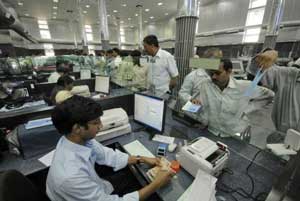
India is set for more banking acquisitions after a record $2.4 billion takeover last week ended four years of a deals drought, as lenders fight for market share and wider reach amid looming competition from a new breed of players.
A banking sector consolidation should support an expected recovery in Asia's third-largest economy through creation of stronger lenders that will control the growth of bad loans and make credit availability easier.
Any deals, though, will be subject to close regulatory scrutiny and may face other hurdles, meaning they are expected at a steady clip rather than in a torrent.
"Deals will happen in the banking sector, but relatively fewer compared to mergers in other non-regulated sectors," said Sanjay Doshi, a partner at consultancy KPMG, referring to segments such as industrials and consumer where there is no sector-specific regulator.
The Indian banking sector is fragmented, with 46 commercial banks jostling for business with dozens of foreign banks as well as rural and co-operative lenders. State banks control 80 per cent of the market, leaving relatively small shares for private rivals.
The state-run banks are unlikely to be part of any takeovers involving private sector rivals as the government has not been keen to bless such transactions. But the private sector, which accounts for nearly half the total number of commercial banks, could see deal activity.
New private players were earlier this year allowed to enter the sector for the first time in a decade, and the central bank plans to grant more bank licences. As a result, some large conglomerates are expected to jump in the fray.
With the incumbents keen to fortify themselves against the new competition and as the new players try to scale-up quickly, takeovers are clearly on the cards, say financial industry executives.
Among the conglomerates, the Aditya Birla group and billionaire Anil Ambani's Reliance Capital are keen on the banking sector and will be eyeing deals to expand quickly after they get permits, say investment bankers. The central bank's stance on allowing conglomerates into banking is unclear.
Some of the bigger private sector players - No. 3 private sector lender Axis Bank, IndusInd Bank and Yes Bank - are also potential acquirers, dealmakers say.
Axis, IndusInd, Yes Bank, Reliance and Birla Group did not respond to requests for comment.
Targets include smaller banks that are localised, but with a high number of urban branches, like western India's DCB Bank and Karnataka Bank, investment bankers said.
DCB's Chief Executive Murali Natrajan said the bank had no plan to merge with any bank, adding they aimed to double the balance sheet size in 36-42 months. Karnataka Bank did not respond to a request for comment.
Kotak Mahindra Bank agreed last week to buy ING Vysya in India's biggest bank deal.
The central bank is also facilitating the setting up of 'payments banks', which take deposits and facilitate transactions but do not lend, and which could eat into the banks' margins.
While the economic rationale for the deals is growing, they face practical hurdles. Pricing of deals is one such. Many founders of small banks see their licenses as prized assets for which they will demand a high price, even though most private sector banks are already trading at significant premiums to their book values.
Bank employee unions also can pose problems, if they fear major job losses in a takeover.
"The banking sector needs consolidation, but ... consolidation will move at a moderate pace in India in the near to medium term," said the head of M&A for India at a large European bank in Mumbai.
Rate Cut
Another message adds: Investors in India's markets are betting that Finance Minister Arun Jaitley will persuade a more hawkish Reserve Bank to reduce benchmark interest rates as early as next week.
Finance ministry sources have told Reuters that Jaitley will urge Reserve Bank of India (RBI) Governor Raghuram Rajan to cut rates at the December. 2 policy review, fearing that economic growth may have slowed again by dropping to 5 per cent in the three months to September.
"The market is hoping Jaitley wins. A rate cut is partially priced in by the debt market and to some extent in the longer-end fowards," said Vikas Babu Chittiprolu, a senior foreign exchange dealer with state-run Andhra Bank.
"But there is apprehension about Rajan actually cutting rates. There is a 50-50 view in the market on the rate cut."
Rajan has resisted calls to cut the RBI's 8 per cent repo rate for fear inflationary pressures might emerge again, even though consumer inflation has dipped below the central bank's targeted levels.
Retail inflation slowed to 5.52 per cent in October, well below the RBI's target of 8 per cent by January, and even below a target of 6 per cent by January 2016.
The bond and swap markets are pricing in a reduction of at least 25 basis points in the repo rate at November 25 policy review.
Yields on benchmark 10-year government bonds have declined 25 basis points (bps) since mid-October, when data showed inflationary pressures receding. Yields on corporate bonds have dropped even more, with those on one-year bonds down nearly 50 bps in the same period.
In the derivatives space, swaps referenced to overnight money market rates have likewise fallen sharply. The one-year overnight indexed swap (OIS) is down more than 45 bps since mid-October, with 20 bps of that move occurring over the last two weeks as investors saw greater chance of a cut.
The markets' appear out of synch with what most economists think.
A Reuters poll showed 41 out of 45 expected Rajan to resist pressure and keep the repo rate unchanged, although slightly more than half of them expect the tone of its policy statement to be more dovish than it was in September.
Traders said that while a rate cut is almost fully priced in at current market levels, there will be a further rally in bonds if Rajan not only reduces rates but also sounds dovish.
Domestic shares also expected to rally which could spur further foreign fund inflows into the market and aid the rupee. Fund flows into the debt market will however be subdued due to debt investment limits being nearly exhausted.
"We expect a reduction at the coming meeting and therefore we are bullish on the rupee and recommend receiving positions in rupee OIS rates," economists at Credit Agricole said in a note on November 26.
The upcoming RBI policy review comes less than two weeks after China unexpectedly cut interest rates to fight deflationary pressures and a little over a month after Japan aggressively expanded its monetary stimulus.
Economists remain divided on the prospects of easing in India though, given Rajan's dogged focus on inflation expectations. The RBI said after its September. 30 policy meeting that it expects inflation to pick up by year-end as the base effect wanes.
"I think Rajan would have his way and we will not see a rate cut. But yes, market has priced in a rate cut to some extent," said Ashtosh Raina, head of foreign exchange trading at HDFC Bank.