
Agri-potential Rangpur resounds with record ADR
JUBAIR HASAN | Saturday, 21 October 2023
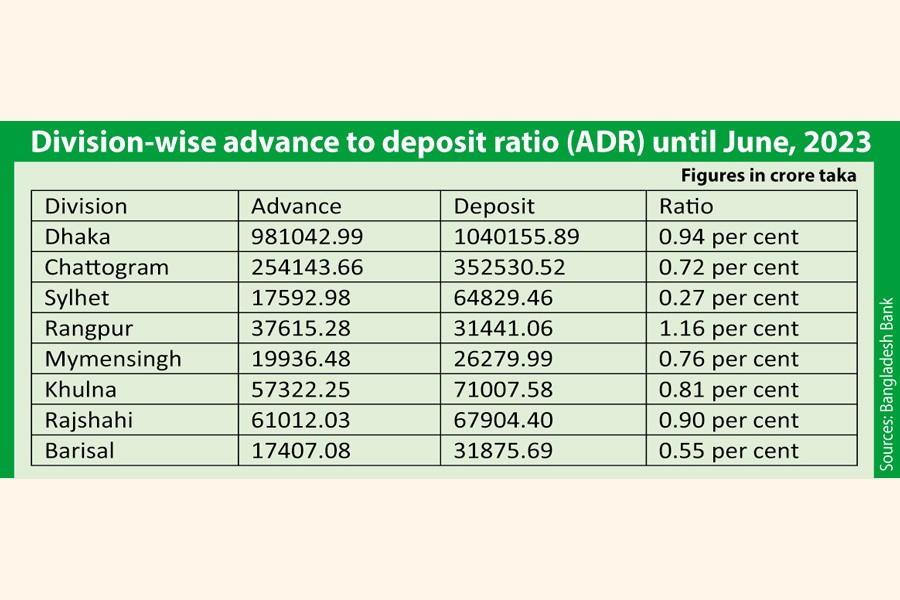
The flow of formal credit to the once-neglected Rangpur division mounts as the agriculturally potential region has the highest advance-deposit ratio (ADR), according to bankers and businesses.
People in the country's eight northern least economically contributing districts had been desperate in getting access to bank credit even a few years ago.
But things started to look up with a significant improvement in physical infrastructure, roads and bridges in particular, in the division.
Now, the administrative bloc of 16,374 square kilometres since Rangpur was established as a division in 2010 is getting more investment from banks than its deposits to the banking system.
According to the central bank statistics, total loans and advances by commercial banks to Rangpur division were estimated at Tk 376.15 billion until June 2023.
On the other hand, the entire deposit portfolio coming from the least developed region to the banking system was Tk 324.41 billion.
Seeking anonymity, a Bangladesh Bank (BB) official said banks' attention to the northern division has risen in recent years, thus contributing to reduce the regional disparity as far as banking operations are concerned.
Years ago, the deposits coming from Rangpur were used in the areas which were economically viable to banks.
As many roads and bridges are developed in recent years, economic and business activities of the people have started growing, the central banker said.
"Look at the statistics of Rangpur division. It's turning into an area where the ADR is the highest of the country. The ratio is 1.16 per cent," he said.
Data shows Sylhet has the lowest ADR (0.27 per cent).
The ratio in Dhaka is 0.94 per cent, Rajshahi 0.90 per cent, Khulna 0.81 per cent, Mymensingh 0.76 per cent, Chattogram 0.72 per cent and Barisal 0.55 per cent.
Talking to the FE, Rangpur Metropolitan Chamber of Commerce and Industry president Md Rezaul Islam Milon said the road-centric communication has been improved remarkably over the years, which is creating economic opportunities to the people living in the region.
Riding on the increased people mobility and business activities, banks started focus more on the area and reshaping the macroeconomic landscape of the once-neglected northern region, he added.
"Earlier, we struggled a lot even to meet senior bank officials to get credit. Now, we can easily meet top bank officials who keep visiting the region on a regular basis," said Mr Milon.
"You will find monga (seasonal famine), which was once typical of the region, in textbooks only."
When contacted, Shahjalal Islami Bank Limited managing director and CEO Mosleh Uddin Ahmed said Rangpur division was one of the lowest savings- and remittance- contributing regions of the country.
Despite its lower contribution, the region is getting comparatively higher loans and advances only because of agricultural credit flow, according to the banker.
Mr Ahmed said there was a disbursement target of farm credit set by the central bank, and lending banks have to meet the target by the end of a fiscal.
"Rangpur division is a highly agricultural potential area. So, a major chunk of the targeted funds used to go to the area. That's probably the reason behind the highest ADR in the region."
Riding on the success of meeting the previous fiscal year's (FY) farm and rural credit-disbursement target, the BB has raised the disbursement target by Tk 41.89 billion for the current FY, 2023-24.
With a 13.60-per cent increase from the FY23 target of Tk 308.11 billion, the BB has set the target of agriculture and rural credit disbursement for banks at Tk 350 billion in FY24.
Prof Dr Md Morshed Hossain, head of economics department at Begum Rokeya University in Rangpur, said the region was still to see significant progress in its industrial development.
But with the harmonious communication and digital growth, a good number of entrepreneurs have emerged in the area and are engaged in diversified economic and business activities alongside traditional trade.
For example, Dr Hossain said, the volume of commercial farming in products like fruits and flowers keeps mounting and the flow of formal credit continues to rise.
"I think this is a good sign to attain the target of sustainable economic growth. For this, we need to ensure easy access to credit for people across the country."
jubairfe1980@gmail.com