
Agricultural education in primary schooling
Kazi Prottoy Ahmed | Sunday, 7 December 2014
Bangladesh is primarily an agrarian country, where almost half the total population is involved with agricultural activities and more than one-third is financially active in agriculture. So, agriculture has the potential to catalyze food security, livelihood improvements and employment generation for a huge portion of our country's population.
Notwithstanding the cliché involved in the statement, it will surely give readers a general understanding of the overall dimension and magnitude of agriculture in heading the overall socioeconomic development of Bangladesh. Now that the significance of agriculture has been recognised, the need is to understand the role of education in agricultural development.
Agricultural education was first introduced with the belief that the overall farm production could be increased by maintaining systematic application of current technologies and agricultural research findings. The belief itself was not misplaced. Higher and intermediate agriculture education still continues to play a pivotal role in maintaining sustainable farming. Education directly impacts on the selection of technology in farming. A better educated farmer would be able to choose a better technology than a less-educated one.
But, a progressively inter-reliant world, however, is producing new challenges for the current agricultural education. Experts say that there are a number of challenges which can call for changes in agricultural education. Increasing marginalisation of agriculture, environmental degradation, the changing role of women in society and the rapid changes in scientific and technical knowledge are all playing their roles. In fact, it has been stated that in many of the developing countries, agricultural education and exercise have been unsuccessful to adjust and respond to the practical needs of rural societies.
Now, under the education system in this country, secondary and higher education in agriculture plays a critical role in rural development and sustainable agricultural production. There was an optional subject named 'Agriculture Science' at secondary education level. At undergraduate and graduate level, a total of 18 agricultural programmes are offered from various schools and universities at present. The current number of students enrolled in these programmes is close to 0.3 million.
Bangladesh Open University (BOU) is also engaged in educating rural people of the country by instilling training to operate modern technology of agriculture with a view to boosting farm produce. The Bangladesh Agricultural University (BAU) in Mymensingh and Sher-e-Bangla Agricultural University (SAU) in Dhaka -- two specialised agricultural universities in Bangladesh -- have been producing agricultural graduates who would join government services and NGOs to practise and disseminate the knowledge to people who are involved with agriculture.
In many countries, including Bangladesh, with planned economies, agricultural education and training were designed mainly to prepare administrators for the managerial and technical services for rural and agricultural development. But there is a whole age group missing from the above discourse. Although being statistically significant, the primary education level was thoroughly ignored. There is no specialized training institute, let alone course contents which are somehow related to practical agriculture in the primary school-level framework.
Now the main question arises: why do the primary school-goers need the basic understanding of practical agriculture? Why can't the secondary or higher education suffice?
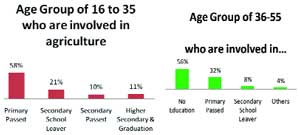
As is seen from the above column bars, a survey conducted among the people who are involved with agriculture in 2009 places, 58 per cent of the age group of 16 to 35 into the 'primary passed' category. Among the age group of 36-55, the number is more startling, as we can see, almost 88 per cent of the samples have passed primary level of education or haven't received any education at all. Although it can be said that the number has improved as several years passed, the number of primary-passed people who are involved with agriculture is significantly high.
It should be acknowledged that Bangladesh has achieved a great feat in net enrolment rate in primary schools. According to the UNICEF, the enrollments in primary schools totaled 16.4 million, with the net enrollment rate being 90.8 per cent. However, it should also be noted that completion rate of the 5-year primary school cycle is still alarmingly low, at 50.7 per cent.
So, this data set actually indicates that almost half of the population who are currently involved with agriculture don't get any exposure to agricultural science and management from the textbooks. Though there are a number of motivational stories and asserts which exemplify the noble profession of farming, the content is just not enough to address problems facing people involved with agriculture. As they drop out way before formally completing their education, this huge knowledge gap directly affects the overall agricultural productivity of our country.
As they do not have the basic knowledge in agriculture, they are unable to use modern technologies in terms of proper application of fertilizers and pesticides, preparing soil for cultivation, improved ways of irrigation and pisciculture. The prevalence of superstitions and age-old cultivation techniques directly prevent modern practice of agricultural cultivation and hinder country's overall agricultural advances.
Now, as the development of education in Bangladesh is such that all young people, in both urban and rural areas, will, before long, have attended at least the primary school and hence primary education must be adapted to this new situation. The school curriculum should be drawn up in such a way that students, who for major reasons are obliged to abandon their education prematurely, will not feel too much out of the element when they make their first contact with agriculture. Also, in order to safeguard the student's attendance in rural schools against the dropout, a system needs to be set up which will constitute shorter duration. As in technical agricultural education, one method of teaching which can be very fruitful is school excursion.
The teachers' aim should be to arouse such students' curiosity and make them feel the necessity to learn more about agriculture. Of course there cannot be any question of teaching agricultural techniques which are too complex for a child, but it is very much achievable to demonstrate to the students on how a plant is produced, lives, grows and multiplies; understanding particular method of farming or particular ways of handling livestock etc.
Questions may arise on the fruitfulness of inclusion of agriculture in the national curriculum at the primary school level, as the urban and semi-urban population don't always get themselves involved with agricultural activities. But being run by an agrarian economy, the importance of a nationwide propagation of agricultural knowledge at a primary level cannot be denied. The primary school, through which all future agriculturalists will pass in increasing numbers, since it will increasingly come to receive all the nation's children, has a definite role to play. It is from among the ranks of its students that the best farmer, the prospective leader of the rural masses will emerge.
The writer is a sophomore at the Institute of Business Administration, the University of Dhaka. He can be reached at: kaziprottoy@gmail.com