
AI and the end of rote learning: towards a new era of cognitive partnership
Serajul I. Bhuiyan | Thursday, 14 May 2026
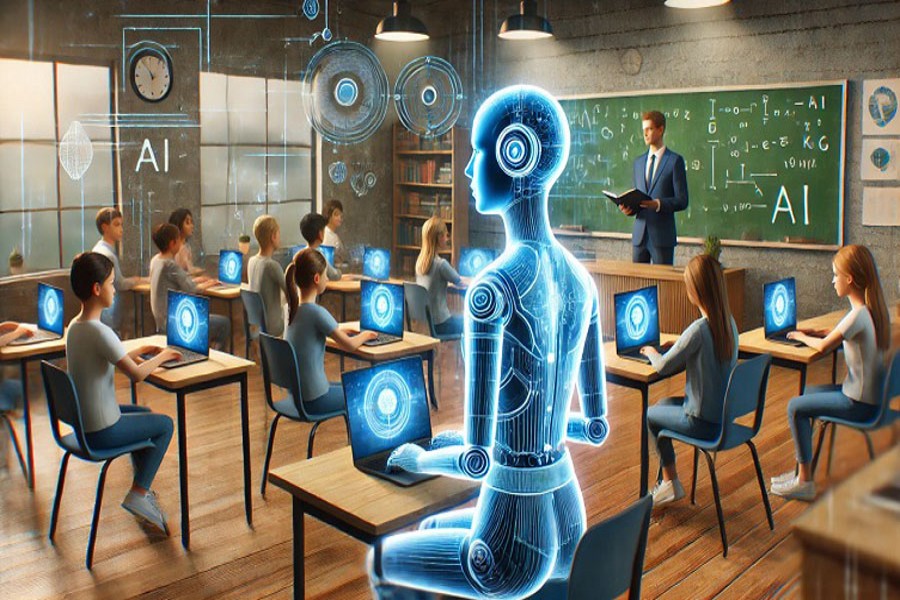
In terms of the history and tradition of education, hardly any changes can compare to those taking place at the moment, thanks to the emergence of artificial intelligence (AI). From the invention of printing to the advent of the internet, every significant technological breakthrough has increased access to information. However, AI represents something far more substantial. Indeed, in addition to altering how knowledge is retrieved, AI is revolutionizing how we create, interpret, and apply information. Rather than focusing on knowledge acquisition, learning processes will now be characterized by cognitive partnerships.
PASSIVE KNOWLEDGE RETRIEVAL BECOMES OBSOLETE: For ages, education has been viewed mainly as an endeavour to accumulate and memorise knowledge. Success in any subject was primarily determined by one's ability to reproduce information in accordance with the curriculum. Thanks to AI-powered software that can retrieve, summarise, and even synthesise large amounts of information in a matter of seconds, the significance of memorising has diminished.
This change involves moving away from merely understanding facts to asking questions about them and making sense of them. The importance of rote learning is slowly diminishing, as students no longer need to memorise large amounts of information by heart. Rather, it is more important that students acquire high-order cognitive skills.
COGNITIVE PARTNERSHIP EMERGES: What distinguishes this educational revolution is the new role learners play. In the past, their task was to absorb all information provided by teachers, which was perceived as the source of knowledge. However, in the light of the emerging cognitive partnership, learners transform into co-creators of knowledge in collaboration with intelligent machines.
AI works as a cognitive support. The job of the AI system is to help the users think, identify patterns, model events, and even challenge prevailing theories. In academic writing and research, students may use AI systems to improve their reasoning, analyse different viewpoints, and improve their expression. When conducting scientific experiments, the AI may help with modeling and prediction. Therefore, the students will be able to analyze the data they collect.
REDEFINING THE INSTRUCTOR'S ROLE: As students' learning processes change dramatically with the use of AI-powered devices, the role of instructors also undergoes a metamorphosis. The teacher no longer serves as the main authority and gatekeeper of knowledge but instead functions as a mediator, counselor, and tutor in this new learning process.
The educator will have to design an experiment that integrates AI technology while also preserving the purity of intellectual pursuit. It means that one has to train their students to use AI, analyse the results it provides, and consider the ethical implications of using such software.
POSSIBILITIES AND ADVANTAGES: The possibilities enabled by the combination of AI and cognitive cooperation are endless. For instance, personalised learning allows educators to tailor educational approaches to suit the unique needs of each learner, based on their approach and pace. Students who cannot cope with conventional approaches will be able to receive personalised assistance with learning.
Moreover, thanks to AI technology, it has become possible to equalise opportunities for learners from all corners of the world and diverse socio-economic backgrounds. In particular, AI-equipped technologies are especially useful for assisting students with physical or mental disabilities.
Finally, cooperation between learners and cognitive technologies leads to the development of innovative solutions. Thanks to AI-assisted automation of routine processes, learners will have more time for creative work and problem-solving.
BANGLADESH: OPPORTUNITIES, CHALLENGES, AND POLICY RECOMMENDATIONS: For Bangladesh, adopting an AI learning environment occurs within a unique context. With initiatives like Digital Bangladesh adopted over the past decade, digital infrastructure has been enhanced to offer advanced technologies in learning institutions. Nonetheless, there have been inconsistencies in realizing the construction of intelligent learning environments.
Regarding policy issues, there are some current policies that acknowledge the significance of using AI technologies. For instance, the National Education Policy of 2010 and the National Artificial Intelligence Strategy of Bangladesh can be highlighted. Nevertheless, the use of these policies in learning institutions is still in its infancy.
There are three key factors that characterize Bangladesh's situation regarding AI and learning:
1. Infrastructure and Access Inequalities
Urban schools and universities are rapidly adopting digital tools. Rural and marginalised communities continue to lag behind in accessing the Internet, obtaining devices, and receiving a reliable power supply. Without solving these issues, AI may exacerbate existing educational inequity.
2. Curricula and Pedagogy Lagging Behind
Currently, most curricula emphasise rote learning and exam preparation. To integrate AI, one must completely rethink the current approach to knowledge and learning processes. In addition to updating the curriculum, one should introduce a new assessment system that values creativity and critical thinking over memorization.
3. Inadequate Instructor Preparedness and AI Awareness
Some teachers are not adequately prepared to use AI technology. This means there is a need to train instructors to incorporate AI technology into teaching.
In order to ensure that the impending change occurs smoothly, Bangladesh can adopt the following strategies:
1. Strategic in Infrastructure
Making the internet and devices accessible in rural areas is important for ensuring equal access to AI-assisted learning environments.
2. Curriculum Reform
AI literacy and data thinking should be incorporated into curricula at all levels of education. Such changes would make it easier for learners to acquire the vital skills needed to function in a globally interconnected society.
3. Teacher Training and Capacity Development
Continuous professional development programs should be established. These would educate instructors about using AI in classrooms, ethics, and innovative pedagogy.
4. Collaboration Between the Public and Private Sectors
It would be reasonable to partner with companies specializing in technology, universities, and other nations to accelerate innovation and resource sharing.
5. Ethical and Regulatory Framework
Establishing clear guidelines regarding data privacy, academic integrity, and responsible use of AI in educational processes is essential.
Overall, the use of AI in learning has enormous potential for Bangladesh, but it must be carefully managed. Provided the government adopts inclusive, forward-thinking policies, AI can become an effective tool for increasing social equity, fostering creativity, and enhancing competitiveness.
CONCERNS AND ETHICAL CONSIDERATIONS: However, several risks are associated with AI-enabled learning processes. First of all, over-reliance on AI may undermine foundational skills since students may avoid engaging in cognitive activities. Additionally, there is a risk of intellectual complacency, in which learners accept AI-generated outputs as accurate.
Other issues include academic dishonesty, misuse of personal data, and algorithmic discrimination. In case AI systems incorporate biases, inequalities, or inaccuracies, they will be replicated in learning outcomes. Thus, learners might find themselves unable to differentiate between valid and machine-assisted knowledge. Therefore, it is necessary to implement an ethical framework that would regulate the use of AI in learning processes. Guidelines could increase transparency, raise awareness, and protect human judgment in decision-making.
TOWARDS A NEW PARADIGM: The introduction of the technology in the learning process means a fundamental change in students' learning experiences. Therefore, it is necessary to reconsider the goal of learning. Today we live in a world where information is everywhere and available immediately. Its volume makes any attempts to memorize futile.
However, a cognitive partnership with AI allows us to think about knowledge and learning processes differently. Curiosity, the ability to change and develop alongside the system, and contributions to worldwide knowledge exchange are the main skills students will gain.
CREATING THE FUTURE TOGETHER: It means that AI does not undermine learners' involvement in the process; instead, it amplifies it. Thus, we can become knowledge architects. Our goal is not to divide and take sides, but to create a new world together. The future of learning means its evolution through the symbiosis of human intelligence and technology.
sibhuiyan@yahoo.com