
AI CRM Banks' smart credit risk management approach
Md. Kamruzzaman | Saturday, 6 June 2026
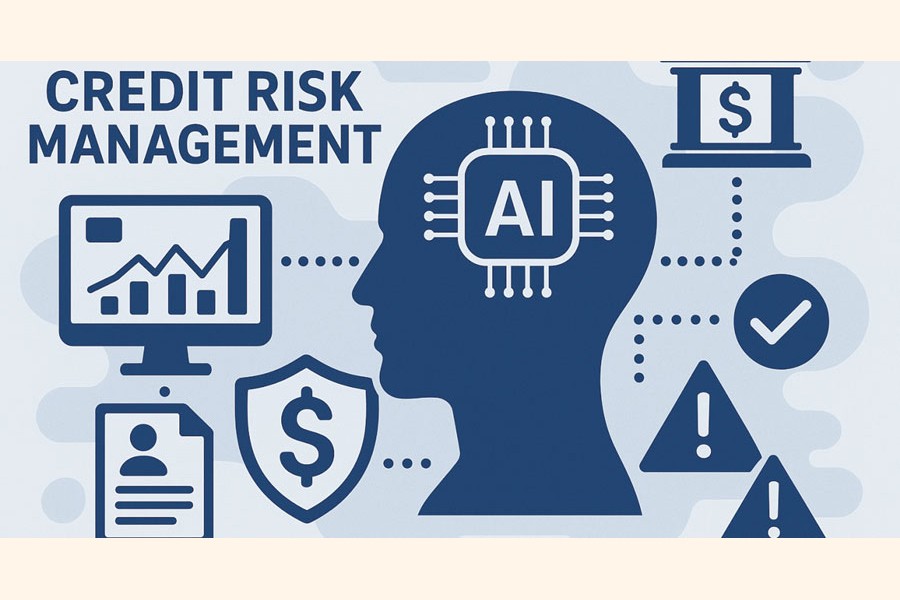
AI tools can be very effective in identifying, analyzing, and mitigating credit risk in commercial banks. In fact, many global banks are already using AI-driven systems for parts of their credit assessment, fraud detection, portfolio monitoring, and recovery operations. The key advantage of AI is that it can process massive volumes of structured and unstructured data much faster than traditional rule-based systems. AI can also detect hidden patterns that human analysts or conventional statistical models may miss. With AI tools CRM approaches in banks can be more smarter and effective.
Credit Risk Identification means identifying which borrowers or sectors may become risky before default actually occurs. In advanced Credit Scoring traditional banking models usually depend on income, collateral, past repayment history, financial statements, CIB data, etc. AI models can additionally analyze borrowers' transaction behaviour, cash flow volatility, mobile banking activity, utility payment patterns, supply-chain relationships, industry stress indicators, macroeconomic signals and behavioral patterns.
For SME or retail borrowers with limited formal credit history, AI can generate "alternative credit scores." For example: a small business may show declining sales deposits, irregular supplier payments, increasing overdraft usage, delayed salary disbursements. AI can detect this deterioration months before a formal NPL event occurs.
AI can excels in Early Warning Signals (EWS). It can continuously monitor Account turnover, EMI delays, covenant breaches, sector downturns, sudden changes in spending behavior, reduction in inventory movement and trade finance irregularities. AI can generate real-time alerts. For Example: if a garment exporter suddenly receives fewer export proceeds while LC liabilities remain high, AI may flag increased probability of stress.
Again, credit risk is often linked with fraud risk. AI systems can detect fake financial statements, synthetic identities circular transactions, related-party exposure, unusual loan utilisation patterns.
Machine learning models are particularly strong in identifying patterns humans cannot easily see. AI improves the quality and speed of risk assessment. AI can estimate Probability of Default (PD), Loss Given Default (LGD) and Exposure at Default (EAD) more accurately than humans. These are core concepts under Basel Committee on Banking Supervision frameworks. AI models often outperform traditional logistic regression models because they can capture nonlinear relationships, interaction effects and hidden correlations. AI can analyze entire loan portfolios to identify sector concentration risk, geographic concentration, correlated borrower groups and systemic vulnerabilities. For example, if many borrowers depend indirectly on one large importer or one export market, AI may detect hidden concentration exposure.
AI model is effectively applicable for Stress Testing & Scenario Analysis. AI can simulate recession, inflation shock, exchange rate depreciation, interest rate hikes and commodity price shocks. Banks can estimate future NPL ratios, capital adequacy pressure and liquidity stress. This is especially useful in emerging economies where macroeconomic volatility is high.
AI becomes strategically powerful in Credit Risk Mitigation. Dynamic Risk-Based Pricing instead of charging uniform lending rates, AI can recommend borrower-specific pricing, collateral requirements, exposure limits and covenant structures. Lower-risk customers get better pricing; Higher-risk customers get tighter controls.
Traditional lending often relies on periodic review: quarterly, half-yearly and annually. AI enables continuous monitoring. A borrower's risk profile can change daily based on transaction data, market conditions, repayment behavior and supply-chain disruption. This allows banks to intervene early. Furthermore, AI can help recovery teams prioritise accounts. It can predict who is likely to cure, who needs restructuring, who may default permanently and which recovery strategy is most effective. AI may also optimize legal action timing, settlement offers and collection communication strategy.
Most Important is: AI Technologies used in banking include Machine Learning Credit scoring, PD models, Deep Learning, Complex pattern recognition through Natural Language Processing, Financial statement analysis, news analysis, related-party transactions and fraud detection.
In real-world major banks and fintech firms are using AI extensively. JP Morgan Chase uses AI for fraud monitoring and credit analytics. HSBC uses AI for AML and transaction risk monitoring. Capital One Bank heavily applies machine learning to retail credit decisions. Upstart, an AI-based fintech company in the USA, uses alternative AI-driven underwriting models.
It cannot be ignored there are several challenges and limitations of using AI in managing Credit Risks in banks. There are Data Quality Problems. Bad data represent bad AI output. Many banks, especially in developing economies, suffer from incomplete borrower data, poor MIS and fragmented systems. Again, AI may unintentionally discriminate if data contains historical bias.
Apart from some limitations the future of banking risk management is likely to combine human judgment and AI analytics. AI probably will not fully replace credit officers, especially for large corporate loans, relationship banking and strategic lending decisions. But AI can dramatically improve speed, consistency, predictive accuracy, portfolio surveillance and early intervention capability.
For banks in Bangladesh, AI could be particularly valuable in SME lending, agriculture finance, retail loans, NPL early warning, trade finance monitoring and mobile financial services data analysis. However, effectiveness depends heavily on digitized banking data, centralized databases, skilled risk analysts, regulatory guidance from Bangladesh Bank and strong IT governance. Banks with fragmented manual systems will struggle to fully benefit from AI until data infrastructure improves.
Several banks and financial institutions in Bangladesh are already using AI tools in limited or partial forms, although the adoption level is still much lower than in developed banking systems. Most AI usage in Bangladesh today appears concentrated in fraud detection, chatbot/customer service, transaction monitoring, AML/CFT screening, digital onboarding and early-stage credit analytics. Full-scale AI-driven credit underwriting is still emerging. The strongest AI adoption in Bangladesh is currently happening in fintech and mobile financial services rather than in conventional banks. bKash uses AI systems for fraud detection, transaction anomaly monitoring, customer support automation, behavioral analytics and alternative credit scoring for nano-loans. BRAC Bank has publicly promoted chatbot services, digital banking automation and data analytics initiatives. Industry reports frequently mention that BRAC Bank is the early adopters of AI-enabled customer service technologies. There are references to City Bank also using analytics platforms, automated customer interaction systems and AI-supported lending assessment initiatives.
Bangladesh Bank itself has started moving toward AI adoption. Recent reports suggest Bangladesh Bank is planning to deploy AI-based fraud detection, AI-supported supervisory monitoring, anomaly detection systems and generative AI tools for regulatory analysis. This is important because once the regulator adopts AI frameworks and guidelines, commercial banks usually accelerate adoption. The fact is AI tools are already entering the banking ecosystem in Bangladesh in meaningful ways. Banks who accept and adapt this technological innovation soon, will get the first-mover advantage, others shall be lagging behind.
The writer is a banker and columnist.
kzamanabbl@gmail.com