
THE ARREST OF MAJOR MOZAFFAR HOSSAIN
An opportunity to unravel mystery surrounding Zia's assassination
Mudassir Hussain Khan | Saturday, 25 July 2026
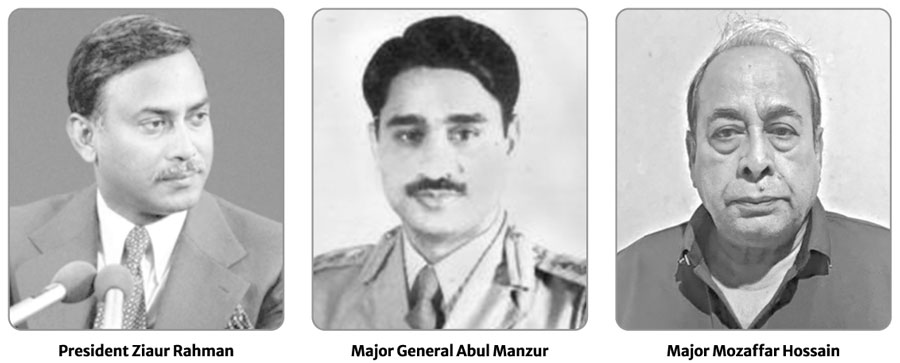
The recent arrest of retired army officer Major Mozaffar Hossain, convicted in connection with the assassination of President Ziaur Rahman, has renewed attention on a pivotal chapter in Bangladesh's post-independence history. More than four decades after the events of May 1981, it underscores how that turbulent period continues to resonate.
Bangladesh emerged from the 1971 Liberation War with a devastated economy, weak institutions, and immense reconstruction challenges. The early years were marked by economic hardship, political polarisation, inflation, shortages, corruption, and the 1974 famine, all of which eroded public confidence. In 1975, constitutional changes replaced the parliamentary system with a presidential one and introduced a one-party structure under BAKSAL -- moves still criticised for prohibition of civil liberty, freedom of speech and gagging press freedom. Later that year, the assassination of President Sheikh Mujibur Rahman in a military coup ushered in political instability and military influence in politics.
Amid this upheaval, General Ziaur Rahman, the proclaimer of independence and a popular, charismatic leader both in the military and the general mass, rose to power and eventually became president. His administration pursued economic liberalisation, rural development, and expanded international engagement, earning recognition for progress in agriculture and governance.
The post-1975 period saw repeated coup attempts instigated both by the defeated political elements and external inimical forces gave rise to and internal tensions within the armed forces, driven by political uncertainty and institutional instability. Against this backdrop, President Ziaur Rahman travelled to Chittagong in May 1981, where he was assassinated by a group of army officers at the Circuit House on May 30, triggering another national crisis.
The government moved quickly to restore order. Major General Abul Manzoor, a central figure in the events, was detained and later killed under mysterious circumstances. Investigations led to controversial trials of several military officers, with death sentences awarded to most of them in Kangaroo military court under directive of the then Chief of Army Staff, General Hossain Muhammad Ershad. Most of them were executed swiftly, while few remained fugitives for years. The arrest of Major Mozaffar Hossain marks a recent step in enforcing those verdicts.
While the judicial process has concluded, historical analysis continues. Courts determine legal responsibility, but historians examine the broader political and institutional dynamics of the time. Bangladesh's early decades highlight the challenges of nation-building, maintaining civilian authority, and ensuring stability within state institutions, the armed forces in particular.
Arrest of Maj Mozaffar, a frontline accused in the assassination of President Ziaur Rahman shouldn't be restricted only to his trial and conviction but also be treated as an opportunity to dig into the whole truth and finding clues and clarifications to a number of unanswered questions, principal among them being: (1) Motive behind the killing of a popular national leader and his meteoric rise as a spokesman of third world countries; (2) Names of individuals and agencies/organisations within and outside the country suspected to be involved in the assassination of President Ziaur Rahman and also the non judicial and mysterious killing of Gen Monzur; (3) Names of officers assumed by many as innocent or not guilty of involvement in the assassination plot and yet illegitimately executed by the power that was; and (4) Ground and pre-planned circumstances created by the then Army Chief of Staff, Gen Ershad, and his associates leading to his grabbing of power by overthrowing President Justice Abdus Sattar and his constitutional govt, at gun-point.
The calamitous events detrimental to the interest of the country that have occurred throughout the period of post independence, underscore the importance of strong democratic institutions, the rule of law, and a professional, apolitical military. Political violence and extra-constitutional actions have repeatedly hindered democratic development, weakening public trust and deepening divisions.
As Bangladesh continues to develop, preserving an accurate and balanced historical record remains essential. The arrest of Major Mozaffar Hossain serves not only as the enforcement of a legal judgment but also as a reminder of the need for careful, evidence-based reflection on the nation's past so that its lessons strengthen, rather than divide, the future.
Lt Col Mudassir Hussain Khan (rtd) is a Bir Protik