
Ancient Hindu temple found built on Buddhist shrine in Dinajpur
Wednesday, 29 July 2015
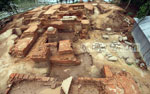
A Hindu temple sits firmly on the remains of a Buddhist shrine in Dinajpur in an awe-inspiring sight that testifies to the conquest by Hindus of Buddhists at Barendra - a region in ancient north Bengal, reports bdnews24.com.
Buddhist monasteries and Viharas had been converted into Hindu temples hundreds of years ago, and an archaeological team in Bangladesh believes these temples they recently unearthed will serve as witnesses to this significant transformation in the region's religious and political history.
Their construction may date back to the 8th or the 11th century, the archaeologists say, and expect carbon dating to fix their antiquity.
Evidence of Buddhist 'Stupas' being changed to Hindu temples already exists, but now, for the first time, archaeologists have found proof of their imposition on a Buddhist place of worship.
It was Emperor Ashoka in the third century BC who had first built a 'Stupa' to preserve the bodily remains of Gautam Buddha, initiating the practice of building these mound-like structures to house the dead.
Jahangirnagar University Professor Swadhin Sen led the team that found the temples after digging 3,600 square feet at 'Itakura Dhibi' at Setabganj's Ranagaon Union.
"It is among around 126 archaeological sites identified when we began our survey at Setabganj (Bochaganj) in 2012," Prof Sen told the news agency. The expedition was being funded by the Ministry of Cultural Affairs.
"The temple had walls on its eastern, northern and southern sides with an opening on the west. The wall was of the tri-ratha type, a significant feature of Hindu temple architecture." 'Tri-ratha' implies a building style having a projection on each side.
A 30-40 cm thick metal panel had been used to separate the base of the Buddhist temple from the Hindu one on top.