
FICCI FINDS WHAT IT TAKES TO BOOST FDI
Appropriate reforms can get BD $15b FDI annually
FE REPORT | Tuesday, 28 July 2026
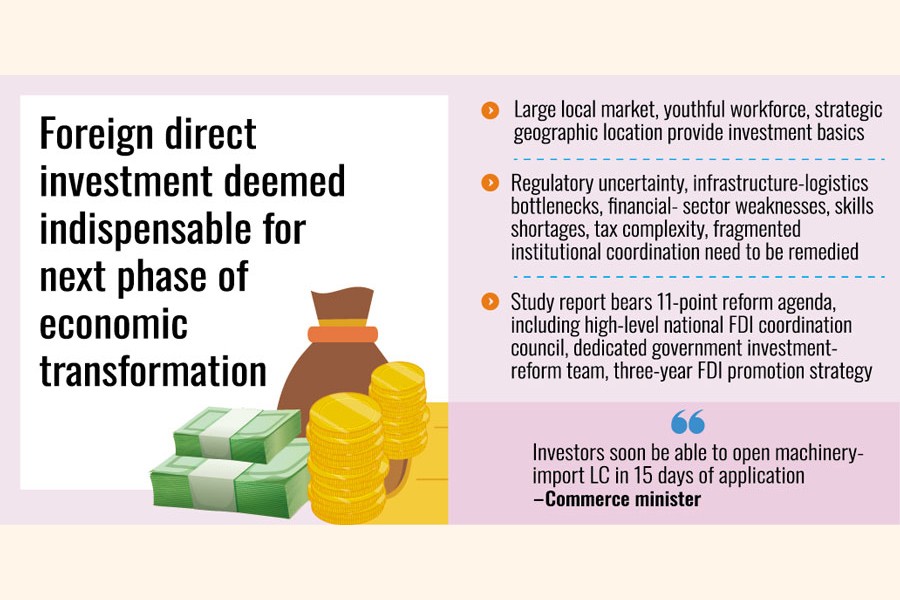
Bangladesh possesses the basics but needs some radical reforms to raise annual foreign direct investment (FDI) inflows to US$15 billion, investors and economists say and show the must-dos to that end.
In a joint study conducted by the Foreign Investors' Chamber of Commerce and Industry (FICCI) and Policy Exchange Bangladesh, it pointed out that Bangladesh's traditional growth model -- driven largely by a trio of ready-made garment industry, remittances and agriculture -- is facing mounting pressure from weak private investment, limited export diversification, persistent trade imbalances and inadequate job creation.
As such, netting FDI is "indispensable" for sustaining the country's next phase of economic transformation.
The study notes that although Bangladesh possesses a large domestic market, a youthful workforce and a strategic geographic location, it continues to lag well behind regional competitors in attracting foreign investment for a gamut of disservices.
What stand in the way, as per the study findings, a regulatory uncertainty, infrastructure and logistics bottlenecks, financial-sector weaknesses, skills shortages, tax complexity, and a fragmented institutional coordination.
It has noted that Bangladesh attracted a net FDI inflow of only US$1.78 billion in 2025, while fresh foreign equity fell to around US$550 million.
At 0.29 per cent of GDP, Bangladesh's FDI-to-GDP ratio remains lowest among comparable regional economies and far below Vietnam's 4.23 per cent, with annual inflows stagnating between US$1.2 billion and US$1.7 billion after peaking at US$3.89 billion in FY2019.
According to the study, the spinoffs from greater FDI are that it can mobilise capital and technology, diversify products and export markets, integrate Bangladesh into global value chains, stimulate domestic private investment, generate quality employment, modernise infrastructure and strengthen macroeconomic stability.
The report bears an 11-point reform agenda, including establishing a high-level national FDI coordination council, introducing a dedicated government investment-reform team, adopting National Investment Policy and omnibus investment law, implementing a three-year FDI promotion strategy, strengthening global investment branding and guaranteeing long-term policy stability.
The report was presented at a FICCI event titled 'Driving Foreign Investment for Jobs and Prosperity in Bangladesh', where ministers, advisers, economists and business leaders discussed reforms required to improve the country's investment climate and accelerate private-sector-led growth.
The keynote presentation was delivered by Dr M Masrur Reaz, Chairman and Chief Executive Officer of Policy Exchange Bangladesh, while senior government policymakers participated in a ministerial panel outlining the government's investment agenda.
Economists, academicians, policymakers and foreign investors have also argued that Bangladesh stands at a critical moment as multinational companies diversify production networks away from concentrated supply chains, stressing that success will depend on coordinated implementation rather than isolated policy announcements.
An emphasis was on attracting "higher-quality investment into advanced manufacturing, electronics, pharmaceuticals, renewable energy, digital services, logistics, healthcare and technology-intensive industries as essential conditions for creating productive jobs and achieving the country's ambition of becoming a trillion-dollar economy".
Improving investor confidence through predictable policies, efficient institutions, better infrastructure and sustained public-private dialogue would determine whether Bangladesh can convert its economic potential into significantly higher investment inflows.
Presenting the keynote, Dr Masrur Reaz said Bangladesh's gradual economic liberalisation since the late 1970s had enabled significant private-sector-led growth, but FDI inflows remained relatively low and volatile despite the country's progress.
"Recent recovery in FDI had been driven more by reinvestment by existing investors than by new foreign entrants."
Drawing on international experience, he said FDI had transformed economies by converting capital into exports, high-quality employment and technology transfer.
He cited Vietnam's export-led industrialisation, Costa Rica's electronics cluster, Malaysia's semiconductor industry, Thailand's automobile sector and Indonesia's electric vehicle battery industry as examples of how strategic foreign investment reshaped national economies.
Dr Reaz argued that Bangladesh's existing growth model faced four structural constraints -- macroeconomic pressures, weakening private investment, a complex business environment and sluggish employment generation.
Private investment has fallen to 21.5 per cent of GDP, its lowest level in 12 years, while exports remain concentrated in ready-made garments for more than 13 years. Youth unemployment stands at 9.4 per cent and the country ranks 128th out of 132 economies in the Economic Complexity Index.
He said Bangladesh requires around an additional US$8 billion in annual FDI merely to increase GDP growth by one-percentage point and argued that the country must strategically position itself to benefit from changing global trade patterns.
The study also highlights Bangladesh's competitiveness gap, pointing to weaknesses in logistics, trade facilitation, regulatory quality, innovation capacity, skills development and sovereign credit ratings compared with competing investment destinations.
In his welcome address, FICCI President Tapan Chowdhury said Bangladesh's economy had expanded from about US$8.9 billion in 1970 to nearly half a trillion dollars today, while merchandise exports had grown to US$48 billion in FY2025-26, driven mainly by the garment industry.
He said the private sector now accounts for around 76 per cent of total investment in Bangladesh, while foreign investors have played a crucial role in industrialisation, employment generation, export expansion, technology transfer and management development.
According to him, FICCI's more than 200 member-companies from 35 countries operating across 22 sectors currently support around 2.2 million direct and indirect jobs and contribute approximately 30 per cent of Bangladesh's national tax revenue.
He said attracting investment into manufacturing, tradable services, digital industries and technology-intensive sectors would be critical for achieving the government's target of creating 10-million jobs.
He said the joint FICCI-Policy Exchange report aimed to provide an evidence-based reform roadmap with measurable performance indicators to raise annual FDI inflows from 0.36 per cent to 2.5 per cent of GDP.
Referring to an internal survey among member-companies, he said FICCI members plan to invest around US$4 billion over the next two to five years, while Berger alone intends to invest around Tk 12 billion by 2027-28.
However, he cautions that Bangladesh continues to attract substantially less FDI than comparable Asian economies because investors assess approval timelines, logistics efficiency, contract enforcement, profit repatriation and institutional coordination before making investment decisions.
During the ministerial-panel discussion, Commerce, Industries, Textiles and Jute Minister Khandaker Abdul Muktadir said the government was implementing major reforms to reduce the time required to establish new businesses.
He announced that investors would soon be able to open letter of credit for importing machinery within 15 days of submitting applications, replacing a process that previously required nearly a year.
He also reaffirmed government commitment to energy security, regulatory stability and predictable investment policies.
The minister said Bangladesh must sustain annual economic growth exceeding 8.0 per cent and significantly increase private investment to realise its ambition of becoming a trillion-dollar economy.
Finance and Planning Adviser Dr Rashed Al Mahmud Titumir said investors primarily seek predictability, stability, energy security and regulatory certainty, adding that the government is strengthening these foundations through long-term fiscal planning and institutional reforms.
He said the government would continue investing in education, healthcare, logistics and multimodal connectivity while introducing targeted fiscal incentives to improve competitiveness and productivity.
Posts, Telecommunications and Information Technology Adviser Rehan Asif Asad identified connectivity, artificial intelligence and cybersecurity as the three pillars of the Fourth Industrial Revolution.
He highlighted the enactment of the Personal Data Protection Law, National Data Governance Law, Cybersecurity Law and Telecom Act 2026, saying that these established a modern legal framework for digital investment.
The adviser also outlined plans to expand broadband connectivity, strengthen digital public infrastructure, introduce a unified digital identity and wallet ecosystem and improve telecommunications quality to attract investment in electronics manufacturing, artificial intelligence, cloud computing and advanced technologies.
BIDA and BEZA Executive Chairman Chowdhury Ashik Mahmud Bin Harun announced that the government would shortly operationalise Invest Bangladesh, a unified investment-promotion agency created to consolidate investment-facilitation services under a single institutional platform.
He said the new organisation would reduce bureaucratic complexity, strengthen institutional capacity and provide investors with a single point of contact while encouraging existing foreign investors to serve as ambassadors for Bangladesh.
Special Assistant to the Prime Minister on Investment and Capital Market Affairs Tanvir Ghani said Bangladesh must diversify its sources of finance by deepening domestic capital markets and improving access to international financial markets.
He said the government is working to mobilise private capital through bonds, equity offerings and other market-based instruments while creating an investment-friendly framework covering taxation, regulation and capital repatriation.
Moderating the discussions, Prime Minister's Office Adviser and Spokesperson Mahdi Amin said the government's overall objective is to reduce the cost of doing business, improve the ease of doing business, create employment and ensure inclusive economic growth through stronger coordination among ministries.
bdsmile@gmail.com