
As Mamdani rises, Bangladeshi diaspora shines in America
Md. Abdul Latif | Tuesday, 18 November 2025
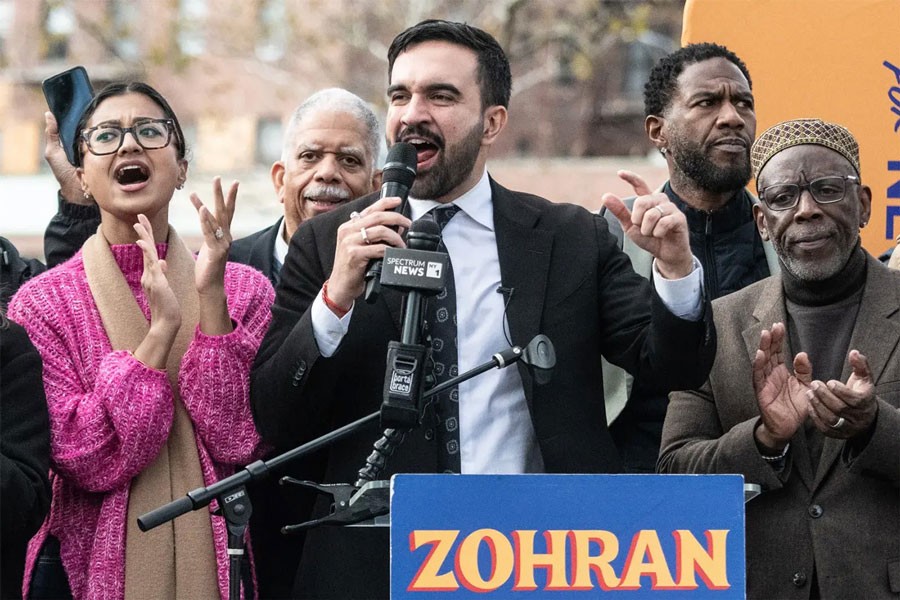
When Zohran Kwame Mamdani, a 34-year-old Democratic Socialist steps before a crowd in Queens-microphone in hand, voice steady-the moment feels bigger than a rally. Behind him stand tenants, students, taxi drivers, and small business owners, many sharing immigrant roots like his own. The son of Indian and African parents, Mamdani embodies a journey across continents and generations seeking belonging and justice in a country often slow to offer both. The Bangladeshi diaspora played a major role in his campaign, which he often acknowledged with his popular phrase "Bangladeshi Aunty." "New York will remain a city of immigrants: a city built by immigrants, powered by immigrants and, as of tonight, led by an immigrant," he told an ecstatic crowd at the Paramount Theater in Brooklyn.
His rise from organiser to elected representative is more than a personal success. It signals an awakening within the Bangladeshi diaspora in America-from surviving to shaping, from silence to speech. As his stature grows, so does the confidence of a community long absent from the American political stage.
THE MAKING OF A NEW KIND OF POLITICIAN: Zohran Mamdani's historic victory in New York City, the USA's most populous city, was powered by surging turnout and new voters. The NYC Board of Elections recorded more than two million ballots-the first time since 1969-with unusually strong participation from young people and those who had skipped recent elections. Mamdani won 1,036,051 votes (50.4 per cent) to Andrew Cuomo's 41.6 per cent. In a city of over 8 million, his victory is one of the most consequential for the Democratic left in years. New data show some former Trump voters backed Mamdani over Cuomo and Curtis Sliwa for NYC mayor, and his coalition was younger, less affluent, and more diverse.
His rise began not in boardrooms or elite law schools but in Astoria apartments and tenant-union hallways. His New York State Assembly campaign was funded by ordinary residents focused on rent, transit, health, and wage equity.
He practices a politics of presence-showing up in neighbourhoods, speaking to everyday struggles, and expanding representation beyond ethnicity. His progressive agenda-universal health care, affordable housing, economic fairness-springs from the lived experience of immigrant communities, including his own.
For many Bangladeshi Americans, his success challenges assumptions about access to power. What once felt distant from kitchen tables in Jackson Heights or Kensington now seems attainable. His win shows how commitment and organisation can turn aspiration into influence, reaffirming a familiar immigrant lesson: persistence, aligned with purpose, changes destinies.
FROM MARGINS TO MOMENTUM: THE JOURNEY OF THE US-BANGLADESHI DIASPORA: The Bangladeshi diaspora in the United States is a story of tenacity. Early arrivals in the 1970s and 1980s came for work, education, and stability after independence. They laboured in restaurants, taxis, garment factories, and family businesses. Survival and education were the pillars of early community life.
Politics was a distant concern, hindered by barriers of language, documentation, and time. Community gatherings centred on culture-language schools, Ramadan iftars, Bangla New Year-rather than voting drives or city hearings. The first generation-built mosques and cultural centres and raised children who would claim a larger stake in American life.
That handover is now clear. Second- and third-generation Bangladeshi Americans have entered law, education, technology, and media. They are activists, scholars, writers, and increasingly public officials. The shift is profound: a community once content with recognition now demands representation. Mamdani embodies this evolution-the child of immigrants fluent in both policy and identity, bridging the cultural and political worlds his parents helped build.
BEYOND SYMBOLISM: Representation, when reduced to symbolic milestones, risks becoming hollow. The significance of Johran Mamdani's rise lies in how he translates visibility into voice. He challenges the common fate of immigrant politicians who serve as figureheads but shy away from bold policy. Instead, Mamdani's leadership is grounded in substance. His proposals on public transit reform and housing are not designed to please demographics; they respond to the lived realities of working-class life.
This redefinition of representation matters profoundly for Bangladeshi Americans. It reclaims politics from the realm of ceremony to that of change. The message is clear: diaspora identity is not only about heritage festivals and cultural pride-it is also about demanding fairness in wages, justice in policing, and dignity in housing.
Mamdani's ascent marks a transition in mindset. The first generation sought to belong through conformity and hard work. The next generation seeks to belong through contribution and assertion. For young Bangladeshi Americans watching Mamdani speak on tenants' rights or climate policy, politics no longer feels foreign-it feels attainable, inevitable, and necessary.
Perhaps most importantly, his success redefines the psychological boundaries of the diaspora. Where earlier immigrants felt they were guests in someone else's story, they now recognise themselves as authors within it.
THE DIASPORA'S EMERGING POWER: The Bangladeshi diaspora's challenge now is to convert pride into participation. Mamdani's visibility can inspire action, but enduring influence will depend on how effectively communities organize behind shared causes.
That transformation has already begun. Voter registration drives in Bangladeshi-heavy neighbourhoods of New York and Michigan have surged. Civic organisations are mentoring youth and women to enter advocacy roles. Weekend Bangla schools are discussing not only culture but citizenship. Social media networks connect entrepreneurs and activists across states, weaving what once were isolated communities into an emerging constituency.
Mamdani's rise proves that political empowerment cannot rest on the shoulders of a single figure-it must be institutionalised. For every elected leader, there must be volunteers, campaigners, policy researchers, and communicators who sustain engagement between elections. For a community historically focused on economic advancement, this marks a new horizon: understanding that democratic participation is itself a form of prosperity.
The journey from community to constituency is not only about votes-it's about voice. As Bangladeshi Americans step into school boards, city councils, and advocacy groups, they claim their rightful space in shaping the American future.
CHALLENGES AND THE ROAD AHEAD: Will the Bangladeshi diaspora echo the resolve Mamdani so strongly voiced: "I will no longer be in the shadows"? Transformation brings trials. His ascent raises expectations and pressure. Within the diaspora, ideological divisions can blur unity: older generations may resist the progressive agendas of younger activists, while others fear that celebrating one figure could foster a personality cult.
Outside the community, structural barriers persist-underrepresentation in policy institutions, racial bias, and economic inequality. The task is not merely to celebrate visibility but to deepen civic literacy, build leadership pipelines, and ensure this political awakening is sustained through education and organisation.
Mamdani's example also demands accountability. Representation should not mean silence in the face of wrongdoing or comfort over conviction. He calls for politics that listens before it leads and governs with empathy rather than ego.
Through mentorship, community think tanks, and local campaigns, the diaspora can cultivate many more leaders in his mold, solidifying a democratic identity that is proudly Bangladeshi and fully American.
THE LIGHT THAT SPREADS: Zohran Mamdani's political journey illuminates more than a New York district; it reflects a generation confident enough to challenge power with empathy. For Bangladeshi youth, his rise revives a familiar lesson: leadership begins with community service and moral conviction. What spreads from his success is not just pride but possibility-a belief that South Asian youth can help shape a more just world. Around the globe, young leaders are redefining politics as service, not status; partnership, not patronage. The Bangladeshi diaspora's vigour is part of a broader movement: a global youth network demanding equity, climate justice, and dignity in public life.
Md. Abdul Latif, PhD is Additional Director, Bangladesh Institute of Governance and Management (BIGM). abdul.latif@bigm.edu.bd