
Atlas expects profit by FY27 after 11 years of losses
FARHAN FARDAUS | Thursday, 11 December 2025
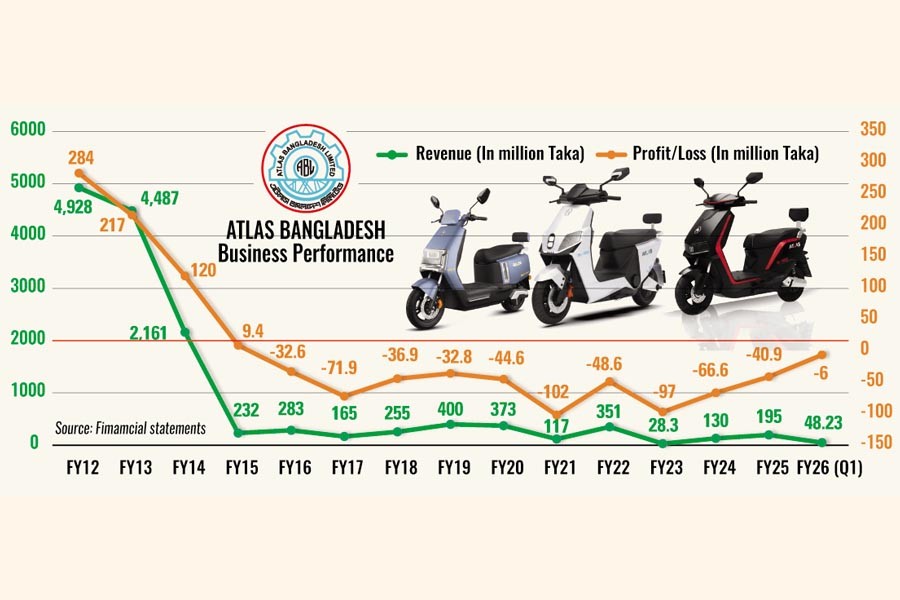
State-owned Atlas Bangladesh expects to break its cycle of losses after 11 years-by FY27-emboldened by what it claims are profitable partnerships and the launch of its own brand of electric two-wheelers.
Its Managing Director Md Ajibor Rahman said the company revised its business strategy after the political changeover in August last year, a move he said was already paying off as annual losses declined.
About 15 years after ties with Honda and Hero Honda fell apart, Atlas last year reconnected with the Japanese and Indian brands to regain its market share.
"Now we will supply Honda motorbikes to government entities. The strategy has already been working because most public offices prefer Honda motorbikes," Rahman said.
"Currently, we are serving 90 per cent of the government market. We have regained market share after reintroducing Honda." Meanwhile, the government has imposed restrictions on public purchases of two-wheelers, saying vehicles used in government projects would not be replaced unless they were at least 10 years old.
The Atlas chief said sales would "improve dramatically" once the restriction was lifted. "If we can sell 10,000 petrol bikes, we will jump out of the red," he said.
The company's electric two-wheeler brand-Atlas EV-has also shown promise. The brand was launched on November 5 this year, and within a short period all 133 vehicles imported and assembled locally were sold out, Rahman said.
"We ran extensive marketing before the launch. The next lot in the pipeline will also be sold immediately after arrival," he added.
To capture a greater market share, Atlas is also exploring the launch of additional brands.
"We are still searching for the best models suitable for our country. If we can identify products best suited for Bangladeshis, we will be able to capture a considerable market share," he said.
Experts have long argued that Atlas failed to grow because of weak technology adoption and lack of innovation, despite decades-long partnerships with Hero Honda and Honda.
This time, the company believes it can address those weaknesses.
"We are currently assembling products locally as the government is yet to introduce a policy on EVs. Once a policy is formulated, we will go for progressive manufacturing," said Rahman.
Sales at Atlas Bangladesh had previously struggled following the exit of major global partners.
After Hero Honda and Honda withdrew in 2010, the company sold off its remaining stock and failed to secure partnerships with other reputed Indian or Japanese brands.
In 2016, Atlas signed a two-year deal with Chongqing Zongshen Motorcycle Group-one of China's top five two-wheeler manufacturers-for importing, assembling and marketing motorcycles. The agreement was later extended for another two years.
However, Zongshen motorcycles failed to attract buyers, resulting in weak sales.
Since 2018, Atlas had maintained a partnership with TVS Auto Bangladesh, a subsidiary of India's TVS Motor Company. However, the arrangement was limited to selling TVS motorbikes to government entities-a model Rahman described as flawed from the outset, since TVS Auto Bangladesh operates separately in the retail market.
"Last year, we reconnected with the Honda brand and terminated our contract with TVS," Rahman said, citing stronger brand positioning of Honda compared to TVS.
Another longstanding challenge for Atlas was the lack of a proprietary brand.
"We worked for a long time without having any brand of our own. To address that deficiency, we introduced Atlas EV, our own electric vehicle brand. It took us two years to establish it," he said.
Atlas has also been working with an Australian company to introduce two additional EV models within the next six months.
"We are receiving a very good response from EV customers as the products are cost-effective. If this continues, we believe we will be able to return to profit by FY27," Rahman added.
farhan.fardaus@gmail.com