
Power paucity hovering around fund crunch
Back pay to plant owners, energy suppliers soars to $2.76 billion
Foreign firms forewarn of petroleum supply halt over payment backlog
M AZIZUR RAHMAN | Tuesday, 6 June 2023
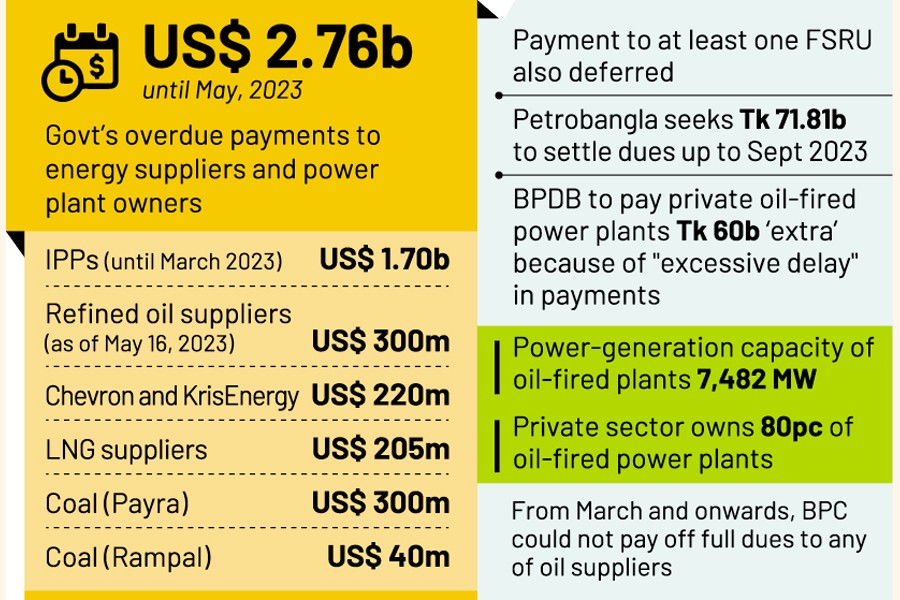
Power paucity in Bangladesh hovers around fund crunch as overdue payments to energy-providers and power-plant owners, both local and foreign, have ballooned over US$2.76 billion by now, sources said.
The back pay owed to the entrepreneurs amounted to around US$2.765 billion until May 2023 as the state-run power, oil and gas entities 'failed' to make payment in time, industry-insiders said.
And if the late payment of interest is taken into account, the overall overdue payments would be higher until the past month, they said.
Moreover, the figure of arrears would rise further if the payments for the months of April and May were added up, president of Bangladesh Independent Power Producers Association (BIPPA) Faisal Khan told the FE.
Of the payment arrears, the payment backlog to privately owned independent power producers (IPPs) amounted the highest--to the tune of around Tk 180 billion (US$ 1.70 billion)--until March, which is equivalent to six months' dues.
State-run Bangladesh Petroleum Corporation (BPC) owes around US$300 million to different refined-oil suppliers, as of May 16.
Almost all the petroleum-oil suppliers of different countries around the globe have already written to the BPC requesting to clear the dues "immediately", a senior BPC official said, while reports say power plants are tripping or running below their capacity for shortage of fuels.
"They have become upset over delayed payments and a few of them have threatened to cease supply of petroleum products to the BPC as a consequence," he said to explain the hardship they are in.
The overdue payments to US oil-major Chevron and Singapore's KrisEnergy against gas purchase from their share of the output in Bangladesh's gas-fields mounted to around US$220 million.
State-run Petrobangla has not been able to pay Chevron and KrisEnergy regularly over the past nine months, since September 2022, due to US dollar dearth, a senior official of the corporation told the FE Monday.
Petrobangla has also been struggling to pay out to global LNG suppliers - both long-term and spot sellers - against purchases of the expensive fuel due to a brewing currency crisis that poses a risk of halting supply, said sources.
Market-insiders have said the corporation owes around US$ 100 million to LNG- suppliers Qatargas, US$ 45 million to OQ, formerly known as Oman Trading International, US$ 40 million to Vitol Asia and US$ 20 million to TotalEnergies.
Dues from the Pyra Power Plant on account of its coal reached US$ 300 million.
Dues from the 1320mw Rampal Power Plant on account of its coal amounted to US$ 40 million.
According to the sale and purchase agreement (SPA) between Petrobangla and Qatargas, the state-run entity is obligated to make payment within 15 days of delivery of the liquefied natural gas.
It has the liberty to make LNG-import payments to OQ within 25 days of import, as stated in the SPA.
Amid the lumped-up problems in fuel supply and power generation--with their domino effect on public life and economic activity for outages-the Petrobangla authorities also deferred payment to at least one floating storage and regasification unit (FSRU).
To come out of the crisis and settle the dues up to September 2023, Petrobangla Chairman Zanendra Nath Sarker has sought fiscal assistance worth Tk 71.81 billion from the Ministry of Power, Energy, and Mineral Resources (MPEMR), a senior official told the FE Sunday.
Petrobangla also wrote to the Bangladesh Bank governor for support in clearing invoices against LNG purchases by providing US dollars to the commercial banks concerned, said the official
Sources said another state-owned entity, Bangladesh Power Development Board (BPDB), agreed to pay the privately owned oil-fired power plants around Tk60 billion as 'extras' because of "excessive delay" in payout.
As per the power-purchase agreements signed with the BPDB, the private power producers should receive the payments against the purchase of electricity within maximum 45 days or one and a half months.
"Many power-plant owners are unable to import furnace oil because of six-month-plus receivables and shortage of US dollars," the BIPPA president, Faisal Khan, said.
Financial condition of some companies is very bad, he said, while there was reportedly no assurance of footing their pending bills from the government exchequer.
Bangladesh's total power-generation capacity from oil-fired power plants is around 7,482 megawatts, of which 6,441 MWs are HSFO - fired and 1,041 MWs diesel or 0.005% sulfur gasoil-fired plants. They account for around 31 per cent of aggregate installed capacity of 24,143 MWs, according to BPDB.
Private sector owns around 80 per cent of the total oil-fired power plants in the country.
The IPPs have exhausted their credit limits with banks due to BPDB's inability to make payment in time. Foreign confirmation banks have, too, exhausted country limit, he added.
"We are importing to the best of our abilities and dollar availability," the BIPPA president said. "We need bill payments from BPDB and US dollar support from Bangladesh Bank."
He demanded that government's allocated subsidy amount be disbursed as per budget for monthly payout to IPPs. Banks need to ensure availability of the US dollar for import of primary fuels as well as spare parts, he pointed out.
Against oil imports from global suppliers, the BPC over the past several months could pay around one-third to half of the total payment arrears to some of the oil suppliers after the deadlines had elapsed, it has been alleged.
Citing an example of delayed payment, an insider said Dubai's Emirates National Oil Company got only US$ 10 million from the BPC on May 9, 2023 although its pending bills mounted to around US$30.82 million having March 27, 2023 as payment deadline. The petroleum corporation also failed to pay a single penny to some other suppliers, said the BPC official.
"We did never face such a situation over payment in the past," said a senior BPC official, adding that BPC could always clear payments to oil suppliers within the cutoff time for payment.
The BPC would clear payments within eight to ten days over the 30-day deadline for oil loading by suppliers until the end of February 2023, he said. But from March onwards the BPC could not pay off full dues to any of the oil suppliers, said sources.
BPC expects to import around 7.69 million tonnes of refined petroleum products this calendar year, up 18.3 per cent from 6.5 million tonnes in 2022.
The fuel comprises around 5.31 million tonnes of 0.005-percent sulfur gasoil (diesel), 700,000 tonnes of Jet A-1 fuel, 600,800 tonnes of 95 RON gasoline (octane), 900,000 tonnes of high-sulfur fuel oil with 3.5-percent sulfur and 180,000 tonnes of 0.50-percent- sulfur marine fuel.
Separately, the country's private sector is likely to import around 3.50 million tonnes of furnace oil, sources said.
The corporation has been sourcing around half of its total refined oils through international tendering system and the remaining half through government-to-government negotiations with state-run oil suppliers across the world.
It usually floats tenders twice every calendar year to import its refined oil products during January-to-June and July-December periods to fix premium rates. It also enters into negotiation with the selected suppliers twice to fix the petroleum prices.
BPC fears to have higher price quotes from oil suppliers for future purchase if the dues are not cleared soon.
Against overdue payments to Chevron and KrisEnergy, the Petrobangla has been counting interest at the London Inter Bank Offered Rate (LIBOR) plus 1.0-1.5 per cent.
It also has been counting interest at LIBOR plus 4.0-5.0 per cent on the overall import bills against purchase of LNG from suppliers.
Bangladesh has been facing an acute dollar crisis since the commencement of the Russia-Ukraine war in February 2022. The country's foreign-currency reserves dropped to down $30 billion last week from a record $48.6 billion in August 2021.
Azizjst@yahoo.com