
Bangladesh explores 'agrivoltaics' to boost food security, clean energy
FE REPORT | Friday, 31 July 2026
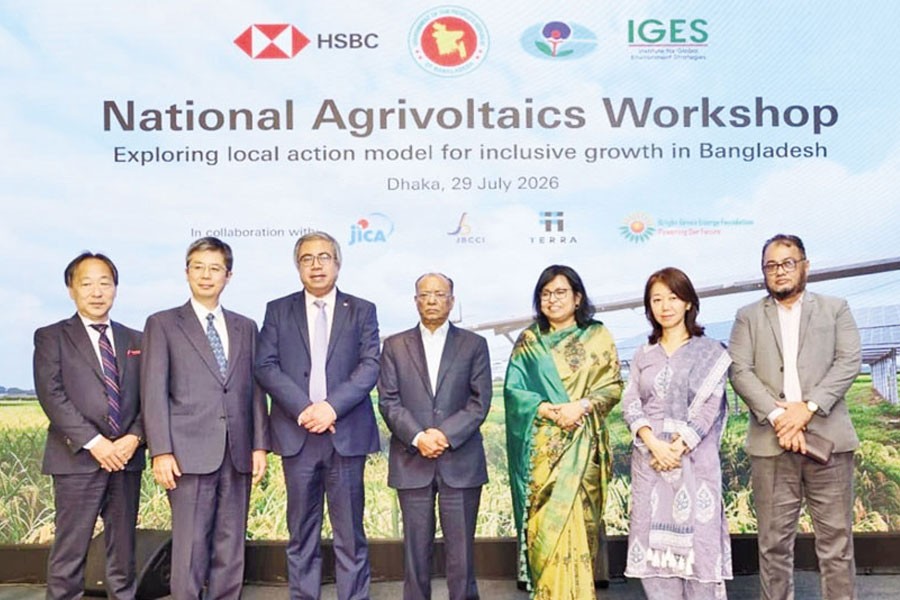
Bangladesh is exploring agrivoltaics -- the dual use of farmland for agricultural production and solar power generation -- as a potential solution to strengthen food security, expand renewable energy generation and enhance climate resilience amid growing pressure on land resources.
The prospects of the emerging technology were discussed at a national workshop titled "Exploring Local Action Models for Inclusive Growth in Bangladesh" held in the city on Thursday.
The event was organised by the Institute for Global Environmental Strategies (IGES), with support from HSBC Bangladesh, in collaboration with the Department of Environment (DoE), TERRA Co. Ltd. of Japan and the Bright Green Energy Foundation (BGEF).
Speaking as the chief guest, Environment, Forest and Climate Change Minister Abdul Awal Mintoo said the government was committed to pursuing integrated solutions that combine climate action, food security and economic development.
"Our vision is to build a Bangladesh where climate action, food security and economic development complement one another," he said, adding that agrivoltaics could help generate clean energy, strengthen farmers' resilience, protect valuable agricultural land and accelerate the country's transition to a low-carbon, climate-resilient future.
Participants said Bangladesh faced mounting challenges from rising electricity demand, shrinking arable land and the adverse impacts of climate change. Agrivoltaics could address these issues by allowing crops and solar panels to coexist on the same land, ensuring both agricultural production and renewable energy generation.
The workshop also focused on a pilot project in Manikganj where shade-tolerant rice is being cultivated beneath elevated solar panels designed to allow agricultural machinery, including harvesters, to operate without disrupting farming activities.
Electricity generated by the solar panels is being used to power irrigation, demonstrating a circular farming model that integrates food production with clean energy generation.
Although installation costs are around 30 percent higher than those of conventional solar systems, organisers said the modular design allows relocation of the facilities and future plans include supplying surplus electricity to the national grid.
Naoki Takahashi, Minister and Deputy Chief of Mission at the Embassy of Japan in Bangladesh, reaffirmed Japan's commitment to supporting Bangladesh's transition towards a low-carbon future, while JICA Bangladesh Chief Representative Junko Takahashi described agrivoltaics as an innovative approach that could promote food security, clean energy, sustainable rural livelihoods and poverty reduction through stronger bilateral cooperation.
IGES President Prof Kazuhiko Takeuchi said Bangladesh has the potential to become a regional leader in agrivoltaics by demonstrating how integrated local solutions can simultaneously advance climate action, food security, clean energy and inclusive economic growth.
Japan Bangladesh Chamber of Commerce and Industry (JBCCI) President Tareq Rafi Bhuiyan called for clear policies, innovative business models and stronger farmer participation to attract private investment in the sector.
HSBC Bangladesh Chief Executive Officer Md. Mahbub ur Rahman said the bank would continue supporting the transfer of Japanese agrivoltaic technology to Bangladesh through its partnership with IGES.
tonmoy.wardad@gmail.com