
COST SURGE IN CHINA
Bangladesh gains from shift in US travel goods sourcing
Exports to US jump over 55pc in January as buyers diversify supply chains
MONIRA MUNNI | Thursday, 26 March 2026
High production costs in China and trade redirection driven by US high tariffs have encouraged American buyers to increasingly diversify their sourcing of travel goods to other destinations like Bangladesh, insiders said.
They added that a couple of companies are expanding their existing capacity to capitalise on the shifting opportunities, while urging the government to provide required policy support.
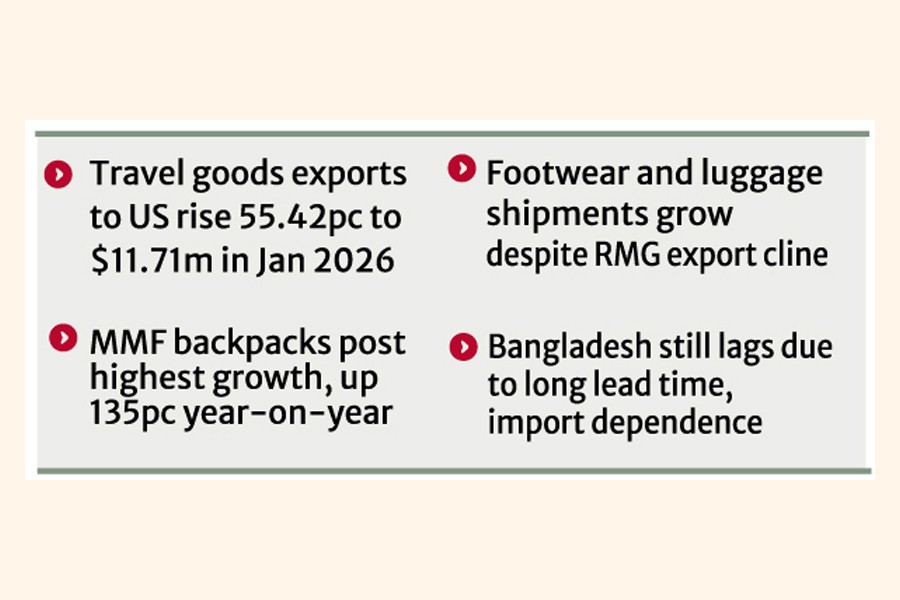
The rebound has already begun to be conspicuous in export earnings, with Bangladesh's shipments of luggage, handbags, sports bags and purses to the United States surging by 55.42 per cent in January.
January 2026 travel goods exports grew significantly and fetched US$11.71 million up from US$7.53 million in January 2025, according to data from the US Department of Commerce's Office of Textiles and Apparel (OTEXA).
Footwear and travel goods exports to the US in January 2026 witnessed significant positive growth though readymade garment shipments posted negative growth during the month.
Despite the momentum, industry insiders cautioned that Bangladesh has yet to capture its potential in the market due to structural bottlenecks, such as long lead times in shipment and dependence on imported raw materials.
Yet, exporters remain optimistic as global demand continues to rise, and more buyers are diversifying supply chains away from China.
Bangladesh earned US$ 123.16 million from travel-goods exports to the US in 2025, marking a 35.95 per cent growth from $90.59 million in 2024 and a sharp rise from $43.47 million in 2020, according to OTEXA data.
Among all product categories, man-made fibre (MMF) backpacks posted the strongest growth. MMF backpacks recorded 135.49 per cent growth to fetch US$ 1.25 million in January 2026 over US$ 0.53 million in January 2025.
Exporters have said global demand for travel goods has been on the rise, and Bangladesh enjoys a comparative advantage on availability and labour cost and costs over China.
Speaking to The Financial Express, AKM Mosphiqur Rahman Masud, Managing Director of Accesture Footwear and Leather Products Ltd, said production cost in Bangladesh compared to Cambodia, Vietnam and China is comparatively low.
Talking over tariff, he said additional tariff is not a challenge as the rate is almost the same for all major manufacturing countries after the US high court verdict.
Cost of labour and production is low while technological upgradation like automation is good which keeps Bangladesh competitive but it lags behind in terms of speed, he noted.
About 90 per cent of the company's leather bags are shipped to the US, he said.
RFL Group has purchased the government's closed old factories in Rajshahi with ready infrastructure and added additional lines to manufacture footwear and luggage.
Talking to the FE, RFL Group Managing Director RN Paul said it invested more than Tk 3.0 billion so far in these two segments last year as they have focused on footwear and luggage manufacturing to grab the shifting business from China and the Chinese led community in Vietnam.
The company's monthly $20 million production capacity would double at the end of this year, he noted.
"Bangladesh has huge opportunities in both footwear and luggage exports mostly because of its huge labour force," he said, adding the group is going to remote areas of the country like Pabna, Rangpur, and Bhola to utilise the untapped and available labour force and create employment.
He, however, sought the government's support in the form of indirect incentives like toll-free raw material transportation, area-based gas pricing, development of local roads for smooth transportation, infrastructure for worker training, and ensuring local services.
He also suggested the central bank should come forward with the required policy support based on different industry needs to help develop the backward linkage industry, saying global factors like the Iran war disrupted the supply chain.
Industry insiders say US buyers are looking to low-cost production hubs as production in China has been high while tariffs are now the same for all major manufacturing countries.
Chinese traders are shifting in a scattered way and Bangladesh needs to attract the whole set of business from China that is shifting to have investment in backward linkage industries, too, they added.
The US trade data show that imports of travel goods from China fell by 52.68 per cent to $106.61 million in the first month of 2026, from $225.32 million in January 2025.
By contrast, shipments from Vietnam and Cambodia grew by 6.29 per cent and 4.60 per cent to $122.36 million and $157.70 million respectively.
Imports from India declined to $33.37 million in January 2026 which was $35.10 million in January 2025.
Munni_fe@yahoo.com