
Bangladesh gets lowest prices for T-shirts in EU Market: Study
Global brands pressure suppliers into unsustainably low prices despite commitments
Monira Munni | Sunday, 24 May 2026
Top global apparel brands source the highest volume of cotton T-shirts for the European Union from Bangladesh while paying the lowest prices, keeping manufacturing costs at unsustainably low levels, according to a latest study.
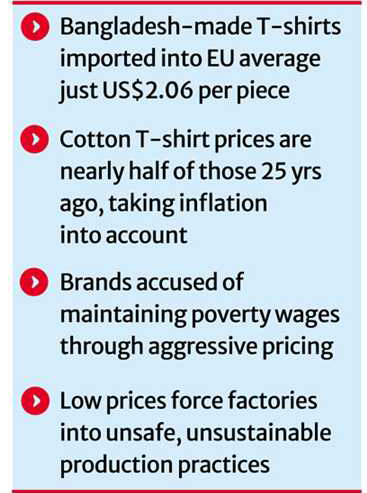
Taking global inflation into account, companies now buy a cotton T-shirt at nearly half the value they paid 25 years ago, the study by human rights NGOs Public Eye and Clean Clothes Campaign revealed on Thursday.
The research found that many buyers source standard cotton T-shirts at around US$2.0 to US$3.0 per piece, while prices below US$1.0 still persist in some segments of the market.
Despite making sweeping commitments on sustainability and workers' rights, many global brands continue to pressure suppliers into accepting unsustainably low prices, the report said.
Focusing on cotton T-shirts -- one of the fashion industry's most common products -- the report found that brands have consistently shifted sourcing to locations offering the lowest prices at scale.
"Today, an overwhelming 61 per cent of cotton T-shirts imported into the EU are made in Bangladesh. The average EU import price for a cotton T-shirt in 2025 was just US$2.67 (EUR 2.36). For T-shirts imported from Bangladesh, the price was even lower at US$2.06 (EUR 1.83)," the report said.
Based on trade data and interviews with suppliers and merchandisers, the report said brands enter negotiations with fixed target prices, knowing that if one factory refuses their terms, another factory will accept due to intense market competition.
This, it said, forces factories to take orders that fail to reflect the real cost of responsible production. As suppliers have little control over material or energy costs, labour conditions often suffer first, with factories cutting workplace safety expenses or pushing workers into excessive overtime for poverty wages.
"Margins for basic items are razor-thin or even non-existent. Producers frequently still take such orders simply to keep production running and ensure they can pay workers' salaries," the report added.
The study closely examined the six largest buyers of cotton T-shirts from Bangladesh over the past five years, including Inditex, owner of Zara, along with Primark and H&M.
It found that none of them had increased sourcing prices in line with global inflation.
Even among relatively higher-paying brands, sourcing prices from Bangladesh rarely exceed US$18 per kilogramme -- roughly equivalent to US$3.0 per piece -- while discount retailers and business-to-business companies often source at US$10 per kilogramme or less, the report noted.
David Hachfeld of Public Eye, one of the report's authors, said relentlessly low sourcing prices remain the organising principle of today's garment industry, shaping sourcing destinations, buyer behaviour and structurally locking in poverty wages.
"A transition towards a just and sustainable fashion system based on two-dollar shirts and other dirt-cheap clothing is impossible," he said.
The report said low sourcing prices hinder the payment of living wages and called for a fundamental overhaul of the garment pricing system -- shifting from the current top-down, cost-cutting model to a bottom-up, cost-covering approach where living wages and decent working conditions are treated as non-negotiable.
It also stressed the need for policy measures, saying brands are unlikely to make such changes voluntarily.
Kalpona Akter, president of the Bangladesh Garment and Industrial Workers Federation, said fashion brands that publicly champion human rights continue to perpetuate poverty wages through aggressive downward pricing policies.
"Higher prices are needed to ensure living wages, safe workplaces and sustainable production," she said.
Mohammad Hatem, president of the Bangladesh Knitwear Manufacturers and Exporters Association, agreed that Bangladeshi suppliers receive the lowest prices.
He alleged that buyers often pay higher prices for the same products when sourced from countries such as Vietnam, describing it as a "double standard" by global brands.
"Buyers frequently demand a wide range of compliance measures and know the actual production costs, yet they still try to offer the lowest rates because they lack 'ethical standards'," he said.
He warned that persistently low prices create multiple problems for factories, including delayed wage payments, which may ultimately lead to factory closures.
"Many factories accept such work orders simply to survive," he added.
munni_fe@yahoo.com