
Bangladesh home to world\\\'s 6.0pc poor
Saturday, 12 April 2014
FE Report
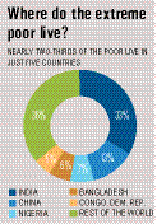
Bangladesh has been ranked fourth among the five countries, where 64 per cent of the world's poor people live with India topping the list, a new World Bank (WB) paper said on April 10.
The top five countries, in terms of numbers of poor they have, are: India 33 per cent, China 13 per cent, Nigeria 7.0 per cent, Bangladesh 6.0 per cent and the Democratic Republic of Congo 5.0 per cent, which together are home to nearly 760 million of the world's 1.2 billion poor.
Adding another five countries - Indonesia, Pakistan, Tanzania, Ethiopia, and Kenya - would encompass almost 80 per cent of the extreme poor.
However, many smaller countries have far higher shares of their people living below the poverty line. In 16 countries, more than half the population is living in extreme poverty.
The top five countries, in terms of poverty density, are the Democratic Republic of Congo, where 88 per cent of the population is below the poverty line, Liberia 84 per cent, Burundi and Madagascar 81 per cent each, and Zambia 75 per cent.
The report noted reducing poverty in these places is as important as making progress in countries, where the absolute number of poor people is much bigger.
"Economic growth has been vital for reducing extreme poverty and improving the lives of many poor people," said World Bank Group President Jim Yong Kim.
"Yet, even if all countries grow at the same rates as over the past 20 years, and if the income distribution remains unchanged, world poverty will only fall by 10 per cent by 2030, from 17.7 per cent in 2010," said the WB president.
He added: "This is simply not enough, and we need a laser-like focus on making growth more inclusive and targeting more programmes to assist the poor directly if we're going to end extreme poverty."
Kim added: "To end extreme poverty, the vast numbers of the poorest - those earning less than $1.25 a day - will have to decrease by 50 million people each year until 2030.
"This means that 1 million people each week will have to lift themselves out of poverty for the next 16 years. This will be extraordinarily difficult, but I believe we can do it. This can be the generation that ends extreme poverty."
"This entails concerted efforts in countries where large numbers of the world's 1.2 billion poor live. Hence, a sharp emphasis on these countries will be central to ending extreme poverty," said the paper.
Tackling poverty requires understanding where the greatest number of poor live, while at the same time also concentrating on where hardship is most pervasive.
The paper said countries need to complement efforts to enhance growth with policies that allocate more resources to the extreme poor. These resources can be distributed through the growth process itself, by promoting more inclusive growth, or through government programmes, such as conditional and direct cash transfers.
In addition, the paper notes, it is imperative not just to lift people out of extreme poverty; it is also important to make sure that, in the long run, they do not get stuck just above the extreme poverty line due to a lack of opportunities that might impede progress toward better livelihoods.
Growth alone is unlikely to end extreme poverty by 2030, says the paper, because as extreme poverty declines, growth on its own tends to lift fewer people out of poverty. This is because, by this stage, many of the people still in extreme poverty live in situations where improving their lives is extremely difficult.
The paper notes that increased income inequality can dampen the impact of growth on reducing poverty. Inequality is not just a problem in itself: in countries with rising income inequality, the effect of growth on poverty has been dampened or even reversed.
In contrast, research indicates that in countries where inequality was falling, the decline in poverty for a given growth rate was greater. Even if there is no change in inequality, the "poverty-reducing power" of economic growth is less in countries that are initially more unequal.
Thus, the World Bank Group's goals of ending extreme poverty and boosting shared prosperity are closely linked --- lasting progress in ending extreme poverty also requires continued attention to what is happening to the bottom 40 per cent of the population.
"It is a sad commentary on our prosperous world that over one billion people live in extreme poverty," said Kaushik Basu, Senior Vice President and Chief Economist at the World Bank.
Equally, progress in improving poor people's lives will not be sustainable if the environmental consequences of economic development are not taken into account. Making growth processes resource-efficient, cleaner and more resilient without necessarily slowing them is important to sustaining economic development, the paper said.